Hindu family forced to flee after prolonged harassment and violence by Muslim family; meat and bones thrown inside Hindu temple
 Lakhimpur, Uttar Pradesh, India
  3 March, 2026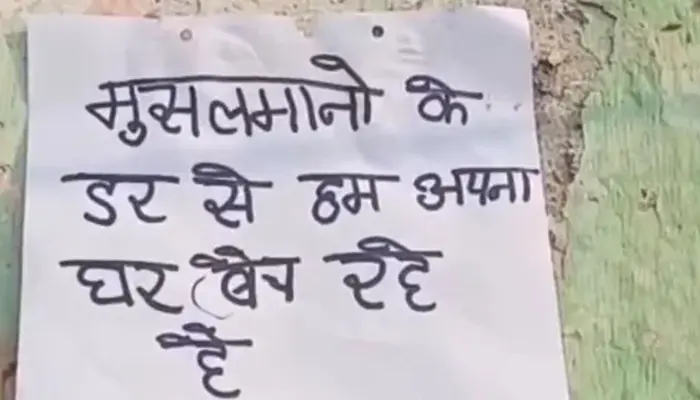
Case Summary
In Mohammadpur village of Lakhimpur Kheri, Uttar Pradesh, a Hindu family was forced to leave their home after prolonged harassment and violence by a neighbouring Muslim family. The Muslim family also threw pieces of meat and bones in a Hindu temple. The victim, a Hindu man named Pradeep Verma, stated that his Muslim neighbour, Ismail Ali, and members of his household repeatedly created disturbances and targeted the Hindu family and their place of worship. The Muslim family threw pieces of meat and animal bones into a Shiva temple and into a well located in front of the Hindu family’s residence. These acts created an atmosphere of intimidation and distress for the Hindu family. The situation escalated on 4 March 2026 when pieces of meat and bones were again thrown into the temple premises. When Pradeep Verma objected to the act, Ismail Ali, Warish Ali, Tahban Ali, Ishtiaq, and the women of their household confronted him, and a physical altercation broke out. During the confrontation, Pradeep Verma was brutally attacked, as a result of which he sustained a head injury. Two women from the Hindu family, Renu Verma and Kalavati, who came to his assistance during the incident, were also injured in the scuffle. Following the assault, a complaint was filed with the police regarding the harassment and violence. Despite approaching the police, the family remained distressed over the continuing hostility in the neighbourhood. The repeated incidents, combined with the earlier acts of desecration at the temple and the violent confrontation that left multiple family members injured, created an environment in which the family no longer felt safe living in their own home. Eventually, Pradeep Verma locked the house and left the village along with his family. Before leaving, a notice was pasted on the house indicating that the property was being put up for sale due to harassment by the Muslims. Subsequently, members of the family approached the Superintendent of Police in Lakhimpur Kheri seeking justice and requesting an investigation and action against those involved. Police officials later stated that a case had been registered in connection with the incident based on the complaint filed by the victim. The Station House Officer of Fardhan police station, Dilip Kumar Choubey, confirmed that a case had been registered, while also noting that Inspector Junaid, who had been posted at Nakaha Pipri, had been removed from his post.
Why it is Hate Crime ?
This case has been added to the tracker under the primary category of- Attack not resulting in death. Within it, the sub-category selected is - Attacked for Hindu identity. In several cases, Hindus are attacked merely for their Hindu identity without any perceived provocation. A classic example of this category of religiously motivated hate crime is a murder in 2016. 7 ISIS terrorists were convicted for shooting a school principal in Kanpur because they got ‘triggered’ seeing the Kalava on his wrist and tilak that he had put. In this, the Hindu victim had offered no provocation except for his Hindu religious identity. The motivation for the murder was purely religious, driven by religious supremacy. Such cases where Hindus are targeted merely for their religious identity would be documented as a hate crime under this category. The other sub-category selected here is - Attacked for opposing radicals or trying to save victim. In several cases, Hindus are attacked for opposing religiously motivated crimes being committed against a fellow Hindu or simply for voicing an opinion opposing radical elements, who either have in the past or continue to persecute Hindus. In such cases, the initial attack against the victim, against which the Hindu was trying to defend the victim, would also need to be classified as a religiously motivated hate crime. Since the initial crime itself was religiously motivated and the subsequent crime of attempting to save the victim or speaking against the radical elements ends up inviting a violent attack, it would also be classified as a religiously motivated hate crime under this category. The second primary category selected here is - Attack on Hindu religious representatins. Within it, the sub-category selected is - Attack on temples. In Hinduism, a temple is the abode of the Deity. The Deity in the Temple is consecrated, thereby, making it a real, breathing entity. Hindus believe that not just the Deity but the temple premises itself are sacred to Hindus since Hindus hold the faith that the entire Temple space is an amalgamation of the divine energy of the deity. Given the central significance of Temples in Hindu Dharma, any attack against a Hindu Temple or its peripheral premises is an attack on the faith itself and is born out of animosity towards the faith, of which, the Temple is a central tenet. Any manner of attack against a Temple and/or its premises would therefore be considered a religiously motivated hate crime. The other sub-category selected is - Defiling religious customs. Sanatan Dharma is not a religion of one book, which is to say that while it has religious scriptures that form the central tenets of the faith, there are several traditions followed through thousands of years, mostly passed from generation to generation orally. There are several such customs and traditions that are followed by various Hindus and Hindu sects. Defiling of these traditions and customs is a breach of an individual or group’s religious practices. Such practices can range from dietary restrictions like not eating non-vegetarian food for a certain period of the year, not eating non-vegetarian food at all, not eating beef since the cow is considered holy in Hinduism, the sanctity of religious customs followed in the house (like many ISCKON devotees), etc. Any malicious action leading to the breach of such traditions or defilement of these traditions owing to animosity towards the faith or for the sake of activism stems not only from the lack of faith in the religion itself but also from disregard for the faith of the devotees who follow the customs/traditions and implicit bias against the faith, the tradition itself. Since these specific traditions are central to the faith of the devotees of that specific sect of Hindus, any non-compliance with these traditional rules would be considered a religiously motivated hate crime. This case has been added to the tracker as a hate crime because the harassment directed at the Hindu family was rooted in religious hostility and involved acts that specifically targeted their faith and place of worship. The Hindu family of Pradeep Verma was repeatedly harassed by members of a neighbouring Muslim household. The acts carried out against them were not limited to personal disputes but involved deliberate desecration of a Hindu religious site, intended to insult their faith and disrupt their worship. The hostility displayed towards the Hindu family was not an isolated quarrel between neighbours but a pattern of targeted intimidation directed specifically at them as Hindus. The harassment escalated into open confrontation and physical violence when the victim objected to the actions of the neighbouring Muslim household. Instead of resolving the matter peacefully, the Muslim family collectively confronted and assaulted the Hindu residents, which demonstrated that the aggression was sustained and directed at the family rather than being a spontaneous altercation. Such behaviour reflected an environment of intimidation where the Hindu family was repeatedly targeted and made to feel unsafe in their own locality, indicating that the hostility they faced was rooted in animosity towards their religious identity rather than an ordinary neighbourhood dispute. In this case, pieces of meat and animal bones were repeatedly thrown into a Shiva temple and a well situated in front of the Hindu family’s residence. In the Hindu religious context, such acts are widely understood as a direct affront to religious sentiments and purity norms associated with temples and sacred spaces. By repeatedly contaminating the temple premises with meat and bones, the perpetrators targeted not only the family but also the sanctity of a Hindu place of worship, reflecting a pattern of behaviour that demonstrated contempt towards Hindu religious practices and beliefs. Hindu temples are regarded as sacred and ritually pure spaces, and the introduction of meat into such premises represented a clear desecration of a place of worship. Such an act reflects a profound disregard for the faith and its practices, stemming from underlying animosity toward Hinduism. This incident exemplifies an intentional effort to insult religious sentiments, warranting its inclusion as a serious offence motivated by hatred. This act cannot be viewed merely as a breach of law and order but as a calculated attempt to dishonour Hindu religious customs, particularly those linked to temple purity and ritual observance. The hostility escalated further when Pradeep Verma objected to these acts of desecration. Instead of resolving the dispute peacefully, members of the Muslim household confronted and assaulted him, resulting in a head injury. Two women from the Hindu family, Renu Verma and Kalavati, who attempted to intervene, were also injured in the confrontation. The violence occurred in the immediate aftermath of the desecration of the temple, linking the physical assault directly to the objection raised by the Hindu victim regarding the disrespect shown to his religious space. The targeting of the family after they protested against the defilement of their temple indicates that the hostility was directed at them because they resisted acts that insulted their faith. Additionally, when such acts are repeatedly directed at a Hindu family and their place of worship, followed by violence when the victims object, it demonstrates that the hostility was rooted in religious prejudice rather than an ordinary neighbourhood quarrel. The targeting of a sacred Hindu site, the assault on those who protested against the desecration, and the eventual displacement of the family collectively indicate that the crime carried a clear religious dimension. Since the actions described involved the desecration of a Hindu temple, targeted intimidation of a Hindu family, and violence triggered by their objection to insults directed at their faith, this case meets the criteria of a religiously motivated hate crime. For this reason, it has been added to the hate crime database of the Hinduphobia Tracker as an incident reflecting hostility directed at Hindus and their religious practices. This incident reflected a broader, documented pattern across multiple regions where Muslim perpetrators harass and disturb Hindus specifically to force them to leave, thereby enabling Muslims to occupy the vacated land or property. Tactics like repeated fights, threats, and violence target Hindu resilience, aiming to break it through religious contempt. Police inaction despite complaints further enabled this, but the core motivation, driving out Hindus to claim space, demonstrates religious animus, fitting hate crime profiles of coercive demographic shifts fuelled by anti-Hindu animosity and Islamic supremacy. This is not the first time targeted harassment and assaults on Hindus by Muslims have forced families to flee their homes. The Hinduphobia Tracker has previously recorded multiple such instances. One example occurred in Bhopal's Muslim-dominated Housing Board Colony, Old Subhash Nagar, Madhya Pradesh, where a Hindu lawyer, Advocate Veena Gautam and her family endured sustained harassment from local Muslims. The perpetrators selectively targeted them due to their Hindu identity and to drive the family away, part of broader Hindu displacements due to religious intimidation in the area. Similarly, in another instance in Madhya Pradesh's Ratlam district, Hindu villagers from Surana threatened to abandon their homes amidst persecution by the Muslim community and official inaction. In this village of around 2,200, predominantly Muslim with Hindus comprising 40%, longstanding peace was shattered as victims faced attacks, abuse, and fake FIRs, compelling them to sell properties and flee for safety. Disclaimer: Hinduphobia Tracker records perpetrators based on identifiable individuals mentioned in reports. In this case, four Muslim perpetrators, Ismail Ali, Warish Ali, Tahban Ali, and Ishtiaq have been counted. The report also mentions women from the same household participating in the assault; however, since their identities and number are not specified, they have not been included in the perpetrator count. Disclaimer: It is important to clarify that none of the media sources covering this case has specified the exact date when the victim's ordeal began. The earliest date mentioned is 4 March 2026, when pieces of meat and bones were again thrown into the temple premises. Since Hinduphobia Tracker records the incident based on when the victim’s ordeal began and not when it was reported, we have considered the date of the incident as 4 March 2026, though the media reported the incident on 7 March 2026.
Victim Details
Total Victim
3
Deceased
0
Gender
- Male 1
- Female 2
- Third Gender 0
- Unknown 0
Caste
- SC/ST 0
- OBC 0
- General 3
- Unknown 0
Age Group
- Minor 0
- Adult 3
- Senior Citizen 0
- Unknown 0


Case Status
Complaint registered


Perpetrators Details
Perpetrators
Muslim Extremists
Perpetrators Range
From 2 To 5
Perpetrators Gender
male
 Sources




