Hindu youths attacked by Muslim mob over playing DJ music, which escalated into stone-pelting on local Hindu community
 Meerut, Uttar Pradesh, India
  25 February, 2026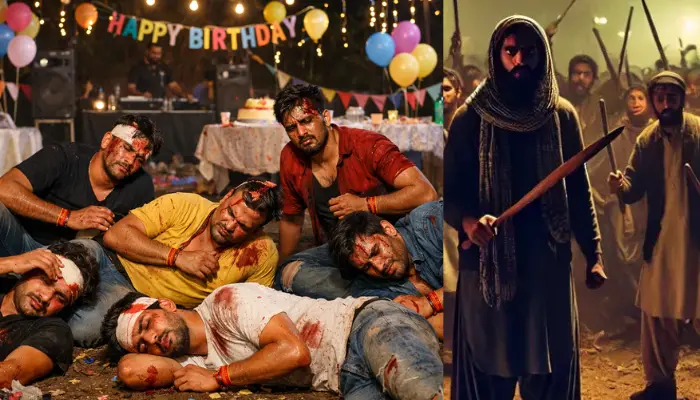
Case Summary
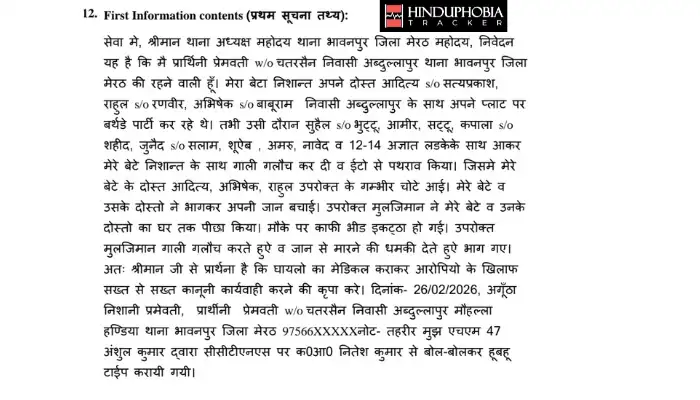
In Bhawanpur village, located in the Meerut district of Uttar Pradesh, a group of Dalit Hindu youths were brutally assaulted by a Muslim mob of 20–25 Muslim youths. The accused attacked them over the playing of a DJ during a birthday party. This further led to the Muslim mob pelting stones at the Dalit Hindu community in the area. Notably, the Hinduphobia Tracker was able to access the FIR. As per the FIR, the victims were identified as Nishant, along with his friends Aditya, son of Satyaprakash, Rahul, son of Ranjeet, and Abhishek, son of Satyaveer, residents of Abdul Lalpur. The Muslim perpetrators were identified as Arshad, son of Shahid, Junaid, son of Islam, Shubham, Amar, Nadeem and 12–14 unknown Muslim boys. The FIR also stated that the victims were even issued death threats by the Muslim perpetrators. According to media reports, this incident occurred on 26 February 2026. Bhawanpur resident Nishant was celebrating a birthday party with his friends on his plot. Songs were playing on the DJ. Then, 20 to 25 youths of the Muslim community entered the birthday party and started protesting against the DJ. They began pressuring those present to stop the DJ by force. A dispute broke out between the two sides over this issue. Following this, the Muslim youths who had forcibly entered the party started fighting. This created chaos at the party. The Muslim attackers then resisted and took out their weapons. The attackers fired several rounds, spreading terror among the Hindus present. People ran for their lives. These attackers surrounded Nishant and his friends and began beating them. Hearing reports of violence and gunfire, many members of the Dalit Hindu community gathered at the spot. Seeing this, the attackers began pelting stones, causing a stampede. People hid wherever they could find space. Many people were injured in the stone pelting and fighting. The attackers then fled, firing in the air. This was the scene of the communal clash. Someone informed officers about the fight between the Dalit Hindus and the Muslim group. The news of the communal clash stunned the police. Forces from several police stations arrived at the scene in a hurry. The circle officer, Sadar Rural, Sudhir Kumar, also arrived and informed officers about the incident. The police immediately sent all the injured to the hospital for treatment. After this, a large number of people from the Dalit community gathered there. The superintendent of police, Rural, Abhijeet Kumar, also had to reach the spot. A complaint was given by Nishant’s mother, Premvati, in which the accused party’s Suhail, son of Bhuttu, Aamir, Saddu, Kapala, son of Shahid, Junaid, son of Salam, Shuaib, Amru, Naveed, besides 12 to 14 unknown attackers, were also named in the complaint. The rural superintendent of police, Abhijeet Kumar, said that a dispute had erupted at a birthday party. A complaint had been received from the injured youth, naming some of the attackers. Efforts were underway to arrest them. The police force had been deployed as a precaution. At the time of writing this report, the situation was normal.
Case Images
Why it is Hate Crime ?
This case is being added to the tracker under the primary category- Attack not resulting in death. The subcategory selected is- Communal Attack/Clash. Communal clash is a form of collective violence that involves clashes between groups belonging to different religious identities. For a communal clash between Hindus and non-Hindus to qualify as a religiously motivated hate crime, the trigger of the violence itself would have to be anti-Hindu in essence. For example, if there is a Hindu religious procession that comes under attack from a non-Hindu mob and after the initial attack, Hindus retaliate in self-defence, leading to a communal clash between the two religious communities. While at a later stage, both communities are involved in the clash/violence, the initial trigger of the violence was by the non-Hindu mob against the Hindus and therefore, it could safely be termed as an anti-Hindu violence. Further, the trigger would also have to be religiously motivated. In the cited example, the attack by the non-Hindu mob was against religious processions and therefore, can be concluded to be religiously motivated. In some cases, the trigger may be non-religious, however, it develops into religious violence against Hindus at a later stage. In such cases too, the foundational animosity towards Hindus becomes the motivating factor of the crime and therefore, it would be classified as a religiously motivated hate crime against Hindus under this category. This incident clearly qualifies as a hate crime due to its communal nature and the religion-fueled disproportionate response by the Muslim assailants. What began as a minor dispute over the playing of DJ music during a birthday party in Bhawanpur, Meerut, which could have remained a simple disagreement between Hindu and Muslim youths, was met with brutal violence by the Muslim mob. Their savage assault on the Hindu youths, including Nishant and his friends, left them with injuries and trauma, an utterly unwarranted reaction that reveals deep-seated hostility. This disproportionate violence over a trivial issue exposes the underlying animosity within the Muslim perpetrators towards the victim due to his religious identity, reflecting a dangerous mindset of religious supremacy that demands dominance by force. In such cases, minor non-religious provocations are met with aggressive retaliation when the victim is Hindu, revealing an alarming pattern of identity-driven hostility that defines such hate crimes. In this incident, after assaulting the Hindu youths, the Muslim perpetrators did not limit their violence to the birthday party group but escalated it against the entire Dalit Hindu community in the area, who had gathered there. The attackers launched a stone pelting assault on the wider Hindu community, turning a dispute over DJ music into a targeted attack on the entire community. This shift from individual youths to the entire Dalit Hindu residents demonstrates deliberate religious animosity and religious‑based targeting based on Hindu identity, not on the nature of the initial disagreement. By directing collective violence at the broader Hindu community, the perpetrators made it evident that the attack was motivated by hostility towards Hindus as a religious group, marking this a clear case of a religiously motivated crime. This sort of violent overreach stems from an Islamic supremacist ideology within certain Muslim circles, which views Hindus as socially and religiously inferior. This toxic belief breeds contempt and aggression, especially when Hindus resist submission or refuse to yield in disputes. The readiness to use weapons, stone pelting, and threats to kill over the playing of DJ music exposes the continuing threat Hindu communities face, as these incidents are not isolated or spontaneous but part of an ongoing pattern of religiously motivated violence. The subsequent stoning of the wider Dalit Hindu community after the initial attack on the youths further demonstrates how the violence escalates beyond the original dispute into a broader communal assault. Several past incidents underscore this grim reality. The 2019 Hauz Qazi violence is a glaring example. A simple parking dispute escalated into a full-scale communal attack against Hindus in the heart of Delhi. Hindu residents, including women and children and their sacred Durga Mandir were targeted mercilessly by Muslims. Hindu idols were destroyed, the temple desecrated, and the community subjected to physical assault. The disappearance of a 17‑year‑old Hindu boy during the violence highlighted the grave dangers Hindus endure, as he was beaten for his faith and forced to flee for his life. This incident exposed how routine conflicts are exploited to unleash communal violence against Hindus, leaving the community traumatised and demanding justice. Similarly, the Hinduphobia Tracker has previously documented numerous instances where non-religious triggers sparked communal violence against Hindus by Muslims. For example, on 30th May 2025, in Dewran Garhiya village, Farrukhabad, Uttar Pradesh, a minor verbal altercation between two Hindu men and a Muslim man escalated into a violent assault by a large Muslim mob, inflaming communal tensions. In another incident on 7th July 2025 in Bhavna Nagar, Raipur, Chhattisgarh, a Hindu family was brutally attacked by a Muslim mob of nearly 80 people following a simple dispute over garbage disposal. Victims suffered severe injuries from sharp weapons. Similarly, on 22nd June 2025 in Ghongade Basti, Solapur, Maharashtra, a minor road dispute led to a targeted communal assault on Hindus by a large Muslim mob, sparking widespread clashes. Given that this case meets the parameters of a religiously motivated hate crime, it is being added to the hate crime database of the tracker. Disclaimer: In this case, the victim count is being recorded as four (4), referring to the Hindu victims Nishant, Aditya, son of Satyaprakash, Rahul, son of Ranjeet, and Abhishek, son of Satyaveer, who are explicitly named in the reports and the FIR. These four individuals are being treated as the documented victims for the database, and the count is therefore entered as four. The Hinduphobia Tracker acknowledges that the entire Dalit Hindu community in the area was also stone-pelted when they gathered at the scene, suggesting many more affected persons. However, since the FIR and reports do not specify the exact number of additional victims, only these four are recorded, making the victim count a conservative and cautious estimate.
Victim Details
Total Victim
4
Deceased
0
Gender
- Male 4
- Female 0
- Third Gender 0
- Unknown 0
Caste
- SC/ST 4
- OBC 0
- General 0
- Unknown 0
Age Group
- Minor 0
- Adult 0
- Senior Citizen 0
- Unknown 4


Case Status
Complaint filed


Perpetrators Details
Perpetrators
Muslim Extremists
Perpetrators Range
From 10 to 100
Perpetrators Gender
male
 Sources




