Hindu woman raped, coerced into marriage, and subjected to prolonged abuse by Muslim man; taken to dargah and forced fed beef
 Mumbai, Maharashtra, India
  22 February, 2017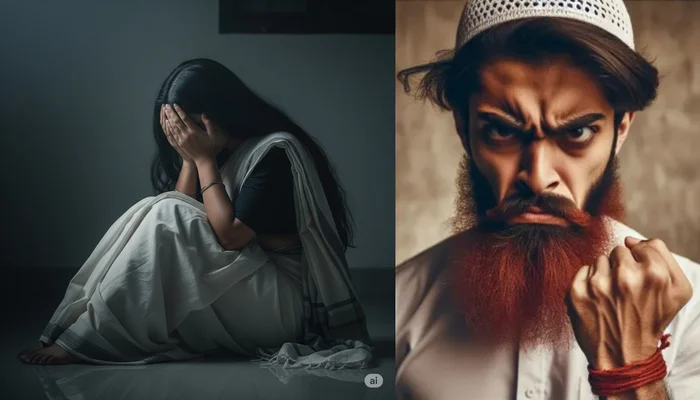
Case Summary
In Mumbai, Maharashtra, a Hindu woman named Savita was lured, sexually assaulted, coerced into marriage, and subjected to prolonged abuse by a Muslim man and his family. She was taken to a dargah and was forced to eat beef in order religiously humiliate her. According to the victim, she was taken to Mahim Dargah in Mumbai, where she was given water laced with intoxicants, after which she became unconscious. She said that after losing consciousness, she was taken to a house, where she was raped by the Muslim accused. Following the assault, the accused’s mother and sister began blackmailing her, and she was subsequently forced into a court marriage. Having already distanced herself from her family by that stage, she was compelled to stay with the accused. Savita stated that she lived with him for nine years and had two children from the marriage. During this period, she was subjected to repeated physical violence and coercion. She was brutally assaulted and was forced to eat beef against her will. She also stated that she was compelled to work to support her children, despite facing abuse and defamation. She further stated that whenever she went to work in formal attire, members of the accused’s family spread rumours about her that she worked in a beer bar or was involved in immoral activities. If she spoke to her male colleagues, she was accused of having affairs and was physically assaulted. She described instances of being beaten outside her workplace to the extent that her face became severely bruised, leaving her unable to go out. Savita further described discriminatory attitudes toward Hindu women within her marital household. She said that while Muslim women wearing burqas, with revealing clothes underneath, were not criticised, Hindu women wearing jeans or T-shirts were labelled immoral. She described this as part of the broader humiliation and control she experienced. She stated that she continues to struggle without support from her family and emphasised that the lack of familial backing often leaves women trapped in abusive situations. She highlighted that many girls contemplate suicide due to isolation and social stigma and stressed the importance of family support in enabling victims to escape coercive circumstances. The incident came to light during the public testimonies of multiple Hindu women, who were survivors of organised targeting, sexual exploitation and coercive religious conversion efforts at the hands of Muslim men. Their statements were delivered at a public event in New Delhi organised on 23 February 2026, ahead of the release of the film The Kerala Story 2, where activists and participants framed their experiences as part of a broader pattern of systematic grooming and religious manipulation of Hindu women. The testimonies included detailed accounts of deception, sexual violence, forced religious practices, intimidation, blackmail, and what they described as repeated inaction by local authorities.
Why it is Hate Crime ?
This case has been added to the tracker under the primary category selected here is - Crimes against women in relationships and other sexual crimes. Within it, the sub-category selected is - Brainwashed and/or groomed, with the tertiary category being - Rape and sexual assault/harassment. In our database, we have not added incidents where women have converted to another religion of their free will and no allegations of forced/involuntary conversion have been made. However, there are certain cases of conversion where the consent itself is a result of the brainwashing or grooming of a minor by the non-Hindu perpetrator trying to victimise a woman for her Hindu religious identity. The phenomenon of grooming points to non-Hindu perpetrators identifying their Hindu victims’ vulnerabilities and exploiting them over months and sometimes years, to extract the supposed ‘consent’ in order to convert their religion. In most cases of grooming, the victims are minors or the grooming started when the victim was a minor. In other cases of grooming, the non-Hindu perpetrator brainwashes and grooms a minor victim to extract their trust and then proceeds to rape them repeatedly with the intent of converting them to their faith. It is pertinent to understand here that when the victim is a minor, the ‘consent’ to convert or enter into a romantic relationship with an adult itself is redundant – addressed by POCSO. While every case of conversion of a minor and incidents of establishing a physical relationship with a minor by an adult is a crime, for the purpose of this database, a case would be considered a hate crime only if there is a distinct religious angle to the grooming. For example, in the UK, if a Hindu minor is targeted by Pakistani grooming gangs, it would be considered a hate crime because the victims are specifically targeted owing to their non-Muslim religious identity with the perpetrators being Muslim. In other cases, if a Hindu minor is brainwashed into entering a physical relationship with the non-Hindu adult perpetrator and the family alleges grooming/brainwashing of the minor to convert her religion, it would form a part of this database. If the victim is a Hindu adult, the case would form a part of this database only if the victim herself says that she was brainwashed/groomed to convert her religion. However, if the victim is deceased (murdered or otherwise), the case would form a part of this database if her family/friends provided testimony that the victim was brainwashed/groomed to convert her religion. Since these crimes have a distinct religious angle where the victim is being targeted owing to her Hindu religious identity, these cases are considered a hate crime. The other sub-category selected here is - Forced conversion after marriage, with the tertiary category being - Forced to eat beef. In such cases, a non-Hindu man marries a Hindu woman, and the force/pressure to convert to any Abrahamic faith, like Islam, begins after marriage. In such cases, typically, two patterns emerge. First, when the relationship is consensual, and the religious identity of the perpetrator is known to the Hindu woman in the relationship. The marriage could be under the Special Marriages Act, where neither parties are required to convert their religion for the marriage to be considered legitimate. While the victim in such cases enters matrimony assuming that religious identity is not a barrier, the non-Hindu man starts to pressure the woman to convert her religion after marriage. The second is when the woman gets into a marriage with the man, pretending to share her faith. Later, when the truth is revealed, the man starts pressuring the woman to convert her religion and give up her religious identity. In both situations, there is application of force by the perpetrator, including the denial of the woman’s religious rights. Some of the means by which the woman is forced/pressured to convert include force-feeding beef, being forced to read the Kalma, being forced to wear a hijab, forced to undergo Halala, etc. There are several instances where, after marriage, the woman voluntarily converts to Islam. Such cases are often argued to be a result of religious brainwashing, however, for the purpose of documenting religiously motivated hate crimes, in the absence of the victim complaining of forced conversion, such cases do not form a part of the database. The other primary category selected here is - Predatory Proselytisation. Within it, the sub-category selected is - Harassment, threats, coercion for conversion. Harassment covers a wide range of behaviours of an offensive nature. It is commonly understood as behaviour that demeans, humiliates, and intimidates a person, including threats and coercion. Harassment and threats, in this case, find their root on discriminatory grounds which has the effect of nullifying a person’s rights or infringing upon his freedom to exercise his right specifically owing to the victim’s religious identity. Verbal and physical threats and psychological or physical harassment are often used against Hindu victims because they choose to practice their professed religion. Religious harassment also includes forced and involuntary conversions by harassment, threats or coercion. Coercion includes intimidatory tactics like force-feeding a Hindu victim beef to convert to another religion, forceful circumcision etc. In several cases documented, non-Hindu perpetrators or those who harbour specific animosity towards Hinduism, harass victims simply based on their religious identity. Such cases often also include harassment to ensure the Hindu victim abandons his/her professed religion and adopts the religion of the perpetrator. Such cases where Hindu victims are harassed to convert to the perpetrator’s religion are rooted in animosity towards the victim’s religious identity and are therefore documented as religiously motivated hate crimes. This case constitutes a religiously motivated hate crime because the Hindu woman was targeted, drugged, sexually assaulted, coerced into marriage, and subjected to sustained abuse and religious humiliation by the Muslim accused and his family. The cumulative pattern of conduct indicates that the harm was not merely domestic violence or interpersonal abuse, but was intertwined with hostility toward and degradation of her Hindu identity. Firstly, the victim was taken to Mahim Dargah, where she was drugged and raped by the Muslim accused. The use of drugs and sexual violence to incapacitate her demonstrates deliberate removal of agency. The involvement of family members demonstrates collective participation, rooted in religious assault, rather than isolated misconduct. These exploitations were not random acts of crime; rather, they functioned as religiously motivated tools aimed at humiliating and dominating a Hindu girl because of her faith. The target was not the victim as an individual, but her Hindu identity. Subsequently, she was assaulted and blackmailed by the accused’s mother and sister and forced into a court marriage. These coercive circumstances, rape followed by blackmail and marriage, further prove that the marital arrangement was not voluntary but enforced through fear and threats. Second, she stated that during the marriage, she was brutally assaulted and was forced to eat beef, an act prohibited in Hinduism, where the cow is considered sacred. For a practising Hindu, dietary practices are often deeply connected to religious belief and identity. Thus, compelling a Hindu victim to eat beef was a deliberate attempt to dishonour her religion and humiliate her. This was not only sacrilegious but also a tactic to weaken her attachment to her faith and force her towards conversion. Such acts have a precedent in history, where Hindu victims were forcibly fed beef by Muslim extremists to desecrate their beliefs and push them towards abandoning their Hindu faith. In this case, the force-feeding of beef was an act of grave religious violation in an attempt to religiously humiliate her. Thirdly, often in such cases, sexual violence and force-feeding beef serve a dual purpose: physical subjugation and religious humiliation. The intention was to break the victim down, emotionally, physically, and spiritually, to distance her from her faith. This was not random violence; it was systematic, targeted, and rooted in religious animosity. Fourth, she also described discriminatory attitudes directed specifically at Hindu women within her marital environment, stating that Hindu women were labelled immoral, while Muslim women were not similarly criticised. This differential moral policing demonstrated religiously framed degradation and reinforces the inference that her Hindu identity was a basis for humiliation and control. This differential moral policing portrayed religious animosity toward Hindu women by applying a harsher and more degrading standard of judgment specifically to them on the basis of their faith identity. Such selective condemnation reflects not neutral conservatism but faith-based bias, where Hindu identity itself became a trigger for shaming and social degradation. This pattern of unequal treatment functioned as a tool of humiliation and control, portraying hostility toward her religious identity and using that hostility to justify violence, reputational harm, and coercive do The broader context in which her testimony was given demonstrates that this was not an isolated interpersonal incident but part of a pattern of religiously motivated hate crimes against Hindus. Her account was presented alongside testimonies of multiple Hindu women who described similar experiences involving identity concealment, coercive conversion, forced nikah, and psychological manipulation. The convergence of recurring elements across independent narratives, particularly deception regarding religious identity, pressure to undergo Islamic rituals or marriage, and the overriding of informed consent, demonstrates systematic targeting of Hindus. Taken together, the drugging of the victim, sexual assault, blackmail, forced marriage, force feeding beef, religiously framed humiliation, and sustained violence establish that the victim was targeted and degraded because of her Hindu identity. Since the perpetrator's actions were motivated by religious animosity, this case has been added to the tracker. Disclaimer: It is important to clarify that none of the media sources covering this case has specified the exact date when the victim's ordeal began, though it is mentioned that she has been married to the accused for nine years. This case came to light on 23 February 2026 at a public event in New Delhi. Therefore, to document this case, we have used an indicative date, 23 February 2017, as a placeholder to represent the beginning of her suffering. While media coverage of the incident may have emerged later, the Hinduphobia Tracker records the incident based on when the victim’s ordeal began, not when it was reported. Disclaimer: The perpetrator count has been recorded as three: the Muslim accused, his mother, and his sister. This count has been maintained strictly for documentation and database standardisation purposes.
Victim Details
Total Victim
1
Deceased
0
Gender
- Male 0
- Female 1
- Third Gender 0
- Unknown 0
Caste
- SC/ST 0
- OBC 0
- General 0
- Unknown 1
Age Group
- Minor 0
- Adult 0
- Senior Citizen 0
- Unknown 1


Case Status
Unknown


Perpetrators Details
Perpetrators
Muslim Extremists
Perpetrators Range
From 2 To 5
Perpetrators Gender
unknown
 Sources




