Anti-Hindu bias: Media deliberately labels Muslim occultist, who poisoned three Hindus under puja pretext, as 'tantrik'
 India
India  11 February, 2026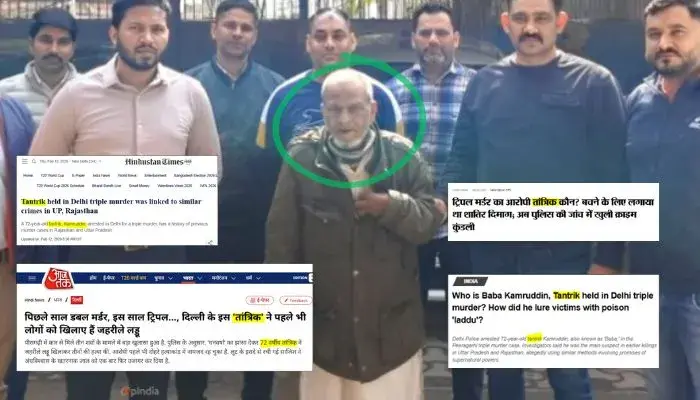
Case Summary
In a clear instance of anti-Hindu misrepresentation, multiple media houses portrayed a Muslim occult practitioner named Kamruddin, who poisoned and killed three Hindu individuals, as a 'Hindu tantrik'. A Tantrik is a Hindu practitioner of Tantra, a system of esoteric spiritual practices and rituals aimed at harnessing and awakening divine energy (Shakti) within the body and universe to achieve liberation, spiritual enlightenment, and unity with the highest principle (Shiva). Tantriks perform specialised rites, meditation, and yogic techniques to attain transcendent powers and spiritual freedom. Notably, this incident came to light when on 11 February 2026, Delhi Police arrested the Muslim occult practitioner Kamruddin for the poisoning deaths of three Hindus, Laxmi, Randhir, and Shiv Naresh, whose bodies were found inside a car near the Peeragarhi flyover in Outer Delhi. Investigations showed that Kamruddin, posing as a Hindu saint (baba) from Firozabad, Uttar Pradesh, contacted the victims through an associate named Salim. He lured them into a pooja, promising "Dhanvarsha", a shower of wealth, asking them to bring ₹2 lakh in cash, cold drinks, and alcohol. During the ritual in Loni, Ghaziabad, he fed them poisoned laddus, stole the money, and fled, leading to their deaths. Further probes linked him to similar crimes in Uttar Pradesh and Rajasthan. However, while reporting on the incident, several prominent media outlets referred to Kamruddin primarily as a “Tantrik” or “self-styled Tantrik” in their headlines, a term rooted in Hindu religious traditions. Publications such as Hindustan Times, India Today, The Indian Express, DNA India and ThePrint used the identifier prominently in headlines, often without foregrounding his name or religious identity. Hindi-language outlets, including Aaj Tak and Dainik Jagran followed a similar pattern. Although the body of reports mentioned the accused’s name, the repeated use of the Hindu-specific term in headlines created a framing that associated the crime with Hindu religious practice rather than identifying the accused as a Muslim occultist. For example, the Hindustan Times published a report with the headline: “Tantrik held in Delhi triple murder was linked to similar crimes in UP, Rajasthan.” The India Today report’s headline read: “Tantrik arrested in Delhi car deaths linked to 5 more murders in UP, Rajasthan.” The Indian Express wrote the headline: “A tantrik who promised to double money, and served ‘poisoned laddoos’: Cracking the Delhi flyover triple murder.” DNA India published a profile of Kamruddin, mentioning his name in the headline; however, it chose not to use the appropriate term and used the term ‘Tantrik’. “Who is Baba Kamruddin, Tantrik held in Delhi triple murder? How did he lure victims with poison ‘laddu’?” the headline read. The Print also used the term ‘Tantrik’ and did not mention Kamruddin’s name in their report’s headline or excerpt. “Delhi cops crack triple murder. ‘Tantrik’ out on bail fed trio poisoned laddoos in name of prasad,” The Print report’s headline read. Aaj Tak headlined its report as: “Pichhle saal double murder, is saal triple…, Dilli ke is ‘tantrik’ ne pehle bhi logon ko khilaye hain jahreelay laddoo.” (Last year double murder, this year triple…, this Delhi ‘tantrik’ has previously fed people poisonous laddoos.) Similarly, Dainik Jagran wrote, “Triple murder ka aaropi tantrik kaun? Bachne ke liye lagaya tha shaatir dimag; ab police ki jaanch mein khuli crime kundli.” (Who is the tantrik accused of triple murder? He used cunning tactics to escape; now his crime history unravels in police probe.) This pattern reflected a broader trend in which Muslim faith healers, pirs or amils involved in criminal conduct were described as “Tantriks” in news reporting. The reporting in the Kamruddin case thus became part of a recurring media practice in which Hindu religious identifiers were selectively applied in a manner that shaped public perception of superstition-related crimes.
Why it is Hate Crime ?
This case has been added to the hate tracker under the prime category- Hate speech against Hindus. Within this, the sub-category selected is- Anti-Hindu subversion and prejudice. Under this, the tertiary categories, namely- 'Anti-Hindu fake news or downplaying' and 'Mislabelling/Misrepresentation of perpetrator's religion as Hindu', have also been selected. Hate speech is defined as any speech, gesture, conduct, writing, or display that is prejudicial against a specific individual and/or group of people, which is leading to or may lead to violence, prejudicial action or hate against that individual and/or group. Media plays a specific and overarching reach in perpetuating prejudicial attitudes towards a community owing to unfair, untrue coverage and/or misrepresentation/misinterpretation, selective coverage and/or omission of facts of/pertaining to issues affecting a specific religious group. This type of bias can dehumanise the victim group, making it easier for others to justify harmful actions against them, which aligns with the objectives of hate speech laws aimed at preventing such harm. It is often observed that the media takes a prejudicial stand against the Hindu community driven by their need to shield the aggressor community which happens to be a numeric minority, however, is the one perpetrating violence against Hindus. For example, the media is often quick to contextualise religiously motivated crimes against Hindus, omit or misrepresent facts that point towards religiously motivated hate crimes, justify and/or downplay religiously motivated hate crimes or simply present fake news to stereotype Hindus. Such media bias leads to the denial of persecution and is often used to dehumanise Hindus, leading to justification for violence against them. For example, the media covered several fake allegations of Hindus targeting Muslims and forcing them to chant Jai Shree Ram. Most of these cases were proved false and fabricated after police investigation. These fake news reports were subsequently never retracted or clarified. Such fake news led to the justification of violence and dehumanisation of Hindus based on the argument that since Hindus targeted Muslims and forced them to chant Jai Shree Ram, the dehumanisation of Hindus and violence against them was par for the course and merely a retaliation. Such media bias leads to prejudicial portrayal of Hindus and offers a justification for violence against them and therefore, is considered hate speech under this category. This case has been added to the tracker because multiple media houses portrayed a Muslim occult practitioner named Kamruddin, who poisoned and killed three Hindus as a Hindu tantrik. The religious marker in this incident lies in the deliberate use of the term "Tantrik" by the media, which is typically associated with Hindu religious practices, to describe Kamuddin, a Muslim occult practitioner. This choice of language serves to obfuscate the perpetrator's Muslim identity and, in effect, whitewashes the crime by connecting it to a term commonly linked with Hindu practices, rather than accurately reflecting his religious background. By referring to Kamruddin as a "Tantrik” without clarifying his Muslim identity, media reports created a misleading association between the criminal act and Hindu spiritual practice, rather than accurately reflecting the perpetrator’s background. This misappropriation risked tarnishing the image of Hindu Tantriks and the broader Hindu spiritual tradition by associating them with acts of deception, poisoning and exploitation committed by a non-Hindu individual. It paints Hindus and the Tantrik tradition in a negative light, fostering societal suspicion, hatred, and potential discrimination against them. Such deliberate distortion is an insult to Hinduism and its ancient spiritual practices. This unjust portrayal contributes to the stigmatisation of Hindus and exposes them to further communal prejudice. Headlines carry disproportionate influence in shaping public perception. Many readers form impressions from headlines alone without engaging with the full body of the report. In this case, repeated headline usage of the term “Tantrik” in connection with poisoning and murder created an associative link between the crime and Hindu religious practice. Although some reports mentioned Kamruddin’s name in the body text, the prominent headline framing ensured that the religious connotation attached to the crime was Hindu rather than Muslim. This framing altered the communal lens through which the incident was understood. This strategic use of Hindu terminology reflects a broader media bias that seeks to downplay or conceal the religious identity of the perpetrators when they are Muslim, while simultaneously emphasising the religious identity of Hindu individuals in similar circumstances. Some media outlets' failure to highlight Kamruddin's Muslim identity, coupled with their use of a term more closely linked to Hindu practices, demonstrates a clear bias, distorting the truth and minimising the communal aspect of the crime. This biased reporting not only misrepresents the facts but also perpetuates an agenda of shielding the Muslim community from scrutiny, while disproportionately focusing on Hindus. Furthermore, the repeated misrepresentation of the perpetrator’s identity by the media, labelling him as a Hindu 'tantrik', not only distorts the facts but also fuels negative stereotypes about Hindus as a community. This mislabelling results in broader harm, as it creates a public perception that such crimes are inherent to Hindu traditions, thereby fostering further hostility and prejudice against Hindus. The combination of targeted exploitation and damaging misrepresentation aligns with the legal and social understanding of a hate crime, as it both victimises individuals based on their faith and contributes to the stigmatisation of the wider Hindu community. Thus, by falsely attributing a Muslim perpetrator’s criminal acts to a Hindu religious identity, the media spread misinformation designed to incite hatred and deepen societal divisions against Hindus and Hinduism. Therefore, this case is being added to the hate crime database of the tracker.


Case Status
Unknown


Perpetrators Details
Perpetrators
Others
Perpetrators Range
From 5 to 10
Perpetrators Gender
unknown
 Sources




