Hindu neighbourhood targeted, temples attacked, and houses set ablaze by miscreants in Chittagong, Bangladesh
 Chittagong District, Bangladesh
  22 January, 2026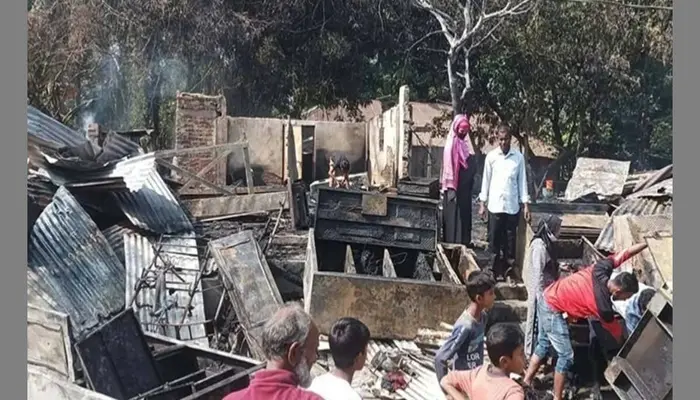
Case Summary
In the Jaffrabad Hindupara area of Wahedpur Union in Mirsarai upazila, Chittagong, Bangladesh, a series of coordinated arson attacks targeted a Hindu neighbourhood, during which seven separate locations, including temples, houses, kitchens and haystacks, were set on fire by some unknown miscreants, creating widespread fear among the Hindu residents. The incidents began on 23 January 2026 when a sack of dry leaves kept beside a Hindu temple at Tapan Dhar’s residence was set ablaze, destroying several items, including a solar battery inside the temple. This was followed by the burning of a haystack at Amio Dhar’s house on 24 January. On 25 January, miscreants set fire to Kanu Nath’s haystack and another haystack at Amio Dhar’s residence, and on the same day, a kitchen belonging to Ratan Dhar was burned. Further attempts continued on 26 January when dry leaves were set on fire at Ashok Dhar’s house, and on 27 January when plastic materials were used in an attempt to ignite a fire near Anup Dhar’s residence. The latest incident occurred on 29 January when a house belonging to a Hindu man named Mridul was set on fire, damaging shelves and clothing. During this time, Mridul's wife, Tamalika Saha, who was alone at the time, raised an alarm and, with the help of neighbours, managed to extinguish the fire. Since that day, there has been no electricity supply in the house. The repeated and targeted attacks on Hindus took place between morning and evening hours when residents were occupied with daily work, prompting the community to organise night-long village guards and install CCTV cameras to prevent further incidents. Despite the matter being reported to the police, the arson continued, intensifying anxiety in the locality, particularly in the context of the upcoming national elections, with concerns that the attacks were intended to intimidate Hindu residents and discourage electoral participation. The Officer-in-Charge of Mirsarai Police Station, Farida Yasmin, visited the area, spoke with residents and initiated an investigation, although no written complaint was filed at the police station. Meanwhile, the Upazila Nirbahi Officer Somaiya Akhter discussed the situation with police officials and informed higher authorities, directing that necessary action be taken. A fresh wave of anti-Hindu violence prevailed across Bangladesh following the death of Sharif Osman Bin Hadi. This escalation occurred against the backdrop of ongoing anti-Hindu violence that had persisted since the ouster of the Sheikh Hasina government in August 2024, during which Hindu homes, temples, and religious spaces were repeatedly attacked, and the Hindu community faced intimidation, arson, and mob attacks. In the aftermath of Hadi’s death, Hindu homes were selectively targeted and set ablaze in multiple localities by Muslim mobs, forcing families to flee and rendering many homeless. The violence was not sporadic but patterned, with Muslim mobs targeting Hindu neighbourhoods, properties, and religious symbols with impunity. One of the many victims of this wave of violence was a Hindu man named Dipu Chandra Das, who was brutally lynched by a Muslim mob over false allegations of blasphemy. Such targeting of innocent Hindus over fabricated charges illustrated the vulnerability of the Hindu minority under conditions of rising communal hostility. Posters and written materials calling for the extermination of Hindus were displayed in public spaces, signalling an alarming normalisation of genocidal rhetoric. Combined with acts of physical violence, arson, and vandalism, these developments demonstrated a coordinated campaign designed to terrorise the Hindu community and assert Islamic dominance. Notably, Sharif Osman Bin Hadi was a Muslim political activist and student leader known for his anti-Hindu and anti-India stance. He was actively involved in the political unrest that followed the fall of Sheikh Hasina’s government and was killed in Dhaka in December 2025 during clashes, after which Hindus were blamed and subsequently targeted.
Why it is Hate Crime ?
This case is being added to the tracker under the primary category- Attack not resulting in death. The subcategory selected is- Attacked for Hindu identity. In several cases, Hindus are attacked merely for their Hindu identity without any perceived provocation. A classic example of this category of religiously motivated hate crime is a murder in 2016. 7 ISIS terrorists were convicted for shooting a school principal in Kanpur because they got ‘triggered’ seeing the Kalava on his wrist and tilak that he had put. In this, the Hindu victim had offered no provocation except for his Hindu religious identity. The motivation for the murder was purely religious, driven by religious supremacy. Such cases where Hindus are targeted merely for their religious identity would be documented as a hate crime under this category. The second primary category selected here is - Attack on Hindu religious representation. Within it, the sub-category selected here is - Attack on temples. In Hinduism, a temple is the abode of the Deity. The Deity in the Temple is consecrated, thereby, making it a real, breathing entity. Hindus believe that not just the Deity but the temple premises itself are sacred to Hindus since Hindus hold the faith that the entire Temple space is an amalgamation of the divine energy of the deity. Given the central significance of Temples in Hindu Dharma, any attack against a Hindu Temple or its peripheral premises is an attack on the faith itself and is born out of animosity towards the faith, of which, the Temple is a central tenet. Any manner of attack against a Temple and/or its premises would therefore be considered a religiously motivated hate crime. This case constituted a clear instance of a religiously motivated hate crime, where Hindu families and their religious spaces in the Jaffrabad Hindupara area were selectively targeted through repeated and coordinated arson attacks. Over the course of one week, seven separate fire incidents affected only Hindu-owned houses and Hindu temples, while no non-Hindu properties in the surrounding area were attacked. This pattern of exclusive targeting demonstrated deliberate identification of victims based on their Hindu religious identity rather than random criminal activity. The sequential nature of the incidents, spread across multiple days, revealed a sustained campaign of intimidation directed solely at the Hindu community. The arson attacks began with an assault on a Hindu temple, where religious property and temple infrastructure were destroyed, and continued with repeated attempts to burn Hindu homes and livelihood resources. The consistency with which only Hindu residences were targeted, despite the presence of other non-Hindu households nearby, underscored the religious motivation behind the violence. Had the intent been ordinary vandalism or theft, the attacks would not have been confined exclusively to Hindu properties. Furthermore, a Hindu place of worship was also targeted, and there was a deliberate attempt to burn a Hindu temple. The temple as an institution holds immense spiritual importance in the Hindu faith. For Hindus, temples are not mere physical structures; they are sanctified spaces believed to embody the divine presence of Hindu deities. Acts of violence against such spaces are not isolated incidents of destruction but reflect underlying hostility towards Hindu beliefs and identity. The manner and timing of the attacks further exposed their hateful intent. Fires were deliberately set during daylight and working hours, when Hindu residents were away or vulnerable, and later escalated to the burning of a Hindu family’s home while a Hindu woman was alone inside. This demonstrated not only intent to destroy property but also to instil fear, panic, and a sense of constant insecurity among Hindu residents. This incident occurred during the ongoing persecution of Hindus in Bangladesh after the death of anti-Hindu and anti-India activist Osman Hadi. This happened just weeks after a Muslim mob brutally murdered Hindu man Dipu Chandra Das and set his body ablaze over a false allegation of blasphemy against Islam in Bhaluka town, Bangladesh, on 18 December 2025. Such targeted violence in quick succession demonstrated it was not an isolated event but a pattern of selective attacks on Hindus with impunity. Notably, the Hinduphobia Tracker recorded several previous instances of Hindus being attacked by having their houses set ablaze. One example occurred on 19 December 2025 in Dhewapara village, Raozan Upazila, Chittagong, Bangladesh, where two houses of three Hindu families were set on fire as attackers targeted them for attempted murder. Bimal Talukder, a resident of the two houses that burned down, stated that four family members were sleeping late at night when the house caught fire. Finding the door locked from the outside, they cut through the fence and escaped. In another instance on 22 December 2025, in Chattogram district of Bangladesh, a Hindu family faced targeted attempted murder by Muslims who set their home ablaze. The attackers locked the family inside the house and set it on fire, even leaving a banner at the scene with explicit threats against the entire local Hindu community. Similarly, in January 2026, Muslims selectively targeted and torched a Hindu home in Bahor village, Nandirgaon Union, Gowainghat Upazila, Sylhet District, Bangladesh. The house belonged to Birendra Kumar Dey, a school teacher. On the day of the incident, the attackers set the property ablaze. Given the selective targeting of Hindu religious and residential properties, the sustained and coordinated nature of the arson attacks, the absence of non-Hindu victims, and the broader context of systemic intimidation against Hindus in Bangladesh, this case met the established parameters of a religiously motivated hate crime. Accordingly, the incident was added to the hate crime database of the Hinduphobia Tracker as an instance of targeted anti-Hindu violence. Disclaimer: The Hinduphobia Tracker records incidents based on when an event occurred or when the victim's ordeal began, rather than when it is reported by the media. In this case, since the targeted attacks began on 23 January 2026, the date of the incident has been selected as such.


Case Status
Unknown


Perpetrators Details
Perpetrators
Unknown
Perpetrators Range
Unknown
Perpetrators Gender
unknown
 Sources




