Hindu families targeted for attempted murder as their homes torched by miscreants in Bangladesh
 Chittagong District, Bangladesh
  18 December, 2025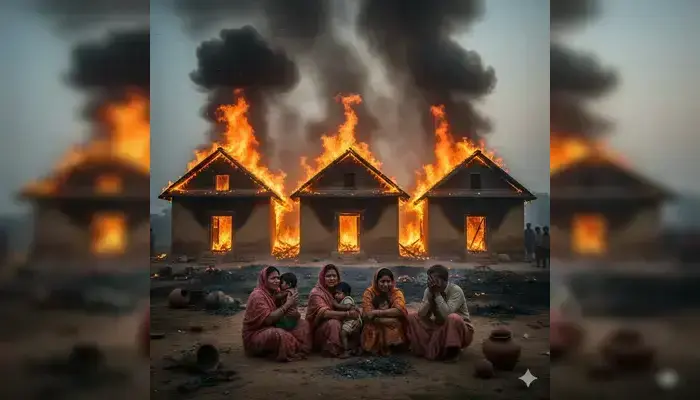
Case Summary
In Raozan Upazila of Chittagong, Bangladesh, two houses of three Hindu families were set on fire as they were targeted for attempted murder by a few unknown attackers. According to media reports, this incident occurred on 19th December 2025 in Dhewapara village of Ward No. 8 of Raozan Municipality. The victims said that the miscreants locked the doors and set the houses on fire. The family members managed to escape by cutting through the tin and bamboo fence. The matter came to light later. A case was filed against unknown persons at the police station in this incident. Bimal Talukder, a resident of the two houses that burned down, said that four members of the family were sleeping late at night. Suddenly, the house caught fire. Finding the door locked outside, they cut through the fence and escaped. Rubel Das, a resident of the other house, also faced the same situation. Regarding the incident, the locals said that a pair of pants soaked in kerosene was found next to Amal Talukdar's house, confirming that an attempt was made to set fire to his house as well. Rangunia Circle Assistant Superintendent of Police (ASP) Mohammad Belayat Hossain said that three families lived in the two houses that were set on fire. The miscreants locked the doors and set the houses on fire. People nearby doused the fire by sprinkling water. A case was registered against unidentified accused in this incident, and efforts were underway to identify and arrest them. Earlier, on 18th December 2025, there were similar arson attacks at the residence and cowshed of a Hindu man, Sadhan Barua, of Keutia Baruapara village in Raozan Sadar Union. A case was filed against unidentified accused at the police station in this incident as well. Raozan Police Station Officer-in-Charge (OC) Sajedul Islam said senior police officials visited the scene. Separate cases were filed in the two incidents. In the Dhewapara village incident, the police detained two suspects. A fresh wave of anti-Hindu violence prevailed across Bangladesh following the death of Sharif Osman Bin Hadi. This escalation occurred against the backdrop of ongoing anti-Hindu violence that had persisted since the ouster of the Sheikh Hasina government in August 2024, during which Hindu homes, temples, and religious spaces were repeatedly attacked, and the Hindu community faced intimidation, arson, and mob attacks. In the aftermath of Hadi’s death, Hindu homes were selectively targeted and set ablaze in multiple localities by Muslim mobs, forcing families to flee and rendering many homeless. The violence was not sporadic but patterned, with Muslim mobs targeting Hindu neighbourhoods, properties, and religious symbols with impunity. One of the many victims of this wave of violence was a Hindu man named Dipu Chandra Das, who was brutally lynched by a Muslim mob over false allegations of blasphemy. Such targeting of innocent Hindus over fabricated charges illustrated the vulnerability of the Hindu minority under conditions of rising communal hostility. Posters and written materials calling for the extermination of Hindus were displayed in public spaces, signalling an alarming normalisation of genocidal rhetoric. Combined with acts of physical violence, arson, and vandalism, these developments demonstrated a coordinated campaign designed to terrorise the Hindu community and assert Islamic dominance. Notably, Sharif Osman Bin Hadi was a Muslim political activist and student leader known for his anti-Hindu and anti-India stance. He was actively involved in the political unrest that followed the fall of Sheikh Hasina’s government and was killed in Dhaka in December 2025 during clashes, after which Hindus were blamed and subsequently targeted.
Why it is Hate Crime ?
This case is being added to the tracker under the primary category- Attack not resulting in death. The subcategory selected is- Attacked for Hindu identity. In several cases, Hindus are attacked merely for their Hindu identity without any perceived provocation. A classic example of this category of religiously motivated hate crime is a murder in 2016. 7 ISIS terrorists were convicted for shooting a school principal in Kanpur because they got ‘triggered’ seeing the Kalava on his wrist and tilak that he had put. In this, the Hindu victim had offered no provocation except for his Hindu religious identity. The motivation for the murder was purely religious, driven by religious supremacy. Such cases where Hindus are targeted merely for their religious identity would be documented as a hate crime under this category. In this case, the arson attack on three Hindu families in Raozan Upazila constituted a clear instance of an anti-Hindu hate crime driven by religious animosity. The perpetrators selectively chose these families for extermination while sparing neighbouring households, demonstrating deliberate identification based on Hindu religious identity. The premeditated method, locking doors from outside to trap sleeping victims inside burning houses, revealed intent not just to destroy property but to annihilate Hindu lives systematically. This calculated violence against Hindus alone exposed the attackers' deep-seated hatred for Hinduism, where mere existence as Hindu residents provoked murderous rage. Such discriminatory targeting of the Hindu minority for elimination fits the precise definition of religiously motivated hate crime, rooted in communal prejudice rather than random criminality. A pair of kerosene-soaked pants found near the victims' houses confirmed premeditated intent to burn alive a Hindu household, revealing deep-seated religious animosity towards Hinduism and the Hindu community. Such calculated efforts to eradicate Hindu families solely for their faith exemplified religious intolerance and hate crimes. This incident occurred just a day after a Hindu man, Dipu Chandra Das, was brutally murdered and his body set ablaze by Muslim radicals over an unproven allegation of blasphemy against Islam in Bhaluka town, Bangladesh, on 18th December 2025. Such targeted violence in quick succession demonstrated it was not an isolated event but a pattern of selective attacks on Hindus with impunity. In another instance, Sadhan Barua, another Hindu man's house and cowshed attacked in a similar manner and were torched, making it a clear instance of an anti-Hindu hate crime. These back-to-back assaults highlighted a climate of religiously motivated hate crimes against the Hindu minority in Bangladesh, making this a clear instance of anti-Hindu hate crime. In this case, even though the identity of the perpetrators remains unknown, the crime is motivated by religious animosity towards Hindus. Therefore, this incident is being added to the hate crime database of the Hinduphobia Tracker. Disclaimer: In this case, even though Hindu families as a whole were targeted, the exact number of family members remained unspecified in media reports. Coverage highlighted Bimal Talukder along with 4 members of his family, Amal Talukder, and Rubel Das, while another Hindu man, Sadhan Barua, faced similar targeting a day earlier at his residence and cowshed. Therefore, for documenting this crime, a conservative estimate of eight victims was selected, and the victim count was recorded as '8'. In this case, since the media reports stated that police arrested two suspects, the perpetrator count is selected as '2'.
Victim Details
Total Victim
8
Deceased
0
Gender
- Male 4
- Female 0
- Third Gender 0
- Unknown 4
Caste
- SC/ST 0
- OBC 0
- General 0
- Unknown 8
Age Group
- Minor 0
- Adult 4
- Senior Citizen 0
- Unknown 4


Case Status
Case sub-judice


Perpetrators Details
Perpetrators
Unknown
Perpetrators Range
From 2 To 5
Perpetrators Gender
unknown
 Sources




