Hindu-majority village targeted, families subjected to brutal torture by Bangladesh army amidst ongoing rampant persecution of Hindus
 Kishoreganj District, Bangladesh
  30 January, 2026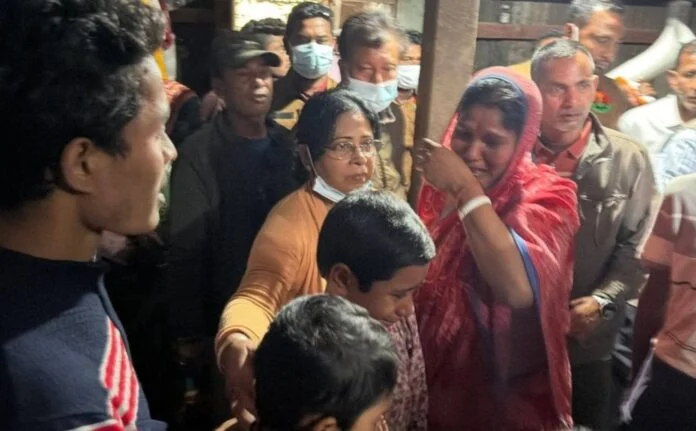
Case Summary
In a Hindu-majority village in Dhanpur Union under Itna Upazila of Kishoreganj district of Bangladesh, Hindu homes were raided, and Hindu families were subjected to brutal torture and assault by the Bangladeshi Army. According to local residents, army personnel conducted house-to-house searches at around 1:00 a.m. on Saturday, 31 January 2026, and subjected members of the Hindu community to physical assault and intimidation without any clear or specific justification. Eyewitness accounts state that several homes were forcefully entered, residents were brutally beaten, and an atmosphere of fear and terror was created throughout the village. Despite the passage of significant time since the incident, the Bangladesh Army failed to provide any logical explanation or concrete evidence to justify the operation. The incident triggered widespread outrage and condemnation. Veteran freedom fighter Fazlur Rahman strongly denounced the violence, calling it a gross violation of human rights and constitutional principles. He demanded an impartial and transparent investigation into the incident and urged the concerned authorities to take immediate steps to prevent further harassment and persecution of minority communities. Human rights activists and civil society groups also expressed deep concern, warning that such actions threaten social harmony and undermine the rule of law. They have called on the government to ensure accountability, protect minority rights, and restore public confidence in state institutions. A fresh wave of anti-Hindu violence prevailed across Bangladesh following the death of Sharif Osman Bin Hadi. This escalation occurred against the backdrop of ongoing anti-Hindu violence that had persisted since the ouster of the Sheikh Hasina government in August 2024, during which Hindu homes, temples, and religious spaces were repeatedly attacked, and the Hindu community faced intimidation, arson, and mob attacks. In the aftermath of Hadi’s death, Hindu homes were selectively targeted and set ablaze in multiple localities by Muslim mobs, forcing families to flee and rendering many homeless. The violence was not sporadic but patterned, with Muslim mobs targeting Hindu neighbourhoods, properties, and religious symbols with impunity. One of the many victims of this wave of violence was a Hindu man named Dipu Chandra Das, who was brutally lynched by a Muslim mob over false allegations of blasphemy. Such targeting of innocent Hindus over fabricated charges illustrated the vulnerability of the Hindu minority under conditions of rising communal hostility. Posters and written materials calling for the extermination of Hindus were displayed in public spaces, signalling an alarming normalisation of genocidal rhetoric. Combined with acts of physical violence, arson, and vandalism, these developments demonstrated a coordinated campaign designed to terrorise the Hindu community and assert Islamic dominance. Notably, Sharif Osman Bin Hadi was a Muslim political activist and student leader known for his anti-Hindu and anti-India stance. He was actively involved in the political unrest that followed the fall of Sheikh Hasina’s government and was killed in Dhaka in December 2025 during clashes, after which Hindus were blamed and subsequently targeted.
Why it is Hate Crime ?
This case is being added to the tracker under the primary category- Attack not resulting in death. The subcategory selected is- Attacked for Hindu identity. In several cases, Hindus are attacked merely for their Hindu identity without any perceived provocation. A classic example of this category of religiously motivated hate crime is a murder in 2016. 7 ISIS terrorists were convicted for shooting a school principal in Kanpur because they got ‘triggered’ seeing the Kalava on his wrist and tilak that he had put. In this, the Hindu victim had offered no provocation except for his Hindu religious identity. The motivation for the murder was purely religious, driven by religious supremacy. Such cases where Hindus are targeted merely for their religious identity would be documented as a hate crime under this category. This case stands as a clear instance of a religiously motivated hate crime, where the Bangladeshi Army targeted Hindu families exclusively in a Hindu-majority village in Dhanpur Union for violence and torture. Hindu homes were singled out, Hindu men dragged out and beaten mercilessly, women and children terrorised, cowering in fear, while all nearby non-Hindu homes remained untouched. In a country like Bangladesh, notorious for its ongoing persecution of the Hindu minority, this selective brutality reveals deep-seated religious animosity towards Hindus and their faith. If the operation had no religious motivations, the army would have targeted families irrespective of religion for any supposed infractions, but they didn't. Only Hindus suffered this fate, their identity as Hindus marking them for hatred, making this an undeniable, religiously motivated hate crime. The nature of the attack further exposes its hateful intent: army personnel stormed Hindu homes at 1:00 a.m. on 31 January 2026 to inflict brutal torture on defenceless families. The innocent Hindu residents, guilty of no crime, were punched, kicked, and beaten savagely, their screams echoing through the night as an atmosphere of terror gripped the village. This disproportionate reaction over nothing, no fault of these Hindu families, showcases deep-seated religious animosity at play, with soldiers revelling in the power to humiliate and harm based solely on the faith identity of the victims. The underlying communal undertones demonstrate hatred for Hindus in a country filled with anti-Hindu hostility, turning a midnight raid into a pogrom-like assault on an entire community's dignity. Bangladesh, in recent decades, has witnessed relentless persecution of Hindus, even at the hands of state authorities, brutal attacks leaving Hindus killed in the streets, temples desecrated and burned to the ground, and families displaced in fear. State forces have complied with perpetrators or joined them outright, amplifying the horror. This persecution intensified after the political exile of Sheikh Hasina, followed by the death of Osman Hadi, unleashing waves of anti-Hindu violence. Amidst this pattern, the Bangladeshi Army's selective targeting, attacking, brutalising, and torturing Hindus in Dhanpur fits seamlessly, soldiers venting hatred on Hindus because of their religious identity. This makes the case part of a broader tapestry of targeted persecution in a nation steeped in anti-Hindu animosity, a textbook religiously motivated hate crime. Additionally, this is not the first time the Bangladesh Army has taken part in anti-Hindu activities. The Hinduphobia Tracker has previously documented instances of anti-Hindu hate crimes by the Bangladesh Army. For example, in June 2025, in Khilkhet, Dhaka, Bangladesh, a Hindu boy named Timpol Paul was beaten by the Bangladesh Army after he opposed and recorded the demands of a Muslim mob calling for the demolition of a Hindu temple. A video of Timpol describing his ordeal went viral on social media. In the video, he stated that he was manhandled, harassed, and beaten by the army when he tried to protest against the Muslim mob and record their actions. Similarly, in August 2025, in Gangachara Upazila of Bangladesh, the Bangladesh Army and paramilitary force Ansar stopped relief work for Hindu victims attacked by a Muslim mob over a false blasphemy pretext. Volunteers from Bangladesh Sammilita Sanatani Jagran Jote, including activist Prosenjit Kumar Haldar and spiritual guru Sri Gopinath Das Brahmachari, were distributing rice, grains, oil, soap, puffed rice, shampoo, and clothing when security forces intervened, took the volunteers into separate rooms, threatened them against aiding Hindus, and insulted the guru. Given that this current case meets the parameters of a religiously motivated crime and matches the pattern of previous incidents of hate crimes committed by the Bangladesh Army, this case is being added to the hate crime database of the Hinduphobia Tracker.


Case Status
Unknown


Perpetrators Details
Perpetrators
State and Establishment
Perpetrators Range
Unknown
Perpetrators Gender
male
 Sources




