Bangladesh Army denies relief to Hindu victims attacked by Muslim mobs under the pretext of ‘blasphemy'
 Rangpur District, Bangladesh
  3 August, 2025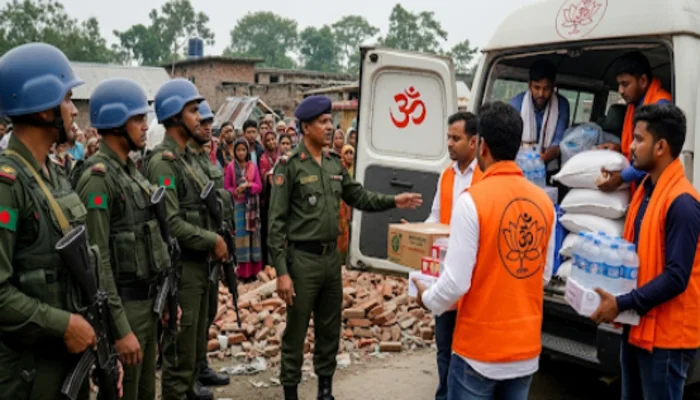
Case Summary
In Gangachara upazila of Bangladesh, relief work meant for Hindu victims, who were attacked by a Muslim mob under the false pretext of blasphemy, was stopped by personnel of the Bangladesh Army and the paramilitary force Ansar. Hinduphobia Tracker has extensively documented the ongoing persecution of Hindus in Bangladesh following the violent ouster of Sheikh Hasina on August 5, 2024. In this incident, Hindus in Betgari Union, located in Gangachara upazila in Rangpur district of Bangladesh, were brutally attacked by a mob of 500 to 600 Muslims. The mob vandalised nearly 15 Hindu homes, forcing 50 Hindu families to flee the area. All of this took place over an unproven allegation of 'blasphemy' against an 18-year-old Hindu boy named Ronjon Roy. Days after the violence, aid and relief materials were being distributed by volunteers from the Hindu organisation called Bangladesh Sammilita Sanatani Jagran Jote to families whose homes had been attacked and destroyed by Muslim mobs. Among the volunteers were Hindu activist Prosenjit Kumar Haldar and Hindu spiritual Guru Sri Gopinath Das Brahmachari. They were distributing relief material like rice, grains, oil, soap, puffed rice, shampoo, and clothing when the Bangladesh army and its paramilitary force (Ansar) intervened. The Bangladesh security forces took the two volunteers into separate rooms and threatened them against helping the Hindu victims. They also insulted the Hindu spiritual Guru. The soldiers then disrupted the relief work and made a public announcement over loudspeakers stating that no such relief work could be carried out without prior permission from the district administration, which, anyway, failed to protect the Hindu victims during the earlier violence. Furthermore, no compensation was announced for the victims of the violence, who were left without either official assistance or relief materials that were brought for them. This incident is one of the several incidents of the continued persecution of Hindus in Bangladesh, which has only increased manifold since the fall of Sheikh Hasina’s Awami League government on August 5, 2024. After her violent ouster, Bangladesh has plunged into chaos as Islamist extremists have taken advantage of the political turmoil to unleash a wave of terror and violence against the Hindu community. The Islamist mobs have attacked Hindu homes, burned them to the ground, and abducted women in a horrific descent into anarchy. Several temples have been destroyed in various parts of the Islamic country in a major crackdown on Hindus. Reports have exposed how Muslim students forced around 60 Hindu teachers, professors, and government officials to resign. Exiled Bangladeshi activist Asad Noor has also revealed that the minority Hindu community is now being coerced into joining ‘Jamaat-e-Islami’. Hindu religious events have been repeatedly targeted. On 6th September, a procession carrying Lord Ganesha’s idol was attacked in Chittagong. Ahead of Durga Puja, multiple incidents of idol vandalism occurred, including attacks in Mymensingh, Pabna, Rajshahi, Kishoreganj, and Dhaka. On 29th November, a violent Muslim mob attacked three temples in Patharghata, Chittagong, immediately after Jumma Namaz. The crackdown on Hindu voices has also escalated. On 30th November, Hindu journalist Munni Saha was arrested in Dhaka. Muslim mob attacks have increased in Bangladesh, for example, on 22nd May 2025, a Muslim mob carried out arson attacks selectively on Hindu homes in Dahar Mashihati village in Abhaynagar upazila in Jessore district of Bangladesh. Even ISKCON leader Chinmoy Krishna Das Prabhu and his aides have been targeted, and attempts have been made to ban ISKCON and suppress Hindu protests through sedition charges. These arbitrary actions point to a systematic pattern of persecution under Muhammad Yunus’s interim government.
Why it is Hate Crime ?
This case has been added to the tracker under the primary category of - Restriction/ban on Hindu practices. Within it, the sub-category selected is - Restriction on expression of Hindu identity. An example of the state-affected prejudicial and targeted orders against the Hindu community would be a government denying the right of a Hindu or a group of Hindus to hold a religious procession owing to the animosity of non-Hindu groups. Denial of the religious right of the Hindus to assuage the non-Hindu group which harbours animosity to a point where it could lead to violence against Hindus is not only a failure of law and order but is a prejudicial order against Hindus, denying them their fundamental rights to express their religious identity. An example of a hate crime against Hindus by a non-Hindu would be a non-Hindu institution forcing its Hindu employees to abandon religious symbols that a Hindu would wear as an expression of faith owing to inherent prejudice against the faith professed by the victim or a non-Hindu group of people restricting a Hindu group from constructing a place of worship simply because the demography of the area in which the temple is being built is dominated by non-Hindus. Such actions are driven by religious animosity and/or prejudice against Hindus and their faith and would therefore be categorized as a hate crime. The second primary category selected here is - Attack not resulting in death. Within it, the sub-category selected is - Attacked for Hindu identity. In several cases, Hindus are attacked merely for their Hindu identity without any perceived provocation. A classic example of this category of religiously motivated hate crime is a murder in 2016. 7 ISIS terrorists were convicted for shooting a school principal in Kanpur because they got ‘triggered’ seeing the Kalava on his wrist and tilak that he had put. In this, the Hindu victim had offered no provocation except for his Hindu religious identity. The motivation for the murder was purely religious, driven by religious supremacy. Such cases where Hindus are targeted merely for their religious identity would be documented as a hate crime under this category. The third primary category selected here is - Hate speech against Hindus. Under this, the sub-category selected is- Mocking/denigrating Hindu leaders. Hate speech is defined as any speech, gesture, conduct, writing, or display that is prejudicial against a specific individual and/or group of people, which is leading to or may lead to violence, prejudicial action or hate against that individual and/or group. Religious leaders are often seen as representatives of the community, especially, the community’s religious faith and beliefs. Mocking or denigrating a religious leader specifically owing to his religious identity and/or the religious rituals he observes can be considered hate speech because the motivating factor of the speech is animosity and/or dislike for what he represents – the religious beliefs and faith of the community. It is important to note that mere insulting words against an individual do not constitute hate speech. It is entirely possible that insulting words are used for an individual, however, the specific speech is not the result of religious hate and/or animosity towards the professed faith of the religious leader, but the individual himself. For the speech to be considered hate speech, the speech itself or the motivating factor behind the speech has to be religious in nature. Such speech which denigrates Hindu religious leaders specifically owing to animosity towards the faith they profess and the community faith they represent will be treated as hate speech under this category. This case has been added to the tracker because Bangladeshi security forces stopped and disrupted the relief work that was meant for Hindus who were victims of violence. The Hindu victims, having suffered targeted attacks by a large Muslim mob, were further persecuted when Bangladeshi security forces blocked humanitarian aid organised by Hindu organisations. The state-sanctioned nature of this persecution was undeniable; first, the Bangladeshi police failed to protect Hindus from the mob attack, and then they ensured that relief material never reached the victims. This double victimisation is a textbook example of state-sanctioned discrimination, where the state machinery is weaponised not to protect but to punish the vulnerable, just because of their religious identity. They even threatened the volunteers, an act clearly intended to silence them, erase the record of the violence, and deny justice to the victims. In the past, Muhammad Yunus himself publicly claimed that attacks on Hindu minorities were “overhyped,” reflecting the deep-seated culture of denial within Bangladesh’s political and administrative elite. Such trivialisation of Hindu persecution stems from a broader disdain and animosity towards Hindus in a Muslim-majority state like Bangladesh, where, as an Islamic nation, the implicit expectation is that Hindus either abandon their faith and identity or leave altogether, as non-adherents are fundamentally unwelcome. This rhetoric trivialises Hindu suffering, shields perpetrators, and normalises violence by portraying minority grievances as exaggerated. It serves to protect the image of the state while entrenching the dominance of the majority community—leaving Hindus with neither justice nor relief. Such actions are rooted in the inherent religious animosity that exists in Islam against polytheistic religions, in this case, Hindus, which sees other faiths as something that needs to be converted. This results in persecution not only by the local Muslim majority population but also at the hands of the administration. Thus, such actions were effectively a statement to the Hindu minorities that in a Muslim majority country like Bangladesh, only Muslims can expect protection or relief from the government or any private organisation. It was a subtle but dangerous attempt at forcing Hindus into abandoning their faith. It was aimed at eroding the cultural and religious identity of Hindus in Muslim majority Bangladesh. These restrictions are not isolated incidents; they reflect a systematic and enduring pattern of state-sanctioned discrimination against the Hindu minority in Bangladesh. The denial of relief, coupled with trivialising their victimisation, reflects the deep-rooted religious animosity towards Hinduism across Bangladesh. Such instances are a direct result of entrenched bias and prejudice against the Hindu community, making this a clear case of religiously motivated discrimination. Furthermore, Bangladesh security forces also insulted the Hindu spiritual Guru. Insulting Hindu spiritual leaders or gurus, whether they are historical figures or contemporary representatives, constitutes hate speech because it seeks to undermine the respect and authority these individuals hold within the Hindu community. Hindu leaders often embody the values, heritage, and aspirations of their followers. When they are targeted with abusive language or false accusations, it is seen as an attempt to delegitimise the collective Hindu identity and achievements of Hindus. Hindu leaders are highly revered and respected, and vile remarks passed towards them are a result of the perpetrator having intense hatred for Hindus and anyone who propagates Hindu rights. This incident qualifies as a Hindu hate crime because the victims were specifically targeted for their Hindu identity; first through mob violence, then through state-sanctioned obstruction of relief. Actions of the Bangladesh security forces were motivated by deep-rooted religious animosity towards Hindus and Hinduism, reinforced by an administrative culture of denial and downplaying of such attacks. This is not only a failure of justice but also a deep institutional prejudice against Hindus in Bangladesh. In the Muslim-majority nation, law enforcement and local administration often capitulate to the pressure of Islamist mobs, prioritising appeasement over justice. There is a consistent pattern of denying protection to Hindus, and even criminalising them when they are the victims. Such state-backed inaction emboldens radical elements and effectively gives them a free pass to target Hindu minorities with impunity. This case, therefore, is not an isolated episode but part of a deeply entrenched pattern of religiously motivated hate and persecution of the Hindu community in Bangladesh. Therefore, this case is being added to the hate crime database.


Case Status
Unknown


Perpetrators Details
Perpetrators
State and Establishment
Perpetrators Range
N/A
Perpetrators Gender
unknown
 Sources




