Hindu homes vandalised; Hindu families displaced over unsubstantiated allegations of 'blasphemy' against Hindu boy in Bangladesh
 Rangpur District, Bangladesh
  26 July, 2025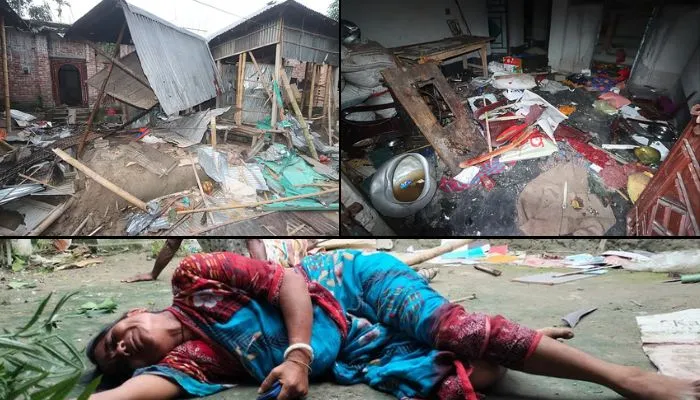
Case Summary
In Betgari Union, located in Gangachara upazila in Rangpur district of Bangladesh, Hindus were brutally attacked by a mob of 500 to 600 Muslims. The mob vandalised nearly 15 Hindu homes, forcing 50 Hindu families to flee the area. All of this took place over an unproven allegation of 'blasphemy' against an 18-year-old Hindu boy named Ronjon Roy. The situation began when Ronjon was unjustly arrested and his home was vandalised by a Muslim mob over false accusations of blasphemy. Hinduphobia Tracker documented this incident where an unidentified individual created a fake Facebook account using Ronjon’s photographs from his real profile. From this fake account, derogatory remarks about Prophet Muhammad and Islam were posted. Shortly afterwards, a Muslim mob took to the streets in protest, demanding action against the Hindu boy. Following this, the violent Muslim mob then selectively targeted Hindu homes and looted their belongings. Fearing for their safety and security, at least 50 Hindu families fled the area. The mob laid siege to Hindu households, perpetrating acts of vandalism and looting. They were armed with sticks and makeshift weapons. Gangachara Police OC Al Emran admitted that he allowed the mob of 500 to 600 Muslims to gather, having mistaken it for a ‘peaceful march.’ He stated, “However, they suddenly launched an attack. One officer was seriously injured.” He added that the mob carried out the attack after the conclusion of the afternoon Namaz. A Hindu victim stated, “How will we survive now? We have been rendered penniless. They (Muslims) have taken away everything.” Another young Hindu girl recounted that police were present when the attackers arrived to vandalise their homes. The police initially resisted the mob, but later fled, abandoning the helpless Hindus to their fate. The Hindu girl then asked, “Why were the homes of innocent people like us vandalised and looted?” Another local Hindu resident, Pramod Mahant, stated that the Muslims were initially supposed to stage a protest in the market area, but soon began shouting slogans and attacking Hindu homes. The dire situation was subsequently brought under control by the police and the army, but the attackers managed to escape the scene of the crime. Reports also stated that not a single arrest had been made in connection with the destruction of Hindu homes. Notably, the Hinduphobia Tracker had previously documented how the Hindu boy Ronjon Roy had been framed under false charges of blasphemy. Following this, his home was vandalised by a Muslim mob. This incident is one of the several incidents of the continued persecution of Hindus in Bangladesh, which has only increased manifold since the fall of Sheikh Hasina’s Awami League government on August 5, 2024. After her violent ouster, Bangladesh has plunged into chaos as Islamist extremists have taken advantage of the political turmoil to unleash a wave of terror and violence against the Hindu community. The Islamist mobs have attacked Hindu homes, burned them to the ground, and abducted women in a horrific descent into anarchy. Several temples have been destroyed in various parts of the Islamic country in a major crackdown on Hindus. Reports have exposed how Muslim students forced around 60 Hindu teachers, professors, and government officials to resign. Exiled Bangladeshi activist Asad Noor has also revealed that the minority Hindu community is now being coerced into joining ‘Jamaat-e-Islami’. Hindu religious events have been repeatedly targeted. On 6th September, a procession carrying Lord Ganesha’s idol was attacked in Chittagong. Ahead of Durga Puja, multiple incidents of idol vandalism occurred, including attacks in Mymensingh, Pabna, Rajshahi, Kishoreganj, and Dhaka. On 29th November, a violent Muslim mob attacked three temples in Patharghata, Chittagong, immediately after Jumma Namaz. The crackdown on Hindu voices has also escalated. On 30th November, Hindu journalist Munni Saha was arrested in Dhaka. Muslim mob attacks have increased in Bangladesh, for example, on 22nd May 2025, a Muslim mob carried out arson attacks selectively on Hindu homes in Dahar Mashihati village in Abhaynagar upazila in Jessore district of Bangladesh. Even ISKCON leader Chinmoy Krishna Das Prabhu and his aides have been targeted, and attempts have been made to ban ISKCON and suppress Hindu protests through sedition charges. These arbitrary actions point to a systematic pattern of persecution under Muhammad Yunus’s interim government.
Why it is Hate Crime ?
This case has been added to the tracker under the primary category- Attack not resulting in Death. Within this, the subcategory selected is- Communal Clash/ Attack. Communal clash is a form of collective violence that involves clashes between groups belonging to different religious identities. For a communal clash between Hindus and non-Hindus to qualify as a religiously motivated hate crime, the trigger of the violence itself would have to be anti-Hindu in essence. For example, if there is a Hindu religious procession that comes under attack from a non-Hindu mob and after the initial attack, Hindus retaliate in self-defence, leading to a communal clash between the two religious communities. While at a later stage, both communities are involved in the clash/violence, the initial trigger of the violence was by the non-Hindu mob against the Hindus and therefore, it could safely be termed as an anti-Hindu violence. Further, the trigger would also have to be religiously motivated. In the cited example, the attack by the non-Hindu mob was against religious processions and therefore, can be concluded to be religiously motivated. In some cases, the trigger may be non-religious, however, it develops into religious violence against Hindus at a later stage. In such cases too, the foundational animosity towards Hindus becomes the motivating factor of the crime and therefore, it would be classified as a religiously motivated hate crime against Hindus under this category. The other subcategory selected is- Attacked for Hindu identity. In several cases, Hindus are attacked merely for their Hindu identity without any perceived provocation. A classic example of this category of religiously motivated hate crime is a murder in 2016. 7 ISIS terrorists were convicted for shooting a school principal in Kanpur because they got ‘triggered’ seeing the Kalava on his wrist and tilak that he had put. In this, the Hindu victim had offered no provocation except for his Hindu religious identity. The motivation for the murder was purely religious, driven by religious supremacy. Such cases where Hindus are targeted merely for their religious identity would be documented as a hate crime under this category. The other subcategory selected in this case is- Attack to induce migration from non-Hindu dominated area. There have been cases where the Hindus living in an area, often with a majority dwelling belonging to non-Hindus or those harbouring animosity towards the Hindu faith, the Hindu residents experience threats and violence. The violence is employed with the aim of making the Hindus leave the area and relocate, so the area could be turned into an exclusive ghetto for adherents of the non-Hindu faith or those who harbor animosity towards the Hindu faith. In several cases, the aim of exodus is explicit. However, in several cases, the demand for exodus of Hindu residents is not explicit, however, violence by non-Hindu residents leaves the Hindu residents no option but to leave the area, thereby, turning the area into an exclusive ghetto of non-Hindu residents. In such cases, there are instances violence against the Hindu residents explicitly. For example, in the Hauz Qazi case of 2019, the Muslim residents claimed that mob violence against the Hindu residents had been triggered by a parking dispute. However, the violence did turn religious with a temple being desecrated and was directed specifically against the Hindu residents. The Hindu residents of the area were clear that the violence was religiously motivated and one of the motives was to affect an exodus of the Hindu residents. In such cases, even though the perpetrators have not explicitly expressed the aim of affecting exodus, the given circumstances and violence and precedent point to the intention of exodus and therefore would be categorized under this sub-category. Such crimes are religiously motivated and therefore are hate crimes. This incident is a stark example of a hate crime perpetrated against the Hindu community in Bangladesh. At its core, the incident revolved around a mere allegation of ‘blasphemy’ levelled at an 18-year-old Hindu boy, Ronjon Roy. Without any proof or credible investigation, a Muslim mob of 500–600 individuals went on an organised rampage directed not only at Ronjon Roy or his family, but at the wider Hindu community. The targets were chosen solely on the basis of their religious identity, in this case, Hindu identity, which marks this incident as a clear case of communal hatred and collective punishment. The escalation began when a fake Facebook account, created using Ronjon’s photographs, was used to disseminate derogatory remarks about Prophet Muhammad and Islam. Instead of seeking truth or following due process, the local Muslims took to the streets in anger, targeting not only Ronjon's house but also other local Hindu homes in a measured and methodical fashion. This reaction exposes a deeply troubling pattern, where even an unsubstantiated accusation against one Hindu individual becomes an excuse to unleash violence, terror and displacement against the entire Hindu community. The use of ‘blasphemy’ as justification for mass violence signals a gross abuse of law and communal power. In Bangladesh, such blasphemy allegations are often manipulated tools, weaponised by Muslim extremists to harass, dispossess, and expel Hindu minorities, showcasing the religious animosity behind such attacks. The collective nature of the attack cannot be overstated. The Muslim mob did not confine itself to Ronjon Roy or his immediate family. Instead, they systematically vandalised nearly 15 Hindu homes, looted property, and left dozens of families utterly destitute. The mob’s actions went beyond outrage or protest; this was a deliberate campaign to inflict maximal pain and humiliation on the Hindu population of the area. The doctrine of collective punishment, where an entire community is made to suffer for the perceived offence of one of its members, showcases the extent of religious animosity at play in this incident. It signals that, in the eyes of the Muslim perpetrators, all Hindus are collectively guilty and must be penalised, irrespective of individual culpability. This principle violates every basic tenet of justice and reflects deeply ingrained religious animosity towards the Hindu community, making it an instance of a religiously motivated crime. Furthermore, the violence and destruction were so relentless and traumatic that at least 50 Hindu families felt compelled to abandon their homes and flee the area. This was not an accident; it was a direct and deliberate consequence of hate-driven violence. The Muslim attackers, by instilling deep fear and making it clear that no protection or justice would be afforded to Hindus, succeeded in driving out a significant portion of the local Hindu community. Such acts are not merely personal attacks; they seek to erase the very presence of Hindus from the area. This kind of action is intended to alter the religious demography, force Hindus into exile, and is rooted in profound hostility towards Hinduism and the Hindu community. It is yet another demonstration of the religiously motivated nature behind the attack. Moreover, the complete impunity enjoyed by the Muslim perpetrators, as evidenced by the fact that not a single arrest was made despite the scale of devastation, only deepens the sense of injustice and emboldens Muslim extremists to commit further violence against Hindus. Even the police fled the area when Hindus were being attacked by the Muslim extremists. This sends a dangerous message that violence against Hindus will not be met with the same seriousness as violence against other communities. Such inaction exemplifies systemic discrimination and the ongoing persecution of the Hindu community due to their religious identity. This incident is thus not simply a matter of sporadic violence or a breakdown of law and order. It is an archetypal hate crime characterised by the stigmatisation and scapegoating of Hindus, the use of 'blasphemy' as a pretext for persecution, the infliction of collective punishment, and the deliberate use of violence to force a vulnerable minority into exile. At every step, the actions of the Muslim mob were shaped by a desire to punish and expel Hindus for their faith. Since such actions are motivated by religious animosity towards the Hindu community; therefore, this case is being added to the hate crime database. Disclaimer: In this case, it is mentioned that members of 50 Hindu families fled the area after the Muslim mob went on a violent rampage against the Hindu community. However, the exact number of victims is not specified. Due to this lack of clarity, we have relied on the most recent Bangladesh census data, which indicates that the average family size in Bangladesh is approximately 4.3 members per household. To ensure a standardised estimation, we have opted to consider an average of 4 members per family. Based on this approach, the estimated total number of victims in this case is calculated as 200 individuals. Therefore, we are using an indicative number of 200 victims as the victim count.
Victim Details
Total Victim
200
Deceased
0
Gender
- Male 0
- Female 0
- Third Gender 0
- Unknown 200
Caste
- SC/ST 0
- OBC 0
- General 0
- Unknown 200
Age Group
- Minor 0
- Adult 0
- Senior Citizen 0
- Unknown 200


Case Status
Unknown


Perpetrators Details
Perpetrators
Muslim Extremists
Perpetrators Range
From 10 to 100
Perpetrators Gender
male
 Sources




