Hindus and their faith mocked: Indian politician mocks sacred Diwali rituals, questions the need to light diyas
 Lucknow District, Uttar Pradesh, India
  17 October, 2025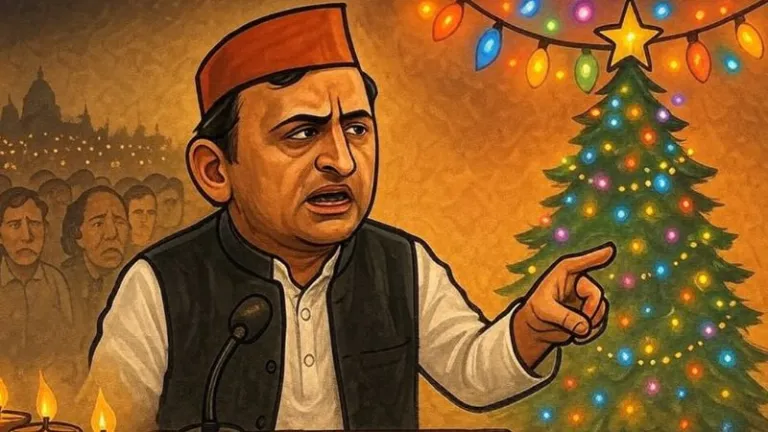
Case Summary
Samajwadi Party politician Akhilesh Yadav stirred outrage with an anti-Hindu remark on Diwali, questioning the very need to light diyas. Speaking at a press conference in Lucknow on Dhanteras, 18 October 2025, Yadav said that instead of lighting diyas and candles every year, people should learn from Christmas celebrations, where lights are displayed for months. He called the repeated spending on diyas a “waste of money” and said that the government should be replaced to make celebrations “more beautiful.” His statement sparked widespread backlash on social media, with many Hindus condemning it as a reflection of disdain towards Hindu festivals. Users across platforms accused Yadav of showing open bias against Hindu traditions. Some even questioned his identity, with one user saying, “Now Akhilesh Yadav has a problem with diyas and candles. People of Uttar Pradesh should decide — is he Christian or Muslim?” Others mockingly renamed him “Akhileshuddin,” saying, “What can one even expect from Akhileshuddin?” Another user wrote, “We have seen many politicians, but none like him who ridicules the very traditions that define us. Under PDA politics, he misleads people while insulting Hindus. On one hand, our potter families work hard all year to craft diyas, and on the other, he urges us to copy Christmas decorations. Should Sanatan Dharma now take lessons from Christmas?” The remarks deeply offended Hindus, who revere Diwali as the festival of light, purity, and truth. For them, lighting diyas is not extravagance but a sacred act that signifies victory of light over darkness, knowledge over ignorance, and truth over falsehood. The Deepotsav tradition runs deep in India’s spiritual and cultural fabric. A diya is seen as the light of the soul and a channel to divine consciousness, capable of dispelling both external and inner darkness. Beyond its spiritual symbolism, the diya also sustains the livelihoods of thousands of potter families who depend on Diwali for their income.
Why it is Hate Crime ?
The primary category in this case is: Hate speech against Hindus. The subcategory under this is: Anti-Hindu slurs, mocking faith. Anti-Hindu slurs and the deliberate mocking of the Hindu faith owing to religious animosity involve the usage of derogatory terms, stereotypes, or offensive references to religious practices, symbols, or figures. One of the common anti-Hindu slurs used against Hindus is “cow-worshipper” and “cow piss drinker”. The intention of using this term is to demean and mock Hindus as a group and their religious beliefs since Hindus consider the cow holy. Additionally, some symbols and the slurs attached to them have a historical context that exacerbates the insult, hate, stereotyping, dehumanisation and oppression against Hindus. Cow worship has been used for centuries to denigrate Hindus, insult their faith and oppress Hindus specifically as a religious group. There has been overwhelming documentation about how cow slaughter has been used to persecute Hindus with cow meat being thrown in temples and places of worship. There has also been overwhelming documentation where cow meat (beef) has been force-fed to Hindus to either forcefully convert them to Islam or denigrate their faith. Apart from cow worship, the Swastika – which holds deep religious significance for the Hindus – has also been misinterpreted and distorted to use as a slur against Hindus. Similarly, the worship of the Shivling has been used by supremacist ideologies and religions to denigrate Hindus owing to religious animosity. Such slurs and denigration stem out of inherent animosity and hate towards Hindus and their faith, therefore, it is categorised as hate speech targeted at Hindus specifically owing to their religious identity. Another subcategory under this is: Subversion of scriptures. Subverting the religious scriptures of Hindus has particularly devastating consequences. Subversion of the scriptures of Hindus is often done to justify or promote hatred, discrimination, or violence against specific individuals or groups of Hindus. Religious scriptures are often nuanced and those who harbour religious animosity towards Hindus often misquote or misrepresent the scripture to legitimise their animosity and hate towards the faith and its adherents. Any such misquoting of scriptures or subversion to justify hate, violence and discrimination against Hindus owing to religious animosity is hate speech and is categorised as such. This case has been added to the Hinduphobia Tracker under the category of Hate Speech Against Hindus, with the subcategory Anti-Hindu Slurs, Mocking Faith, as well as Subversion of Scriptures. Samajwadi Party politician Akhilesh Yadav’s remarks questioning the need to light diyas on Diwali go far beyond political commentary. They reflect a growing pattern of hostility and mockery toward Hindu traditions in India’s public life. By calling the act of lighting diyas “a waste of money” and suggesting people should learn from Christmas celebrations instead, Yadav directly insulted one of the most sacred rituals in Hinduism. Such words do not show awareness or reform — they reveal contempt for Hindu faith and culture. Diwali, or Deepavali, holds deep meaning within Hinduism. It celebrates the victory of dharma over adharma, light over darkness, and knowledge over ignorance. Lighting a diya is not just decoration — it is a prayer in the form of light. Each flame represents the awakening of the soul and the victory of good within and around us. Across Hindu homes, this act of lighting diyas connects families to the divine and to the timeless teachings of Sanatan Dharma. Calling this sacred act “wasteful” strips Diwali of its spiritual meaning and disrespects the devotion of millions of Hindus. A diya is not a symbol of spending; it is a symbol of faith. While the festival also supports the work of potter families, its heart lies in bhakti (devotion) and dharma (righteousness). To ridicule this practice is to mock the very soul of Hindu worship. Yadav’s comparison of Diwali to Christmas shows a clear cultural bias. While Christmas is respected and joyfully celebrated in India, Diwali, on the other hand, is rooted in thousands of years of Hindu philosophy and spirituality, representing an inner awakening and reverence for dharma. Comparing the two on aesthetic or financial grounds diminishes the sanctity of Hindu traditions and perpetuates a subtle form of cultural subversion. This is not an isolated instance. The Samajwadi Party has a record of its leaders making anti-Hindu statements that undermine and insult Hindu beliefs. Samajwadi Party MLA Ram Achal Rajbhar previously delivered a speech glorifying the burning of the Ramayana by E.V.R. Ramaswamy (Periyar), a known anti-Hindu ideologue from Tamil Nadu. Rajbhar went further, claiming that Periyar’s rewritten version was the “true” Ramayana, thereby dismissing one of Hinduism’s most sacred scriptures. He also insulted Hindu saints, mocked the Kumbh Mela, and disparaged Ayodhya — the birthplace of Lord Ram and a city deeply revered by Hindus worldwide. Similarly, Samajwadi Party spokesperson Rajkumar Bhati insulted Hindu religious sentiments in a YouTube interview with The Red Ink. In that discussion, Bhati deliberately distorted Hindu scriptures and mocked deities, framing Lord Ram’s righteous act of slaying Bali as cowardly. He selectively misquoted the Ramayana to label Ram as unethical, completely ignoring the moral context in which Bali’s deceit and tyranny were addressed. Such deliberate distortion and vilification of sacred narratives constitute subversion of scriptures, which is a distinct form of hate speech aimed at delegitimising Hindu theology and weakening the faith’s moral foundation. The pattern of statements emerging from Samajwadi Party leaders indicates not isolated ignorance but an entrenched ideological disdain toward Hinduism. When prominent political figures mock or trivialise Hindu traditions, they legitimise prejudice, deepen social divisions, and embolden those who view Hindu culture as inferior or outdated. This cumulative behaviour, mocking Hindu rituals like lighting diyas, glorifying those who burnt the Ramayana, ridiculing Hindu deities, and twisting sacred scriptures, demonstrates an ongoing pattern of Hinduphobic discourse. Such actions collectively amount to hate speech against Hindus because they target the religion’s practices, symbols, and revered figures with the intent to deride and provoke. Diwali is not a festival that can be measured by material or decorative comparison. It embodies the spiritual light that sustains India’s collective conscience. Questioning or belittling this act, particularly by political leaders, undermines the cultural and emotional fabric of the Hindu community. For these reasons, this case has been added to the Hinduphobia Tracker as a clear example of religiously motivated hate speech, reflecting contempt for the Hindu faith and an attempt to normalise anti-Hindu rhetoric in mainstream political discourse.


Case Status
Unknown


Perpetrators Details
Perpetrators
State and Establishment
Perpetrators Range
One Person
Perpetrators Gender
male
 Sources




