Hindu man and his mother brutally assaulted by Muslim group near mosque over minor dispute
 Agra, Uttar Pradesh, India
  16 October, 2025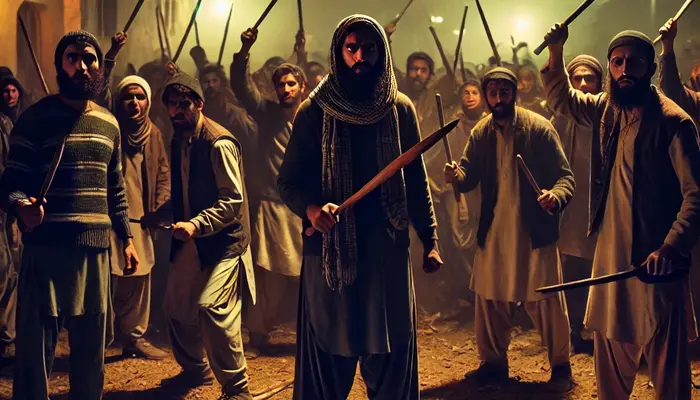
Case Summary
In Agra, Uttar Pradesh, a Hindu man named Jitendra Kumar and his mother, Guddi Devi, were brutally attacked by a group of Muslim men near a mosque. The dispute arose from a mere non-religious altercation. According to media reports, this incident took place near the Burani Mosque. Jitendra Kumar, who resided near the mosque in the Trans-Yamuna Police Station area, stated that he was returning home from the market with his mother, Guddi Devi, at 9 pm on Friday, 17th October 2025. During this time, the Muslim accused, Kalua Khan, a nearby resident, along with his son and other Muslim men, surrounded them and assaulted them with sticks. Guddi Devi was dragged onto the road and beaten, injuring both her and Jitendra. Hearing the noise, local Hindus from the neighbourhood came to the scene, causing the attackers to flee while threatening them. This incident heightened tensions between the Hindu and Muslim communities in the area. Reports confirmed that the dispute between Jitendra and Kalua Khan began while they were drinking alcohol at a nearby liquor shop. An argument escalated into a fight. When family members arrived after receiving the information, they also became involved in the altercation. Following this, the accused attacked Jitendra and Guddi near the Burani Mosque. Anil Kumar Sharma, district coordinator of Bajrang Dal, a Hindu organisation, along with other officials, reached the police station with the victim's family and demanded police action. The police assured that action would be taken and arranged for medical examinations of the injured. Anil Kumar Sharma warned that if the police did not arrest the accused, a protest would be held at the Trans-Yamuna Police Station on Saturday, 18th October 2025. Following this, the Station House Officer Rohit Kumar confirmed that the injured Hindu victims had been medically examined.
Why it is Hate Crime ?
This case has been added to the tracker under the primary category- Attack not resulting in death. The subcategory selected is- Communal Clash/Attack. Communal clash is a form of collective violence that involves clashes between groups belonging to different religious identities. For a communal clash between Hindus and non-Hindus to qualify as a religiously motivated hate crime, the trigger of the violence itself would have to be anti-Hindu in essence. For example, if there is a Hindu religious procession that comes under attack from a non-Hindu mob and after the initial attack, Hindus retaliate in self-defence, leading to a communal clash between the two religious communities. While at a later stage, both communities are involved in the clash/violence, the initial trigger of the violence was by the non-Hindu mob against the Hindus and therefore, it could safely be termed as an anti-Hindu violence. Further, the trigger would also have to be religiously motivated. In the cited example, the attack by the non-Hindu mob was against religious processions and therefore, can be concluded to be religiously motivated. In some cases, the trigger may be non-religious, however, it develops into religious violence against Hindus at a later stage. In such cases too, the foundational animosity towards Hindus becomes the motivating factor of the crime and therefore, it would be classified as a religiously motivated hate crime against Hindus under this category. The other subcategory selected is- Attacked for crossing 'Muslim area'. One of the reasons that Hindus get attacked unprovoked specifically by Islamists is for crossing ‘Muslim areas’. Essentially, Muslim mobs often attack Hindus crossing or present in certain areas which have a majority Muslim population. It has often been cited as one of the reasons to blame Hindus for attacks against themselves, signalling that Hindus displaying religious symbols, taking our religious processions or crossing any area which is dominated by Muslim residents is a provocation in and of itself. These areas are mostly ghettoized areas where mobs mobilize quickly to attack Hindus for a variety of reasons like playing music during a religious procession, crossing a mosque, wearing a tilak or any other religious symbol in a Muslim-dominated area, praying at a local temple in that area etc. There have been cases where the few local Hindus of that area have been attacked on their way to the Temple for prayers as well, simply because the area is considered a Muslim-dominated area. Several times, it is entirely possible that the immediate trigger for the violence against Hindus was non-religious in nature, however, the violence became religiously motivated in nature because the area was Muslim dominated and the residents on the whole harboured animosity towards Hindus, evidenced from the actions of the mob, the slogans, and the nature of the attack. Such crimes are motivated by the religious identity of the victims and are therefore classified as hate crimes under this category. In this case, the violent attack on Jitendra Kumar and his mother, Guddi Devi, must be understood as a deeply religiously motivated hate crime due to the clear and disproportionate brutality inflicted upon them by the Muslim perpetrators. While the initial dispute originated from a personal altercation involving a disagreement during alcohol consumption between Jitendra and Kalua Khan, the scale and severity of violence that followed cannot be dismissed as mere fallout from a personal quarrel. The attackers’ choice to unleash physical brutality specifically targeting a Hindu man and his mother, using sticks and dragging Guddi onto the road to assault her, signals that the act was imbued with religious animosity. This disproportionate response exemplifies the communal undertones underlying the incident, illustrating that the violence was driven by hatred towards the victims’ religious identity rather than simply retaliation for a personal grievance. The manner in which Guddi Devi was dragged mercilessly onto the road and subjected to a vicious beating alongside her son further highlights the religious animosity at the heart of this attack. The attackers did not just physically assault Jitendra but extended their violence to his elderly mother, demonstrating a disturbing and intensified level of hatred and cruelty. Such ferocity goes beyond any normal dispute resolution and exposes the intent to cause harm rooted in communal hostility. The Muslim group’s actions revealed an animus not simply towards Jitendra as an individual but as a representative of his Hindu religious community. This violent targeting of a vulnerable Hindu mother and son encapsulates the communal tensions and malice festering beneath the surface of what might be presented as a personal disagreement. Additionally, the premeditated nature of this assault is glaringly evident in the fact that Kalua Khan, his son, and their accomplices were armed with sticks before the attack. This readiness to resort to organised violence reflects a calculated and deliberate targeting of Jitendra and Guddi Devi based on their religious identity. Their preparedness for a brutal attack decisively negates the possibility that this was a spontaneous act of rage; instead, it underlines a planned assault aimed at intimidating and harming the victims because of their Hindu faith. Such communal targeting makes this incident a clear example of a religiously motivated criminal act. The incident occurred near a mosque, and it is crucial to note that Muslims often consider areas near mosques, dargahs, or where their community is in the majority as "Muslim areas." This reveals a disturbing sense of Islamic supremacy held by the attackers, who viewed the area near the mosque as an exclusive zone where non-Muslims, particularly Hindus, were unwelcome. This sense of entitlement and superiority reflects deep-seated prejudice and an attempt to assert religious dominance over public spaces. The assault on the Hindu victims was motivated by this supremacist ideology, with Muslims in the area looking down upon Hindus and believing they had the right to control who could move freely in ‘their area.’ Such an act illustrates a dangerous mindset rooted in exclusion, intolerance, and religious animosity, making this case an ideal example of a crime motivated by religious animosity. Notably, the Hinduphobia Tracker has previously documented numerous instances where non-religious triggers sparked communal violence against Hindus by Muslims. For example, on 30th May 2025, in Dewran Garhiya village, Farrukhabad, Uttar Pradesh, a minor verbal altercation between two Hindu men and a Muslim man escalated into a violent assault by a large Muslim mob, inflaming communal tensions. In another incident on 7th July 2025 in Bhavna Nagar, Raipur, Chhattisgarh, a Hindu family was brutally attacked by a Muslim mob of nearly 80 people following a simple dispute over garbage disposal. Victims suffered severe injuries from sharp weapons. Similarly, on 22nd June 2025 in Ghongade Basti, Solapur, Maharashtra, a minor road dispute led to a targeted communal assault on Hindus by a large Muslim mob, sparking widespread clashes. Given that this particular incident meets the parameters of a hate crime, and considering the previous instances of such communal attacks, this case has been added to the hate crime database of the Hinduphobia Tracker. Disclaimer: Media reports state that, along with Kalua Khan and his son, multiple other Muslim accomplices were involved in attacking Jitendra Kumar and Guddi Devi. However, as the exact number of perpetrators has not been specified in these reports, for the purpose of documentation, the victim count has been recorded as '2', referring specifically to the Muslim accused, Kalua and his son.
Victim Details
Total Victim
2
Deceased
0
Gender
- Male 1
- Female 1
- Third Gender 0
- Unknown 0
Caste
- SC/ST 0
- OBC 0
- General 0
- Unknown 2
Age Group
- Minor 0
- Adult 2
- Senior Citizen 0
- Unknown 0


Case Status
Complaint filed


Perpetrators Details
Perpetrators
Muslim Extremists
Perpetrators Range
From 2 To 5
Perpetrators Gender
male
 Sources




