Hindu man forced to chant Islamic supremacist slogan, assaulted for saying "Jai Shri Ram" by Muslims amidst their 'I Love Mohammad' campaign
 Jalandhar, Punjab, India
  2 October, 2025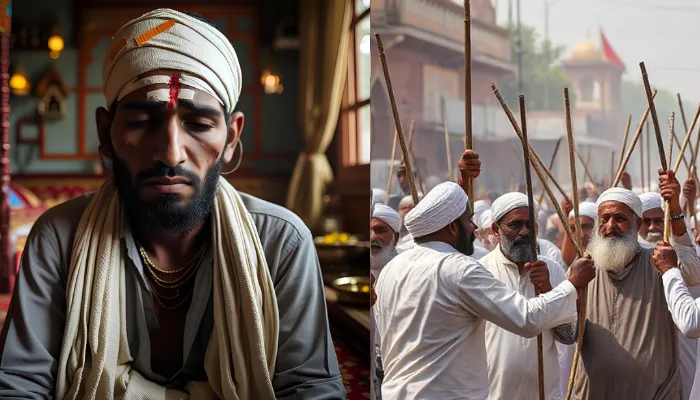
Case Summary
In Jalandhar, Punjab, a Hindu man named Yogesh was forced by a Muslim mob to chant "Allah Hu Akbar", an Islamic supremacist slogan. When he refused and instead chanted "Jai Shri Ram," he was physically assaulted by members of the Muslim community. This incident occurred amidst a protest by Muslims related to the "I Love Mohammad" poster controversy. According to media reports, the victim submitted a written complaint to the police, stating that at around 4:00 pm, while passing near Press Club Chowk in Jalandhar, he encountered members of the Muslim community marching with "I Love Mohammad" posters. During this, a man chanted "Jai Shri Ram," which Yogesh repeated. Following this, some Muslims stopped him and demanded he chant "Allah Hu Akbar." He replied, "I am a Hindu and will chant 'Jai Shri Ram.'" Upon chanting "Jai Shri Ram," he was assaulted by members of the Muslim community. The victim appealed for strict action against those who attacked him. Hindu organisations declared protests until justice was served to Yogesh. Following the incident, the atmosphere in Jalandhar remained tense. Police presence increased significantly, with all anti-social activities closely monitored. The victim stated that the police at Baradari police station initially took no action following his complaint, leading him to coordinate with BJP workers and Hindu organisations. After the video of the attack went viral online, BJP leaders and Hindu organisation representatives staged protests, including a 40-minute sit-in outside the Deputy Commissioner's office and an hour-long sit-in at BMC Chowk. Advocate Naeem Khan, head of the Muslim Organisation Punjab, claimed that during a peaceful march holding "I Love Mohammad" banners, a young man riding an Activa scooter collided with members of the Muslim community. Khan claimed that the man told Muslims, "Your place is not in Punjab, but in Pakistan. If you want to live in Punjab, chant 'Jai Shri Ram'." The "Jai Shri Ram" chant was repeated by Yogesh, which escalated tensions. Khan claimed that Yogesh admitted his mistake and the matter was resolved, but renewed clashes occurred later. Jalandhar Deputy Commissioner of Police, Naresh Dogra, assured that necessary legal actions will be taken against the accused. This incident did not emerge in isolation but forms part of a larger pattern of organised agitation by Muslims across the country, centred on the “I Love Muhammad” campaign. The campaign itself arose from a controversy deliberately misrepresented by Muslim groups. On 5th September 2025, violence broke out in Rawatpur, Kanpur, during a Barawafat procession, when Muslims attacked and defaced Hindu posters. This was following a complaint by Hindus, where police removed an “I Love Muhammad” poster that had been fixed on the Ram Navami gate on 4th September 2025. An FIR was then lodged against Muslims for vandalising Hindu posters, but the Muslims twisted the narrative, claiming that the police action was taken against Muslims for merely putting up “I Love Muhammad” posters. This distortion became the rallying cry for Muslims to organise protests and violence across several districts. Slogans of “Sar Tan Se Juda” were raised in rallies, and Hindus, as well as police personnel, were attacked. This was an orchestrated campaign by Muslims to openly challenge law and order while asserting Islamic supremacy.
Why it is Hate Crime ?
This case has been added to the tracker under the primary category- Attack not resulting in death. Within this, the subcategory selected is- Attacked for Hindu identity. In several cases, Hindus are attacked merely for their Hindu identity without any perceived provocation. A classic example of this category of religiously motivated hate crime is a murder in 2016. 7 ISIS terrorists were convicted for shooting a school principal in Kanpur because they got ‘triggered’ seeing the Kalava on his wrist and tilak that he had put. In this, the Hindu victim had offered no provocation except for his Hindu religious identity. The motivation for the murder was purely religious, driven by religious supremacy. Such cases where Hindus are targeted merely for their religious identity would be documented as a hate crime under this category. The other subcategory selected is- Communal Clash/ Attack. Communal clash is a form of collective violence that involves clashes between groups belonging to different religious identities. For a communal clash between Hindus and non-Hindus to qualify as a religiously motivated hate crime, the trigger of the violence itself would have to be anti-Hindu in essence. For example, if there is a Hindu religious procession that comes under attack from a non-Hindu mob and after the initial attack, Hindus retaliate in self-defence, leading to a communal clash between the two religious communities. While at a later stage, both communities are involved in the clash/violence, the initial trigger of the violence was by the non-Hindu mob against the Hindus and therefore, it could safely be termed as an anti-Hindu violence. Further, the trigger would also have to be religiously motivated. In the cited example, the attack by the non-Hindu mob was against religious processions and therefore, can be concluded to be religiously motivated. In some cases, the trigger may be non-religious, however, it develops into religious violence against Hindus at a later stage. In such cases too, the foundational animosity towards Hindus becomes the motivating factor of the crime and therefore, it would be classified as a religiously motivated hate crime against Hindus under this category. This incident constitutes a clear case of a hate crime against Hindus. The Hindu man was attacked simply for chanting "Jai Shri Ram," a religious slogan invoking Lord Ram, which he repeated after another man during a Muslim protest. If the Muslim protestors had a genuine issue, they could have pursued legal action or handled the matter through mature dialogue. Instead, they resorted to violent behaviour, forcing the Hindu man to chant "Allahu Akbar," an Islamic supremacist slogan, and physically assaulting him when he refused and continued chanting "Jai Shri Ram." This assault targeted him explicitly for his Hindu identity and faith, making it a religiously motivated crime. The attack crosses into communal hate crime territory because the violence was provoked by a religious slogan central to the Hindu faith and devotion. "Jai Shri Ram" means "Victory to Lord Ram" and is a phrase deeply revered by Hindus as an expression of faith. Assaulting someone for uttering such a slogan reveals religiously motivated hostility and intent to suppress Hindu religious expression. The Muslim protestors claimed that the Hindu victim provoked them by chanting "Jai Shri Ram." The critical question is why such a benign Hindu chant would be perceived as provocative. This supposed provocation exposes an underlying intolerance and hostility towards Hindu religious slogans. Even if the Muslims found it provocative, they had legal avenues available to resolve the matter peacefully. Instead, the attackers took the law into their own hands, violently assaulting the Hindu man and forcing him to chant an Islamic supremacist phrase. "Allahu Akbar," meaning "God is great," is an Islamic declaration affirming the supremacy of Allah. Compelling a Hindu to utter this phrase is a direct assault on his religious identity and freedom, constituting a hate crime. Unlike "Jai Shri Ram," which is an expression of reverence and praise to Lord Ram — a central figure symbolising righteousness and virtue in Hinduism — "Allahu Akbar" asserts Islamic supremacy over other faiths. Forcing a Hindu to chant this slogan is an act of religious coercion and an attack on his faith, making it a religiously motivated crime. Moreover, this violence unfolded against the backdrop of the "I Love Mohammad" poster controversy, which itself was an anti-Hindu provocation. Henceforth, this cannot be examined in isolation; it belongs to a wider sequence of anti-Hindu events. The backdrop of this controversy lies in the incident of 4–5 September 2025, when, during a Barawafat procession in Rawatpur, Kanpur, Muslims vandalised Hindu posters and banners. Following this, a complaint was filed by Hindus, and action was taken against rioting Muslims. A day earlier, police had removed an “I Love Muhammad” poster that had been illegally fixed on the Ram Navami gate. The FIR was lodged against Muslims for vandalising Hindu religious posters. However, this straightforward case of vandalism was deliberately distorted by Muslims, who portrayed themselves as victims and claimed that police action had been taken only because they displayed “I Love Muhammad” posters. This misrepresentation was not incidental but calculated, for it became the rallying point for widespread mobilisation across Uttar Pradesh and beyond. In the weeks that followed, Muslims organised rallies and agitations where lethal slogans such as “Sar Tan Se Juda” were openly raised. These slogans are not symbolic protests but direct calls for beheading, a form of religiously sanctioned violence. Hindus were attacked in several places, and even police attempting to maintain order were assaulted. Given that this case meets the parameters of a religiously motivated hate crime, it is being added to the hate crime database of the Hinduphobia Tracker.
Victim Details
Total Victim
1
Deceased
0
Gender
- Male 1
- Female 0
- Third Gender 0
- Unknown 0
Caste
- SC/ST 0
- OBC 0
- General 0
- Unknown 1
Age Group
- Minor 0
- Adult 1
- Senior Citizen 0
- Unknown 0


Case Status
Complaint filed


Perpetrators Details
Perpetrators
Muslim Extremists
Perpetrators Range
Unknown
Perpetrators Gender
unknown
 Sources




