Hindu deities mocked and poor hindu villagers coerced to convert to Christianity in Fatehpur, UP
 Fatehpur, Uttar Pradesh, India
  20 December, 2025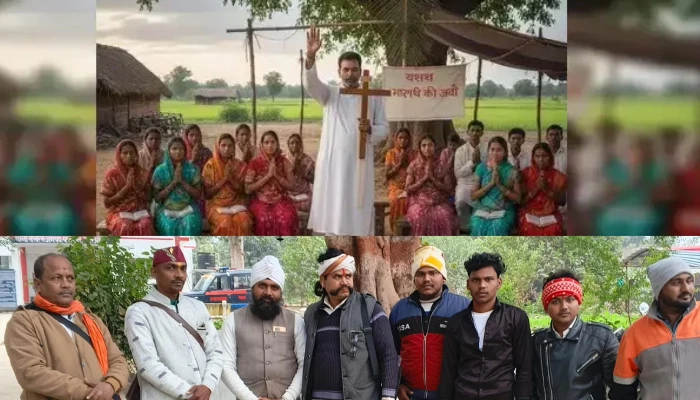
Case Summary
In the Khakhreru region in Fatehpur, Uttar Pradesh, poor and vulnerable Hindus were targeted to convert by mocking Hindu deities and by promising job offers, medical treatment at the home of village resident Balraj Paswan on December 21, 2025. Those who refused were threatened and coerced into converting. As per the complaint filed by Bihari Lal, one of the victims, Sunil Paswan, Sangeeta Paswan, Balraj Paswan, and Ram Singh, lured and coerced poor and vulnerable people in the village and neighbouring area into converting to Christianity by promising free education, medical treatment, jobs, and good marriages for their children. They also offered money to people who converted. He also stated in the complaint that on December 21, 2025, Anil Kumar Paswan and his associates made derogatory remarks about Hindu deities at Balraj Paswan's home. The complainant was also pressured to convert, but refused and expressed his faith in Hinduism. When he resisted, the accused threatened to kill him, verbally abused him, and also physically assaulted him. Nearly 40 to 50 poor and vulnerable Hindu men and women were lured into religious conversions at the home of village resident Balraj Paswan. When members of the Hindu organisation, Vishwa Hindu Parishad, were informed about the illegal prayer meeting, they immediately reached the site and confronted the accused. Meanwhile, the police were informed, who reached the spot and recovered books related to Christian missionaries, an e-rickshaw, and five motorcycles from the scene. Several people were brought to the police station and questioned. Based on Bihari Lal's complaint, the police registered a case and began an investigation. Station House Officer Vidya Prakash Singh stated that on December 22, 2025, the accused Anil Kumar Paswan (son of Jhalli Paswan, resident of Bhimpur village, age about 27 years) and Sangeeta Paswan (wife of Balraj Singh, resident of Lohangapur village, age about 45 years) were arrested under FIR No. 289/2025, sections 115(2), 352, 351(2) BNS and 3/5(1) of the Uttar Pradesh Prohibition of Unlawful Religious Conversion Act, 2021.
Why it is Hate Crime ?
This case is documented under two primary categories: Predatory Proselytisation, under which it is noted in three sub-categories. The first subcategory is: Conversion/attempts to convert by inducement. Predatory Proselytisation is not just limited to threat, harassment, force and violence, but it also has contours of stealth. In several cases, the Hindu victim is exploited to convert, with non-Hindus taking advantage of their poverty. In such cases, the Hindu victim who is suffering financially is offered monetary benefits, including lucrative offers for jobs, health treatment, education, etc, to induce the victim into changing his/her religion. In such cases, the religious identity of the victim and the aim to disenfranchise him from his faith form the heart of the crime. Also, taking advantage of and exploiting an individual’s economic vulnerabilities is widely acknowledged as exploitation, forms of which are often penalised by law. Such cases, therefore, are considered religiously motivated hate crimes since the victim’s religious identity forms the very heart of the crime itself. The second subcategory selected is- Attempting to convert/converting by denigrating Hinduism. In several cases, Hindus are converted or an attempt is made to convert Hindus by denigrating their faith, Hinduism. In such cases, the Hindus associate with the non-Hindu perpetrators often by choice and then, the attempt to convert them by insulting their faith, showing the faith down etc begins. An example of this would be a non-Hindu gathering where the Hindus are attending the gathering of their own free will. However, once they attend the gathering, there is an explicit attempt to convert them by abusing their faith and hailing the faith of the perpetrator. The denigration of the Hindu faith is often based on misrepresentation of the Hindu faith, its doctrine and scriptures and insult to espoused traditions if not blatant lies about Hindu beliefs and ways. Such conversions or attempts at conversions are driven by animosity towards the Hindu faith and are therefore documented as religiously motivated hate crimes. The third subcategory selected is- Harassment, threat, coercion for conversion. Harassment covers a wide range of behaviours of an offensive nature. It is commonly understood as behaviour that demeans, humiliates, and intimidates a person, including threats and coercion. Harassment and threats, in this case, find their root on discriminatory grounds, which has the effect of nullifying a person’s rights or infringing upon his freedom to exercise his right specifically owing to the victim’s religious identity. Verbal and physical threats and psychological or physical harassment are often used against Hindu victims because they choose to practice their professed religion. Religious harassment also includes forced and involuntary conversions by harassment, threats or coercion. Coercion includes intimidatory tactics like force-feeding a Hindu victim beef to convert to another religion, forceful circumcision, etc. In several cases documented, non-Hindu perpetrators or those who harbour specific animosity towards Hinduism, harass victims simply based on their religious identity. Such cases often also include harassment to ensure the Hindu victim abandons his/her professed religion and adopts the religion of the perpetrator. Such cases, where Hindu victims are harassed to convert to the perpetrator’s religion, are rooted in animosity towards the victim’s religious identity and are therefore documented as religiously motivated hate crimes. Another selected primary category is: Attack not resulting in death. Under this, the secondary category selected is: Attack for refusal to convert. When there is pressure, threat or coercion employed upon the Hindu victim to convert to a different religion, in several cases, the victim refuses to succumb to the pressure/threats. Once the victim refuses, the perpetrator proceeds to attack/assault the victim owing to his/her refusal to convert. In such cases, the pressure/threat/intimidation/coercion/violence itself is driven by animosity towards the victim’s Hindu faith. The violenc,e th, en is another hate crime driven by the victim’s refusal to abandon his professed faith, Hinduism, and convert to the religion of a non-Hindu perpetrator. Since the victim’s faith is at the heart of the pressure to convert and the ensuing violence towards the victim, such cases are considered religiously motivated hate crimes. Now the accused attempted to force the Hindu victim to renounce his religion and convert to Christianity. Pressuring a Hindu individual to discard his religious faith and embrace another is a direct attack on his religious identity and dignity. It is not a matter of personal choice; it is coercion rooted in hostility towards the victim's Hindu identity. Such an attempt reflects religious animosity because the act is not simply about personal differences but about erasing the victim’s Hindu faith, making it a religiously motivated crime. The facts of this case indicate that religion was not incidental but central to the conduct described in the complaint. According to the complainant, economically vulnerable Hindus were gathered and offered free education, medical treatment, employment opportunities, financial assistance, and improved marriage prospects for their children in exchange for converting. When material benefits are tied directly to a change of faith, especially among poor and socially vulnerable individuals, the element of inducement becomes inseparable from religious targeting. The complaint further states that derogatory remarks were made about Hindu deities during the gathering. Mocking or belittling the religious symbols of a community while simultaneously encouraging adherence to another faith transforms the act from simple proselytisation into one that carries hostility toward the victim’s existing religious identity. It reflects not merely an attempt to promote another belief system, but an attempt to undermine and degrade the one the victims already follow. Crucially, when the complainant refused to convert and reaffirmed his faith in Hinduism, he was threatened with death, verbally abused, and physically assaulted. The sequence of events is significant. The escalation occurred only after he declined to abandon his religion. This establishes a direct link between his continued adherence to Hinduism and the violence that followed. The refusal to convert appears to have been the trigger for threats and assault. The reported scale of the activity, involving dozens of poor and vulnerable Hindus at a single residence, further indicates that the effort was structured rather than incidental. Law enforcement registered the case under provisions of the Uttar Pradesh Prohibition of Unlawful Religious Conversion Act, 2021, reflecting that authorities considered the matter serious enough to invoke statutory protections against unlawful conversion. Taken together, the promises of material benefits, the denigration of Hindu deities, the threats upon refusal, and the physical assault tied directly to the victim’s decision not to change his faith demonstrate that religious identity was the focal point of the confrontation. The harm described was directly connected to the victims being Hindus and resisting pressure to relinquish that identity. Disclaimer: The Hinduphobia Tracker records incidents based on when an event occurred or when the victim's ordeal began. It is important to clarify that none of the media sources covering this case has specified the exact date when the conversion activities began. Therefore, for documentation purposes, we have recorded the date based on when the incident was reported in the media, 21 December 2025. Disclaimer: In this case, reports state that nearly 40 to 50 poor and vulnerable Hindus were gathered and targeted for religious conversion at a single residence. However, the exact number of individuals directly affected has not been officially specified. Due to this lack of precise numerical confirmation, the total number of individuals impacted in this incident is recorded as 50. Further, since no specific gender breakdown is provided, we have evenly divided the count, recording 25 male and 25 female victims for the sake of consistency in documentation.
Victim Details
Total Victim
50
Deceased
0
Gender
- Male 25
- Female 25
- Third Gender 0
- Unknown 0
Caste
- SC/ST 0
- OBC 0
- General 0
- Unknown 50
Age Group
- Minor 0
- Adult 0
- Senior Citizen 0
- Unknown 50


Case Status
Complaint filed


Perpetrators Details
Perpetrators
Christian Extremists
Perpetrators Range
From 2 To 5
 Sources




