Hindu religious event defiled: Muslims masquerading as Hindus rob women devotees during Bhagwat Katha gatherings
 Bijnor, Uttar Pradesh, India
  23 September, 2025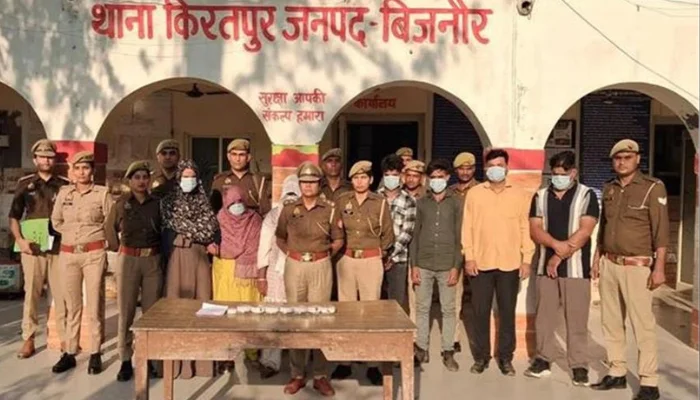
Case Summary
In Kiratpur town of Bijnor district in the state of Uttar Pradesh, a Hindu religious event, Bhagwat Katha gatherings (Hindu Puranic storytelling sessions), was desecrated by Muslims who had masqueraded as Hindus. The accused also robbed the female devotees present at the gathering. According to media reports, the incident came to light when the police uncovered a Muslim gang that had attended several Hindu Katha events dressed in saffron robes. They targeted women devotees by robbing them of their jewellery and then fled from the gatherings. Several stolen ornaments were later recovered from the accused. The group wore saffron robes to appear unsuspecting and blend in with Hindu devotees. Using the religious attire as a disguise, they surrounded women, took advantage of the large crowds, and snatched their chains before slipping away. The thieves were so skilful that many women were unaware they had been robbed until after the events. The matter reached the police after a Bhagwat Katha held in Kiratpur on 24th September 2025 was targeted by the group. During this event, gold chains belonging to three women were stolen on the same day. A report was lodged at the police station. The husband of one of the victims stated that someone had cut a three-tola gold chain from his wife’s neck. On the same day, two other people also reported that their gold chains had been stolen. The police formed two teams and initiated a detailed investigation. During the inquiry, the police examined the closed-circuit television (CCTV) footage from the Bhagwat Katha venue. The video showed seven people sitting around the three women whose chains were taken. Their behaviour appeared suspicious. Instead of listening to the discourse, they seemed distracted. The police retrieved their photographs and conducted verification using artificial intelligence (AI) technology, identifying three individuals as Rahimeen, Faisal, and Shahbaz. Further investigation revealed that all three were residents of Kiratpur. Rahimeen is the wife of Ashraf and the daughter of Akram; Shahbaz resides in the Mirdagan locality; and Faisal is from Hasanpur, near Kiratpur. When the police arrested and interrogated them, it emerged that this was part of their gang’s organised operation to steal gold jewellery by exploiting crowds at temples, religious events, and Hindu gatherings. During questioning, the accused disclosed additional gang members: Firoz Khan, a resident of Mustafabad in Delhi; Pooja alias Munni, a resident of Ghaziabad; Arif, a resident of Hapur; and Rekha, a resident of Kharkhoda in Meerut district. Police teams subsequently arrested the remaining members from the respective locations mentioned by the accused. A Scorpio car, four gold bracelets, two pairs of gold tops, gold earrings, a gold chain, and twenty-nine thousand rupees in cash were recovered from their possession.
Why it is Hate Crime ?
This case has been added to the tracker under the primary category- Attack on Hindu religious representations. Within this, the subcategory selected is- Defiling Religious customs. Sanatan Dharma is not a religion of one book, which is to say that while it has religious scriptures that form the central tenets of the faith, there are several traditions followed through thousands of years, mostly passed from generation to generation orally. There are several such customs and traditions that are followed by various Hindus and Hindu sects. Defiling of these traditions and customs is a breach of an individual or group’s religious practices. Such practices can range from dietary restrictions like not eating non-vegetarian food for a certain period of the year, not eating non-vegetarian food at all, not eating beef since the cow is considered holy in Hinduism, the sanctity of religious customs followed in the house (like many ISCKON devotees), etc. Any malicious action leading to the breach of such traditions or defilement of these traditions owing to animosity towards the faith or for the sake of activism stems not only from the lack of faith in the religion itself but also from disregard for the faith of the devotees who follow the customs/traditions and implicit bias against the faith, the tradition itself. Since these specific traditions are central to the faith of the devotees of that specific sect of Hindus, any non-compliance with these traditional rules would be considered a religiously motivated hate crime. This incident was a glaring instance of a religiously motivated crime, striking at the very heart of Hindu religious identity and the sanctity of the Bhagwat Katha, one of Hinduism’s most revered spiritual discourses. The actions of the Muslim perpetrators, who deliberately posed as Hindu devotees during this sacred gathering, went beyond ordinary theft. Their deceit was a calculated attempt to infiltrate and defile a space of worship that carries profound meaning for millions of Hindus. By hiding behind saffron robes and adopting Hindu religious symbols, the assailants not only committed robbery but also violated the spiritual sanctity and collective faith of the devotees. Their conscious decision to masquerade as Hindus exposed a deliberate intent to mock and profane a sacred gathering dedicated to divine narration and devotion. The Bhagwat Katha, a hallowed recitation centred on the glories of Lord Vishnu and the teachings of the Bhagavata Purana, embodies purity and reverence. It is not merely a cultural observance but a deeply spiritual event where devotees come together for introspection, prayer, and upliftment of the soul. By targeting such an event while pretending to share its pious purpose, the perpetrators exhibited not only contempt for Hindu faith but open animosity toward its religious symbols and values. The saffron attire and tilak that they misused are powerful emblems of renunciation, divinity, and inner purity. Trivialising these sacred signs for deceitful purposes was an act of cultural violation that wounded the dignity of an entire faith community. Incidents like these cannot be viewed in isolation. They mirror a pattern of hostility directed at Hindu sacred spaces, revealing how acts of violence against religious gatherings often stem from bigotry rather than mere greed. Committing theft or defilement during a Bhagwat Katha is not a random offence—it is an assault on the Hindu way of worship, an act that undermines trust and harmony within the community. The Muslim impostors, by blending with genuine devotees, not only betrayed human decency but also risked inflaming tensions that threaten the delicate fabric of communal peace. The Hinduphobia Tracker has already documented similar occurrences in recent times. In July 2025, in Muzaffarnagar, Uttar Pradesh, the Hindu Kanwar Yatra—a sacred pilgrimage devoted to Lord Shiva—was desecrated in a comparable manner when Muslim men disguised themselves as Hindu pilgrims. They participated in the procession, committed thefts, and disrupted the sanctity of the religious journey, fuelling communal tensions. These recurring patterns of deceit and desecration clearly demonstrate that such offences are driven by religious hostility and not mere opportunistic crimes. The Kiratpur Bhagwat Katha desecration thus stands as a stark example of religiously motivated offence against Hindus and has been rightfully recorded in the Hinduphobia Tracker’s hate crime database. Disclaimer: While this tracker acknowledges that 7 individuals have been named as accused in this case, for documentation purposes, the religion of the perpetrators has been recorded as Muslim since the majority of the accused are Muslims. The religious identity of the other accused, Rekha and Pooja, has not been independently verified at the time of documentation. However, given that they were also complicit in the crime directed towards the Hindus, the case is recorded under a single perpetrator religion for consistency in categorisation. This approach ensures clarity in data representation without overlooking the involvement of other accused individuals.


Case Status
Arrested


Perpetrators Details
Perpetrators
Muslim Extremists
Perpetrators Range
From 5 to 10
Perpetrators Gender
both
 Sources




