Indian politician insults Hindu saint and declares Hindus do not exist as a collective identity
 Lucknow, Uttar Pradesh, India
  1 November, 2025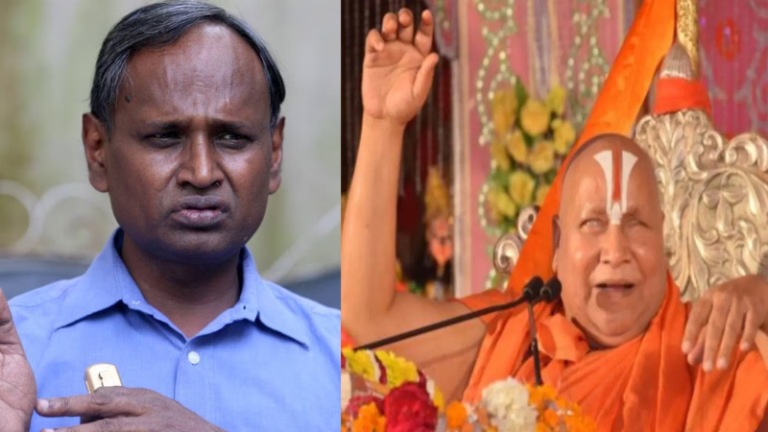
Case Summary
A Congress party politician named Udit Raj insulted Hindu saint Jagadguru Rambhadracharya in public and mocked his blindness, saying that he was not only blind by eyes but also blind in the mind. He accused Rambhadracharya of disrespecting the Constitution and also made statements against the Hindu religion. Udit Raj claimed that there is no single Hindu identity in India and only castes exist, and argued that if Hindus really existed, then Dr Ambedkar would not have become a Buddhist. He also accused the NDA alliance of wrongfully winning 70 to 80 seats in the 2024 Lok Sabha elections. This controversy started after Jagadguru Rambhadracharya spoke about transforming India into a Hindu Rashtra. He said that the Manusmriti was the first Constitution of the country, and Dr BR Ambedkar was not the only maker of the current Constitution. He further said that for making India a Hindu Rashtra, it would be necessary to win 470 seats in Parliament in order to amend the Constitution. He stressed that India should continue to have at least 80 per cent Hindu population and warned that if the situation did not improve, then Hindus would face persecution.
Why it is Hate Crime ?
The primary category in this case is: Hate speech against Hindus. The first subcategory under this is: Mocking/denigrating Hindu leaders. Hate speech is defined as any speech, gesture, conduct, writing, or display that is prejudicial against a specific individual and/or group of people, which is leading to or may lead to violence, prejudicial action or hate against that individual and/or group. Religious leaders are often seen as representatives of the community, especially, the community’s religious faith and beliefs. Mocking or denigrating a religious leader specifically owing to his religious identity and/or the religious rituals he observes can be considered hate speech because the motivating factor of the speech is animosity and/or dislike for what he represents – the religious beliefs and faith of the community. It is important to note that mere insulting words against an individual do not constitute hate speech. It is entirely possible that insulting words are used for an individual, however, the specific speech is not the result of religious hate and/or animosity towards the professed faith of the religious leader, but the individual himself. For the speech to be considered hate speech, the speech itself or the motivating factor behind the speech has to be religious in nature. Such speech which denigrates Hindu religious leaders specifically owing to animosity towards the faith they profess and the community faith they represent, will be treated as hate speech under this category. Another subcategory under this is: Anti-Hindu slurs, mocking faith. Anti-Hindu slurs and the deliberate mocking of the Hindu faith owing to religious animosity involve the usage of derogatory terms, stereotypes, or offensive references to religious practices, symbols, or figures. One of the common anti-Hindu slurs used against Hindus is “cow-worshipper” and “cow piss drinker”. The intention of using this term is to demean and mock Hindus as a group and their religious beliefs since Hindus consider the cow holy. Additionally, some symbols and the slurs attached to them have a historical context that exacerbates the insult, hate, stereotyping, dehumanisation and oppression against Hindus. Cow worship has been used for centuries to denigrate Hindus, insult their faith and oppress Hindus specifically as a religious group. There has been overwhelming documentation about how cow slaughter has been used to persecute Hindus with cow meat being thrown in temples and places of worship. There has also been overwhelming documentation where cow meat (beef) has been force-fed to Hindus to either forcefully convert them to Islam or denigrate their faith. Apart from cow worship, the Swastika – which holds deep religious significance for the Hindus – has also been misinterpreted and distorted to use as a slur against Hindus. Similarly, the worship of the Shivling has been used by supremacist ideologies and religions to denigrate Hindus owing to religious animosity. Such slurs and denigration stem out of inherent animosity and hate towards Hindus and their faith, therefore, it is categorised as hate speech targeted at Hindus specifically owing to their religious identity. This incident has been added to the Hinduphobia Tracker because it is a clear case where the attack is not on a political argument or a policy viewpoint, but on the core identity of Hindus and on one of Hindu Dharma’s highest respected figures. When Udit Raj used abusive language about Jagadguru Rambhadracharya and mocked his physical disability, he crossed from political disagreement into targeted humiliation of a Hindu spiritual authority. Furthermore, he combined that personal mockery with a direct attack on the Hindu identity itself by claiming there is no Hindu identity in India at all. This is an old strategy that Hinduphobia repeatedly uses: the attempt to erase the Hindu as a recognisable civilisational category, to reduce Hindus to fragmented caste units, and to deny the legitimacy of Hindu self-definition. Such statements have structural meaning. They delegitimise Hindu existence itself. They deny the right of Hindus to define themselves as a collective. This is a core feature of contemporary Hinduphobic rhetoric. Additionally, this present incident is not occurring in isolation. Udit Raj is a documented repeat offender. This same politician has previously targeted Hindu religious expressions and celebrations with similar contempt. He publicly criticised the Deepotsav celebrations in Ayodhya, where lakhs of lamps were lit on the banks of the Saryu during Diwali, and framed those Hindu rituals as acts that harmed Muslims and oppressed Dalits. This is a well-established pattern of hostile framing. He repeatedly portrays Hindu religious practices as inherently oppressive and presents Hindu devotional acts as direct violence against others. This consistent pattern transforms ordinary Hindu religious observance into an object of suspicion and blame. This is a classical Hinduphobic construction. In the present case, Udit Raj not only mocked a revered Hindu Guru but also attacked the Hindu faith as illegitimate. He claimed Hindus do not exist. He claimed Hindu identity is fictitious. He implied Hindu Dharma has no civilisational continuity. These are textbook features of Hinduphobia, which seeks to delegitimise Hindu existence. When such assertions are made by a senior political figure, the hostility is not merely personal. It is symbolic. It impacts discourse levels. It influences how Hindu existence is narrated in public forums. It also emboldens further contempt towards Hindu symbols and leaders. The Hinduphobia Tracker documents cases which demonstrate hostility directed at Hindu identity, Hindu practices, Hindu symbols, Hindu spaces, and Hindu persons because they represent Hindu Dharma. This case fits squarely into the category of verbal hatred and targeted delegitimisation of Hindu identity. It is a repeated pattern from the same political actor. It contributes to an environment of normalisation where abusing Hindu leaders, mocking Hindu faith claims, and presenting Hindu traditions as inherently oppressive becomes publicly acceptable. For these reasons, this case is included in the Tracker as a hate crime against Hindus in the form of rhetorical dehumanisation and sustained ideological hostility. Disclaimer: The number of victims in this report has been set to 1, since Jagadguru Rambhadracharya was personally abused by Udit Raj. Although the broader attack was directed at Hindus collectively, for documentation protocol, the individual victim count is taken as 1.
Victim Details
Total Victim
1
Deceased
0
Gender
- Male 1
- Female 0
- Third Gender 0
- Unknown 0
Caste
- SC/ST 0
- OBC 0
- General 0
- Unknown 1
Age Group
- Minor 0
- Adult 1
- Senior Citizen 0
- Unknown 0


Case Status
Unknown


Perpetrators Details
Perpetrators
Others
Perpetrators Range
One Person
Perpetrators Gender
male
 Sources




