Stones pelted at Garba event: Violence unleashed by Muslims following social media post by Hindu man saying 'I Love Mahadev'
 Gandhinagar, Gujarat, India
  23 September, 2025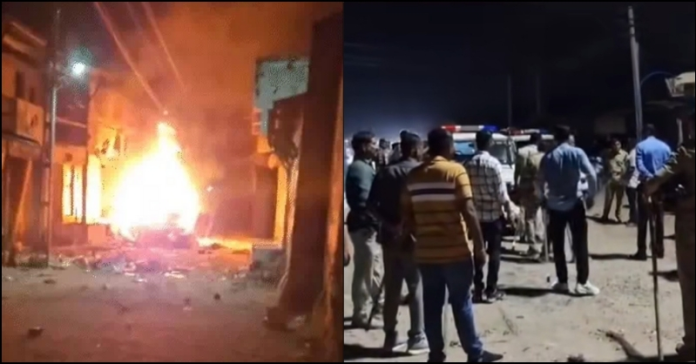
Case Summary
Hindus were attacked during Garba celebrations in Bahiyal village of Dahegam, Gandhinagar district, Gujarat, on the night of September 24, 2025. The violence was sparked by a social media post made by a Hindu youth, who had written “I Love Mahadev” and urged others to trend it in response to “I Love Mohammad.” The post enraged members of the Muslim community, who then approached the man’s shop, forcing him to flee for safety. In his absence, the shop was vandalised and set ablaze, as CCTV footage later showed several Muslim men breaking into the premises and causing damage. The unrest quickly escalated into full-scale violence. Stones were pelted, rods were wielded, and vehicles were set ablaze in a Garba event which was held nearby. More than eight vehicles belonging to Hindus were attacked, and one shop was completely burnt down. Even police officers who rushed to the spot to restore order were assaulted, with two police vehicles sustaining heavy damage. Eyewitness footage from the site captured chaotic scenes of men hurling stones, while the cries of a Hindu mother searching for her son in panic could be heard in the background, underlining the terror caused by the mob violence. According to a report in News Capital Gujarat, a shop owner, who was sitting outside at the time, recounted that a mob of nearly five thousand people descended during the night and deliberately targeted his shop. He explained that his village has only about 80 Hindu households, surrounded by a much larger Muslim population. The mob, armed with stones and weapons, stormed the premises and ransacked it. He further noted that the attackers were not limited to young men but also included minors who had joined the violence. The shop owner stated that after vandalising the shops, the Islamic fundamentalist mob turned its aggression towards the Garba celebrations, pelting stones at the gathering. They did not stop there. The attackers stormed the temple of Mahadev, creating chaos inside and looting the donation box. Reports also confirmed that the temple of Ambe Mata was damaged during the rampage. The incident was clearly targeted at the Hindu community, as the Hindu Man’s simple expression of devotion to Lord Shiva became the pretext for aggression. Following the attacks, a heavy police presence was deployed in Bahiyal to prevent further escalation. Authorities arrested around 60 perpetrators and began efforts to identify others. While no deaths were reported, the violence left the Hindu community shaken, with both physical injuries and the destruction of their property serving as stark reminders of the targeted nature of the assault. Police appealed to residents to refrain from posting inflammatory material online.
Why it is Hate Crime ?
The primary category in this case is: Attack not resulting in death. The first subcategory under this is: Attacked for Hindu identity. In several cases, Hindus are attacked merely for their Hindu identity without any perceived provocation. A classic example of this category of religiously motivated hate crime is a murder in 2016. 7 ISIS terrorists were convicted for shooting a school principal in Kanpur because they got ‘triggered’ seeing the Kalava on his wrist and tilak that he had put. In this, the Hindu victim had offered no provocation except for his Hindu religious identity. The motivation for the murder was purely religious, driven by religious supremacy. Such cases where Hindus are targeted merely for their religious identity would be documented as a hate crime under this category. The second subcategory under this is: Attack against Hindu devotees. Hindu devotees are a few of the easiest targets of religiously motivated hate crimes because during the festival/procession/puja etc, for non-Hindus it is easy to profile their victims on the basis of religion. Hindu devotees come under attack on several occasions by individual non-Hindus or mobs of non-Hindus owing to their animosity against Hinduism, its symbols and tradition/practices. There are several instances of Hindu devotees being attacked while they worship in temples or temporary religious structures, during religious processions, doing bhajan/kirtan/puja in their own homes, in the residential society etc. These attacks are perpetrated by non-Hindus primarily because of their animosity towards Hindus and their faith. In some cases, the trigger for the violence may be non-religious, however, there are two elements that make these hate crimes. First, the Hindus who come under attack are attacked violently while indulging in religious activity. Whether they are in a place of worship or not is immaterial to the crime. When individuals are attacked while indulging in religious practices, the attack in itself is a hindrance to their freedom to practice religion and therefore constitutes a hate crime. Secondly, religious supremacist doctrines and ideologies deem religious practices of Hindus to be offensive ab initio since they are considered “sinful” by these ideologies, worthy to be annihilated by force or coercion. Driven by these religious supremacist ideologies and doctrines, the attacks against Hindu devotees stem from intrinsic animosity towards Hinduism. In some cases, the trigger for the violence may be non-religious, however, it develops into a religiously motivated crime during the course of the violence. Since these attacks stem from animosity towards Hindus and Hinduism, they are considered religiously motivated hate crimes under this category. The third subcategory under this is: Communal clash/Attack. Communal clash is a form of collective violence that involves clashes between groups belonging to different religious identities. For a communal clash between Hindus and non-Hindus to qualify as a religiously motivated hate crime, the trigger of the violence itself would have to be anti-Hindu in essence. For example, if there is a Hindu religious procession that comes under attack from a non-Hindu mob and after the initial attack, Hindus retaliate in self-defence, leading to a communal clash between the two religious communities. While at a later stage, both communities are involved in the clash/violence, the initial trigger of the violence was by the non-Hindu mob against the Hindus and therefore, it could safely be termed as an anti-Hindu violence. Further, the trigger would also have to be religiously motivated. In the cited example, the attack by the non-Hindu mob was against religious processions and therefore, can be concluded to be religiously motivated. In some cases, the trigger may be non-religious, however, it develops into religious violence against Hindus at a later stage. In such cases too, the foundational animosity towards Hindus becomes the motivating factor of the crime and therefore, it would be classified as a religiously motivated hate crime against Hindus under this category. Another primary category in this case is: Attack on Hindu religious representations. The first subcategory under this is: Violence against religious structures or centres. In Hinduism, a religious structure is also considered divine. Hindus believe that not just the Deity but the religious structure itself is sacred. In this sub-category, we would document attacks against religious structures which are not consecrated temple spaces. Such religious spaces could be temporary in nature – for example – the religious spaces erected specifically for festivals like Durga Puja etc. This category would also document cases of attacks against religious centres. These spaces in their own right may not be ‘sacred’ per se, however, are often spaces where religious gurus live, religious teaching is imparted, or belong to religious institutions. Any attack against religious structures is a result of animosity towards the religion itself, which manifests itself through the religious spaces and therefore, such attacks are considered religiously motivated hate crimes. Religious centres are also manifestations of the religion, its teachings or gurus and therefore, attacks against such centres would be considered religiously motivated hate crimes. The second subcategory under this is: Attack on Temples. In Hinduism, a temple is the abode of the Deity. The Deity in the Temple is consecrated, thereby, making it a real, breathing entity. Hindus believe that not just the Deity but the temple premises itself are sacred to Hindus since Hindus hold the faith that the entire Temple space is an amalgamation of the divine energy of the deity. Given the central significance of Temples in Hindu Dharma, any attack against a Hindu Temple or its peripheral premises is an attack on the faith itself and is born out of animosity towards the faith, of which, the Temple is a central tenet. Any manner of attack against a Temple and/or its premises would therefore be considered a religiously motivated hate crime. This case has been included in the Hinduphobia Tracker because it represents a textbook instance of targeted violence against Hindus, their devotional practices, and their community spaces. The events in Bahiyal, Dahegam, were not a spontaneous quarrel but an eruption of calculated hostility directed at Hindus for expressing their religious identity. The Hindu man’s online remark, “I Love Mahadev,” was neither inflammatory nor derogatory. It was a devotional affirmation rooted in reverence for Lord Shiva. Yet, this peaceful and non-provocative post was seized upon by members of the Muslim community as justification to attack him, his shop, and eventually Hindus participating in Garba festivities. The background to this violence reveals how the so-called “I Love Muhammad” campaign itself was built upon a false premise. On 5 September 2025, a case was filed in Kanpur against Muslims for vandalising Hindu posters during the Barawafat procession. However, Muslims deliberately distorted the narrative, falsely claiming that the FIR had been lodged for merely putting up “I Love Muhammad” posters. This distortion became the rallying cry for widespread mobilisation. Across the country, rallies were organised where lethal slogans like “Sar Tan Se Juda” (behead them) were raised, targeting Hindus and even the police who attempted to maintain order. Thus, when Hindus responded peacefully with “I Love Mahadev,” it was not an act of aggression but an expression of devotion. The subsequent Muslim outrage, attacks, and destruction were not a response to provocation but the continuation of an organised, religiously motivated campaign of intimidation. The violence in Bahiyal, therefore, falls under multiple categories of religiously motivated hate crimes. First, Hindus were attacked for their religious identity alone. The Hindu youth had offered no provocation beyond affirming his faith, echoing past cases where Hindus have been assaulted or even murdered merely for wearing a tilak, tying a kalava, or chanting the name of their deities. Second, the attack specifically targeted Hindu devotees engaged in Garba, a central religious practice during Navratri. Garba celebrations became the site of mob violence, with Hindu participants, vehicles, and property assaulted. This represents not only an assault on individuals but also a direct obstruction of the Hindu community’s freedom to worship and celebrate their traditions. Additionally, the case qualifies as a communal clash where the initial trigger was exclusively anti-Hindu in nature. The Hindu devotional post was met with Muslim mobilisation, vandalism, arson, and mob attacks, which escalated into a large-scale confrontation. While the violence later acquired the appearance of a clash, the origin was clearly rooted in animosity towards Hindu expression. The specific attack on the shops of Hindus, the burning of vehicles, the targeting of Garba participants, and the assault on police officers were all deliberate extensions of this hostility. A further layer of this hate crime lies in the attack on Hindu religious representations. Garba venues, though temporary structures, hold sacred value as spaces consecrated for worship and devotion during Navratri. The arson and violence in such spaces constitute attacks not merely on property but on Hindu religious expression itself. Hindus regard the act of worship and the structures built for such worship as sacred manifestations of their faith. Destroying them is a clear demonstration of religious hatred and supremacist animosity. The targeting of the Mahadev and Ambe Mata temples during the Bahiyal violence underscores the religiously motivated nature of the attacks. Temples in Hinduism are not merely buildings; they are sacred spaces where devotees perform worship, seek blessings, and participate in religious rituals. By deliberately storming the Mahadev and the Ambe Mata temple, creating chaos, and looting the donation box, the mob attacked not only property but the core of Hindu religious practice and faith. It cannot be dismissed as mere coincidence that the mob, which had already attacked shops belonging to Hindus and disrupted a Garba gathering, proceeded to target temples specifically. The sequence of events demonstrates a pattern of deliberate targeting: first the devotees, then their economic spaces, and finally their sacred sites. The attackers’ focus on religious symbols and spaces indicates an animus rooted in religious hatred. Attacking temples during an ongoing religious festival and in a location where Hindus were clearly practising their faith shows that the aggression was directed against Hinduism itself. Taken together, the Bahiyal incident cannot be reduced to a local skirmish. It is a link in a larger chain of escalating anti-Hindu actions, rooted in distortions of fact, supremacist ideology, and deliberate incitement. The so-called “I Love Muhammad” campaign, constructed on a fabricated grievance, was used to mobilise mobs and inflame anti-Hindu hatred. Hindus, when they expressed devotion to Lord Shiva, became the immediate victims of this wider campaign. The result was violence, arson, and terror deliberately aimed at silencing Hindu religious expression and punishing Hindus for their identity. For these reasons, the case has been added to the Hinduphobia Tracker. It represents not just a communal disturbance but a targeted, religiously motivated hate crime where Hindus were attacked for being Hindu, for practising Hindu devotion, and for refusing to be silenced in the face of intimidation. The man’s expression “I Love Mahadev” was an act of faith; the response it provoked revealed entrenched animosity, distortion, and an intent to suppress Hindu identity through violence. Disclaimer: Though the number of rioters has been stated to be in thousands by eyewitnesses, the number of perpetrators has been set to 60 for documentation purposes because the Police arrested 60 people following the incident. The number will be updated after more details emerge.


Case Status
Arrested


Perpetrators Details
Perpetrators
Muslim Extremists
Perpetrators Range
From 10 to 100
Perpetrators Gender
unknown
 Sources




