Hindus targeted with Sar Tan Se Juda slogans by Muslims over false narrative of “I Love Mohammad” poster removal
 Kannauj, Uttar Pradesh, India
  18 September, 2025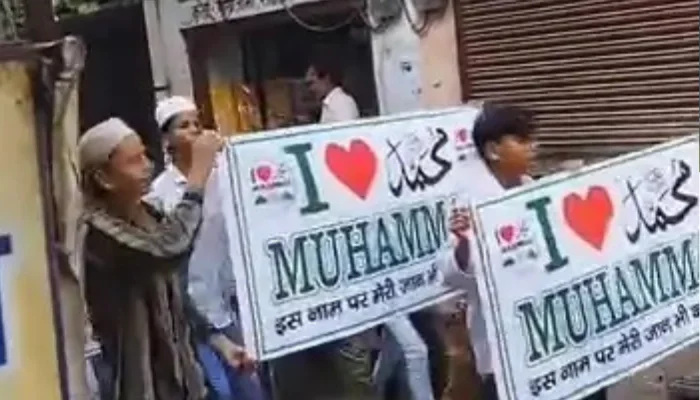
Case Summary
In Kannauj, Uttar Pradesh, the Hindu community was subjected to threats and intimidation through “Sar Tan Se Juda” slogans by members of the Muslim community. According to media reports, this incident occurred after Friday prayers on 19th September 2025 at the Safdarganj mosque. A group of Muslim youths held an unauthorised procession through the streets, raising these violent Sar Tan Se Juda slogans. The participants carried banners stating “I Love Mohammad.” A passerby recorded a video of the incident, which subsequently went viral on social media. Hindu organisations expressed strong displeasure following the video’s circulation. Initially, police denied the incident, but as social media outrage grew, they began efforts to identify and question some of the youths involved. Several Muslims were detained and taken to the police station for questioning. Despite the Local Intelligence Unit having forecast the possibility of such a procession, police vigilance was lacking, allowing the Muslim youths to disrupt peace in the city. The procession began near Pata Nala mosque in the Safdarganj area, passing through Lakhan Chhota Chowraha, Lakhan Tiraaha, Ramnarayan Chowraha, and the vegetable market before returning to the mosque. Attempts to contact the Superintendent of Police, Vinod Kumar, were unsuccessful as he was unreachable by phone. This incident came in the aftermath of another communal flashpoint in Uttar Pradesh. On 5th September 2025, during a Barawafat procession in Rawatpur, Kanpur, Muslim youths used sticks to deliberately damage Hindu posters displayed in a local neighbourhood. The act followed a dispute the previous day, when an “I Love Muhammad” signboard was installed in front of Zafar Wali Gali for the Barawafat observance. The local Hindu residents objected to this, leading police to relocate the board. Despite the police clarifying that the FIR in Kanpur was filed specifically for the destruction of Hindu posters, and not for removing the “I Love Muhammad” board, a distorted narrative spread across the country that the FIR was linked to the “I Love Muhammad” banner. This falsehood fuelled nationwide protests, where Sar Tan Se Juda slogans were raised by Muslims as a violent threat against Hindus.
Why it is Hate Crime ?
This case has been added to the tracker under the primary category- Hate speech against Hindus. Within this, the subcategory selected is- Violent threats. Violent threats, explicit, implicit or implied, is the most dangerous form of hate speech since it goes beyond discriminatory and prejudicial language to express the intent of causing harm to an individual or a group of people based on their religious identity and faith. There could be several different kinds of threats that are issued to Hindus based on religious animosity. An explicit threat would mean the direct threat of violence towards an individual Hindu, a group of Hindus or Hindus at large. Physical violence, death threats, threats of destruction of property belonging to Hindus and threats of genocide would mean explicit threats against Hindus for their religious identity. Implicit threats may not be a direct threat but implied through the use of symbols of actions – for example – in the Nupur Sharma case, other than explicit threats, there were also implicit threats when Islamists took to the streets to burn and beat her effigies. It implies that they want to do the same to Nupur Sharma – thereby is considered an implicit threat. Violent threats can be delivered in person, through letters, phone calls, graffiti, or increasingly through social media and other online platforms. It would be important to understand that a threat – explicit or implicit, online or offline – to an individual who happens to be a Hindu does not qualify as a religiously motivated threat. Such a threat, while vile and dangerous, could be owing to non-religious reasons and/or personal animosity. To qualify as a religiously motivated threat, it would need to exhibit an indication that the individual is being targeted for religious reasons and/or owing to his/her religious identity as a Hindu. This case has been added to the hate crime database because the use of the slogan “Sar Tan Se Juda” constitutes an explicit and religiously motivated threat directed at Hindus. “Gustakh-e-Rasool ki Ek hi saza, sar tan se Juda, sar tan se Juda”, which translates to “There is only one punishment for being disrespectful to Rasool (Prophet Muhammad), their head separated from their torso, their head separated from the torso”, is an Islamist clarion call, that has become a staple feature of violent protests that have so far claimed the lives of at least 6 Hindus, including Kanhaiya Lal in Udaipur and Umesh Kolhe in Amravati, after Muslim fundamentalists, egged on by the dog-whistling of Alt News co-founder Mohammed Zubair against former BJP spokesperson Nupur Sharma, resorted to violence for what they perceived as ‘blasphemy’ against Prophet Muhammad. From Kanpur in India’s northern plains to the southern metropolis of Bengaluru, from Kolkata in the east to Hyderabad in the south, protests in the name of blasphemy have erupted in almost every corner of the country as Islamists took to the streets running amok and shouting “Sar Tan Se Juda” chants over the perceived belief of blasphemy against their Prophet. Though a radical Muslim outfit in Pakistan coined this slogan, it has gained popularity among Islamists in regions beyond its geographical origins. Over the years, we have seen large crowds of Islamists chanting the “Sar Tan Se Juda” slogan, which is nothing but a direct incitement to violence against Hindus, leading to murders committed in the name of blasphemy. The radicalised outcry is not merely a statement of disapproval; it is a call for the execution of an individual through beheading, based on their religious identity. When this slogan is raised, it sends a clear and terrifying message not just to the individual targeted but also to anyone else who might share similar views or dare to express them. This tactic of intimidation aims to silence dissent and suppress freedom of expression, particularly in religious discourse. It aims to instil fear in the broader community. Islamists use this tactic to settle personal scores with non-Muslims, particularly Hindus, by levelling fabricated charges of blasphemy against them, which causes outrage and paints a target on them. The underlying hatred and animosity toward non-Muslims, especially Hindus, drive these false blasphemy accusations as a means to subjugate and victimise them. The appearance of this slogan in Kannauj demonstrates how deeply this violent rhetoric has permeated. The repetition of it in public settings functions as a call for execution and sends a chilling warning to anyone, particularly Hindus, who might be perceived as dissenting or unwilling to submit to Islamist diktats. The very utterance of the slogan transforms public space into a theatre of intimidation, where Hindus are reminded that their lives could be taken for resisting Islamist assertions in civic disputes. This case is also significant because it illustrates how misinformation is weaponised to mobilise violence. The false claim that an FIR was filed against the “I Love Muhammad” banner in Kanpur became the pretext for raising these slogans in Kannauj. In reality, the FIR concerned the destruction of Hindu posters, yet the distortion was sufficient to provoke communal outrage and legitimise threats against Hindus. This pattern of twisting facts to generate anger and then channelling that anger into violent slogans reflects a deliberate mechanism of incitement. The slogan’s danger lies not merely in its verbal content but in its historical and contemporary consequences. Across South Asia, including India, there are multiple recorded cases where individuals accused of blasphemy have been murdered after such chants were raised by Muslim crowds. From school teachers to political leaders, victims have been executed in acts directly linked to the “Sar Tan Se Juda” call. It therefore serves as a bridge between verbal incitement and physical violence, collapsing the distance between threat and action. The classification of this case under “Hate speech against Hindus – Violent threats” is therefore justified. The slogan is not a matter of community pride or protest; it is an explicit incitement to religiously motivated killing. Its use in Kannauj, in connection with a false narrative that Hindus had insulted Islam, underscores the vulnerability of Hindu communities to targeted intimidation. It also illustrates the broader pattern where Islamist groups use blasphemy allegations, fabricated or exaggerated, as tools to victimise Hindus and silence expressions of Hindu identity in public life. By documenting this case, the Hinduphobia Tracker records both the local incident and its wider ideological lineage. It demonstrates how a slogan that originated in Pakistan’s radical Islamist circles has now become a transnational chant of intimidation against Hindus. It highlights the continuity between speech and violence, reminding us that words which openly prescribe beheading cannot be dismissed as mere rhetoric. They are violent threats in their most direct form, and their repetition in Kannauj places Hindus under the shadow of potential physical harm solely for their religious identity. Therefore, this case is being added to the hate crime database. It is important to highlight here that despite the flawed narrative peddled in the aftermath, the incident in Kanpur was clearly anti-Hindu in nature. The core trigger was not the removal of an “I Love Muhammad” banner, as was widely circulated, but the desecration of Hindu religious posters. The FIR itself records this fact, serving as official evidence that the sequence of events began with an attack on Hindu symbols. Accordingly, the desecration of Hindu posters, the subsequent protests where Muslims are taking to the streets and raising violent sar tan se juda slogans, waving Palestinian flags, have been included in the tracker. Each of these acts is a direct expression of hostility toward Hindus and their religion, leaving little doubt about their targeted nature. At the same time, while several attacks on police officials have also occurred, these are not being documented as individual cases in the Hinduphobia Tracker. The violence against law enforcement arose because the FIR named members of the Muslim community for desecrating Hindu posters, which made the police appear as indirectly siding with Hindus. In this sense, the attacks on authorities can also be seen as an extension of the same hostility that was originally directed against Hindus. However, since the assaults were aimed at state authority rather than Hindus themselves, and because the tracker follows extremely strict parameters, we are not adding these incidents as individual entries in the tracker.


Case Status
Arrested


Perpetrators Details
Perpetrators
Muslim Extremists
Perpetrators Range
Unknown
Perpetrators Gender
male
 Sources




