Hindu family brutally assaulted after confronting Muslim family over land encroachment in Muslim-majority area
 Mumbai, Maharashtra, India
  8 July, 2025
Case Summary
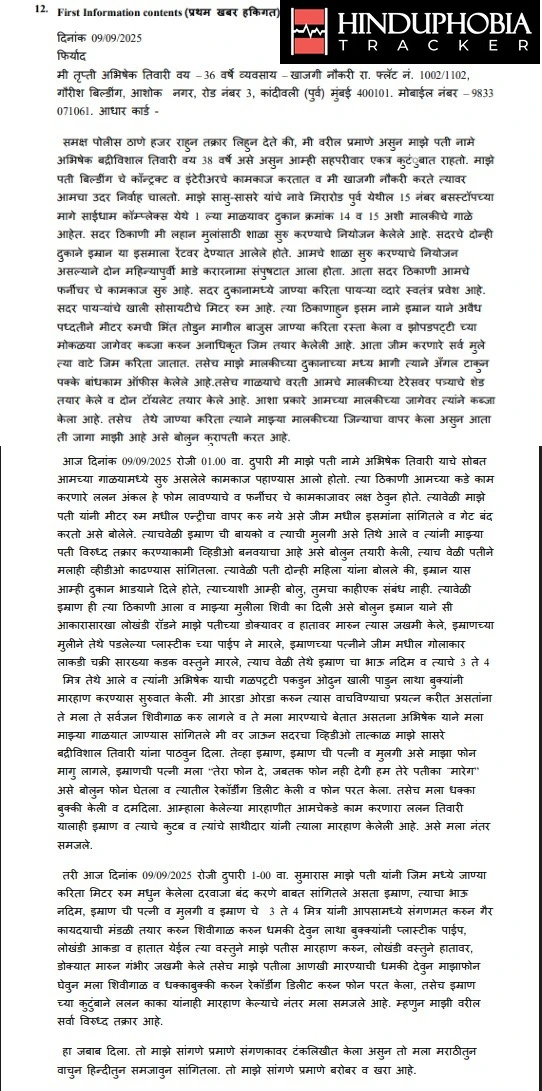
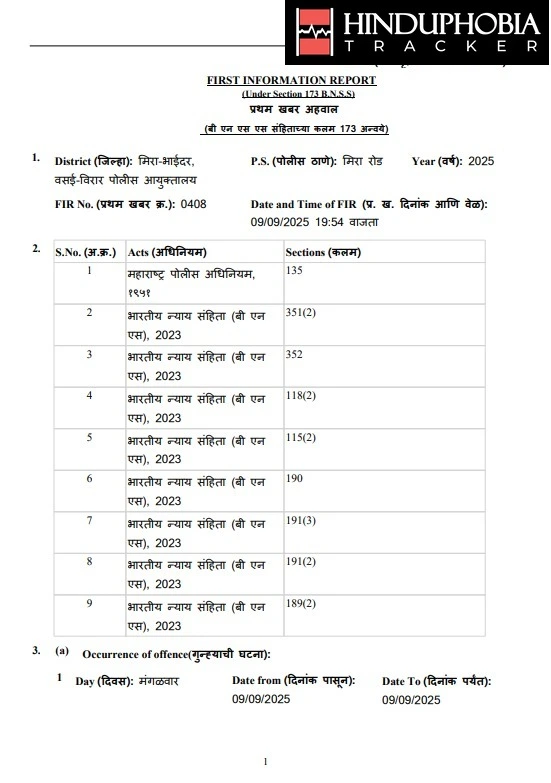
In Mira Road, Mumbai, a Hindu family was given death threats and brutally assaulted after they confronted a Muslim family over land encroachment in a Muslim majority locality. The victim also highlighted the hostile conditions for Hindus in the Muslim-majority area. He said that they were constantly subjected to threats and abuses by the members of the Muslim community, making it impossible for them to live there. According to the complaint filed by the victim, Trupti Tiwari reported that her husband, Abhishek Badvishal Tiwari, who worked in construction and furniture, managed shops owned by her mother-in-law in Saidham Complex. They rented these shops to a Muslim man named Ismail Imran, but the rent agreement was terminated two months prior, as the Hindu family planned to start a school and operate their furniture business in the premises. However, the accused, Imran and his family carried out multiple unauthorised constructions. They occupied open slum land to build a gym in the vacant plot at the back of the complex and broke the wall of the meter room of the society to create a passage for the gym. They also constructed a concrete office within the shop that belonged to the victim. They also constructed a shed and two toilets on the terrace, which was also owned by the victim. They began using the staircase belonging to the victim to access these constructions and started claiming that the land belonged to them. On 9 September 2025, around 1:00 PM, Abhishek objected to gym members using the illegal passage and attempted to close the gate, which resulted in a violent confrontation. Imran’s wife and daughter approached the Hindu family while recording a video of the incident, claiming that they would complain to the police. Abhishek told them that since he had rented the shop to Imran, he would speak to him directly. Imran then arrived and began accusing Abhishek of abusing his daughter before violently assaulting him with an iron rod, seriously injuring him. Imran’s wife and daughter also attacked Abhishek using a plastic pipe and a round wooden object from the gym. Violence intensified as Imran’s brother Nadeem and several associates also joined in, grabbing Abhishek by the neck and repeatedly kicking and punching him. Trupti intervened, but she was also attacked, while her mobile phone, with which she recorded a video of the video was forcibly taken and the video was deleted. The family’s worker, Lalan Tiwari, was also assaulted during the attack. As of the date of this report, an FIR was registered at Mira Road Police Station against Imran, Nadeem, their wives, daughters, and other family members. Trupti also revealed that in such a Muslim-dominated locality, even daughters of Hindu families are not spared, as they face attacks, abuse, and constant threats, making survival difficult for Hindus. Hindus, in the locality, were constantly subjected to threats, abuse, and encroachment issues. The investigation was ongoing, while the Hindu family remained under persistent threat.
Case Images
Why it is Hate Crime ?
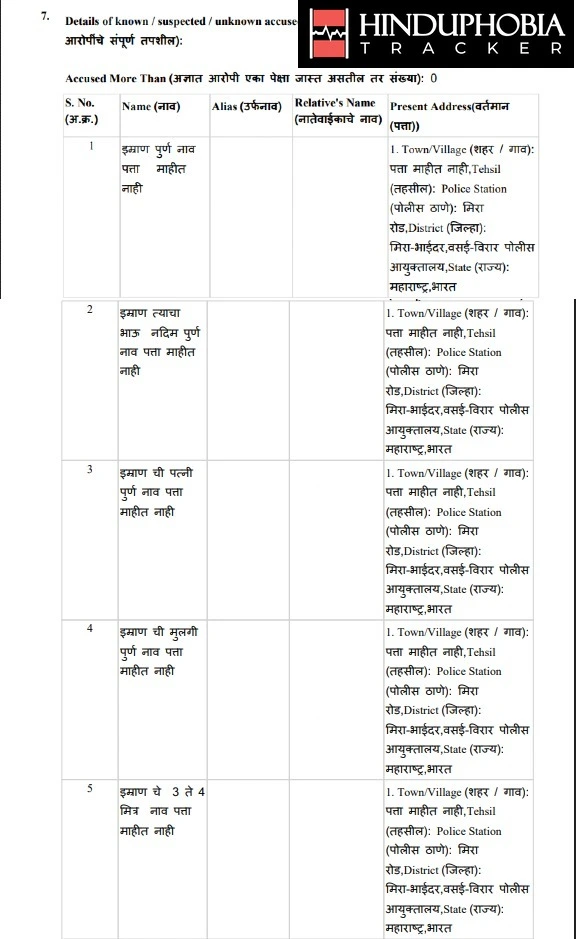
This case has been added to the tracker under the primary category- Attack not resulting in death. The subcategory selected is- Communal Clash/Attack. Communal clash is a form of collective violence that involves clashes between groups belonging to different religious identities. For a communal clash between Hindus and non-Hindus to qualify as a religiously motivated hate crime, the trigger of the violence itself would have to be anti-Hindu in essence. For example, if there is a Hindu religious procession that comes under attack from a non-Hindu mob and after the initial attack, Hindus retaliate in self-defence, leading to a communal clash between the two religious communities. While at a later stage, both communities are involved in the clash/violence, the initial trigger of the violence was by the non-Hindu mob against the Hindus and therefore, it could safely be termed as an anti-Hindu violence. Further, the trigger would also have to be religiously motivated. In the cited example, the attack by the non-Hindu mob was against religious processions and therefore, can be concluded to be religiously motivated. In some cases, the trigger may be non-religious, however, it develops into religious violence against Hindus at a later stage. In such cases too, the foundational animosity towards Hindus becomes the motivating factor of the crime and therefore, it would be classified as a religiously motivated hate crime against Hindus under this category. The other sub-category relevant here is - Attacked for opposing radicals or trying to save victim. In several cases, Hindus are attacked for opposing religiously motivated crimes being committed against a fellow Hindu or simply for voicing an opinion opposing radical elements, who either have in the past or continue to persecute Hindus. In such cases, the initial attack against the victim, against which the Hindu was trying to defend the victim, would also need to be classified as a religiously motivated hate crime. Since the initial crime itself was religiously motivated and the subsequent crime of attempting to save the victim or speaking against the radical elements ends up inviting a violent attack, it would also be classified as a religiously motivated hate crime under this category. This incident clearly qualifies as a hate crime due to its communal nature and the disproportionate violence inflicted upon the Hindu husband and wife by the Muslim family. What began as a minor issue over land encroachment turned into a one-sided, violent, and communal attack on the Hindu family. It is important to note here that it was the Muslim accused who encroached upon the land of the Hindu victims and began asserting authority over that land. When the Hindu family confronted them, they were subjected to brutal assault in an effort to silence them and prevent any further violence from being raised against them. This is on the lines of a larger pattern where any opposition to the actions of members of the Muslim community results in violent retaliation, especially when the victim is Hindu. Such acts of disproportionate violence against Hindus are not isolated or spontaneous incidents; rather, they are driven by deep-seated religious animosity towards the Hindu community and Islamic supremacist ideology, which views non-Muslims as inherently inferior. This results in hostility towards non-Muslims, especially Hindus, when Hindus assert their rights, seek justice, or refuse to submit or comply with the demands of the Muslim community. This violent overreach stems from an Islamic supremacist ideology within Muslim extremist circles, which views Hindus as socially and religiously inferior. This toxic belief breeds contempt and aggression, especially when Hindus resist submission or refuse to yield in disputes. The readiness to use violence under the pretext of minor issues exposes the continuing threat Hindu communities face, as these incidents are not isolated or spontaneous but part of an ongoing pattern of religiously motivated violence. This violence also serves as a statement for the larger Hindu community, especially in a Muslim dominated locality, to not raise any voice against Muslims, else they will be met with the same fate. The fact that the attack occurred in a Muslim dominated locality demonstrated how such spaces are often treated as exclusive zones where Hindus are considered outsiders and can be targeted with impunity. This was also highlighted by the victim, who stated that the Muslim dominated locality created a hostile environment for Hindus, who were constantly subjected to threats, abuse, and encroachment issues. The confrontation and disproportionate violence in the Muslim area represent clear targeting and premeditated intent, as the accused’s actions likely would have no consequence or opposition in such areas. In many such cases across India, violence against Hindus has been concentrated around mosques, dargahs, or localities dominated by Muslims. These spaces are often constructed as communal strongholds where religious identity dictates social control, leading to the exclusion and targeting of Hindus. This behaviour is not simply reactive hostility but an organised form of communal entitlement, where sometimes even the very presence of Hindus in Muslim-majority areas is interpreted as a provocation, let alone a minor argument. Even when an initial dispute appears unrelated to religion, the disproportionate violence inflicted upon the victim reveals a deeper layer of religious animosity towards the Hindu identity. Several past incidents underscore this grim reality. The 2019 Hauz Qazi violence is a glaring example. A simple parking dispute escalated into a full-scale communal attack against Hindus in the heart of Delhi. Hindu residents—including women and children—and their sacred Durga Mandir were targeted mercilessly by Muslims. Hindu idols were destroyed, the temple desecrated, and the community subjected to physical assault. The disappearance of a 17-year-old Hindu boy during the violence highlighted the grave dangers Hindus endure, as he was beaten for his faith and forced to flee for his life. This incident exposed how routine conflicts are exploited to unleash communal violence against Hindus, leaving the community traumatised and demanding justice. Similarly, the Hinduphobia Tracker has previously documented numerous instances where non-religious triggers sparked communal violence against Hindus by Muslims. For example, on 30th May 2025, in Dewran Garhiya village, Farrukhabad, Uttar Pradesh, a minor verbal altercation between two Hindu men and a Muslim man escalated into a violent assault by a large Muslim mob, inflaming communal tensions. In another incident on 7th July 2025 in Bhavna Nagar, Raipur, Chhattisgarh, a Hindu family was brutally attacked by a Muslim mob of nearly 80 people following a simple dispute over garbage disposal. Victims suffered severe injuries from sharp weapons. The above-mentioned cases clearly demonstrate a pattern of attacks against Hindus. Even if the conflict is a result of a non-communal issue, it often takes on a communal nature where Hindus are frequently targeted and brutally attacked by a large Muslim mob. These attacks are not random or spontaneous acts of violence. What happened to the Hindu family, in this case, is part of a larger pattern where Hindus are targeted not just out of personal anger, but because of deep-rooted religious hatred and a supremacist mindset. This case mirrors several others across the country. Time and again, small disagreements—over roads, water, music, or neighbourhood issues—turn into communal attacks, where large Muslim mobs target Hindus. The response is always premeditated and excessive, and the victims are left seriously injured, sometimes for life. The pattern is clear: Hindus are being deliberately targeted, even when the issue has nothing to do with religion. This kind of repeated violence is not just criminal—it is communal. It stems from religious hatred and a desire to intimidate Hindus. That makes it a hate crime, and it must be recognised and documented as such. Disclaimer: It is important to clarify that none of the media sources covering this case have specified the exact date when the victim's ordeal began, though it is implied that the unauthorised construction began after the rent agreement was terminated, about two months ago. Thus, to document this case, we have used an indicative date—July 9, 2025—as a placeholder to represent the beginning of the victims' suffering. While media coverage of the incident emerged on September 12, 2025, the Hinduphobia Tracker records the incident based on when the victim’s ordeal began, not when it was reported. Disclaimer: The FIR names the accused as Imran, his wife and daughter, his brother Nadeem, and three to four of his friends. Therefore, the number of perpetrators is recorded as eight.
Victim Details
Total Victim
3
Deceased
0
Gender
- Male 2
- Female 1
- Third Gender 0
- Unknown 0
Caste
- SC/ST 0
- OBC 0
- General 3
- Unknown 0
Age Group
- Minor 0
- Adult 3
- Senior Citizen 0
- Unknown 0


Case Status
Complaint registered


Perpetrators Details
Perpetrators
Muslim Extremists
Perpetrators Range
From 5 to 10
Perpetrators Gender
both
 Sources




