Hindu organisation unfairly vilified: Ambedkarite Buddhist politician calls for RSS ban, blames it for law and order problems
 New Delhi, Delhi, India
  30 October, 2025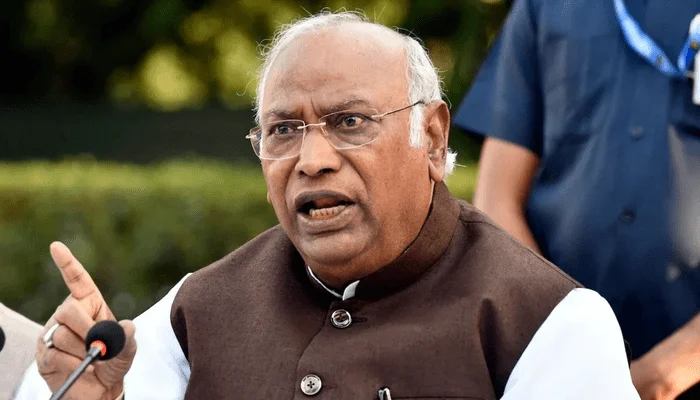
Case Summary
A prominent Hindu organisation, the Rashtriya Swayamsevak Sangh (RSS), was vilified by Karnataka Congress President Mallikarjun Kharge, a Buddhist by faith and a follower of Ambedkarism, an anti-Hindu political movement. He falsely accused the RSS of being responsible for the country’s law and order problems. According to media reports, the accused on 31st October 2025, called for a ban on the Rashtriya Swayamsevak Sangh (RSS), blaming the organisation for most of India’s law and order issues. Kharge made these remarks in response to Prime Minister Narendra Modi, who had criticised the Congress Party in his address during the 150th birth anniversary celebrations of Sardar Vallabhbhai Patel. Prime Minister Modi had denounced the Congress Party for failing to uphold Patel’s vision of a united India, despite Patel himself being a senior Congress leader. The accused made his anti-Hindu comments during a press briefing in New Delhi, where he accused Prime Minister Modi of disrespecting Sardar Vallabhbhai Patel by allowing government employees to associate with the RSS. He referred to a government order from the previous year that lifted the restriction prohibiting government employees from participating in RSS activities. The accused stated that the RSS had been banned after the assassination of Mohandas Karamchand Gandhi on suspicion of involvement, during the time when Sardar Vallabhbhai Patel served as the Union Home Minister. The accused also demanded the withdrawal of the government order dated 9th July 2024, which permitted government officials to be linked with the RSS. He stated that if any adverse consequence arose as a result of lifting this restriction, the Bharatiya Janata Party (BJP) government would bear responsibility. Kharge said, “This is not good for the country, and it is like tasting poison, the result of which is certain death. There is no need to taste poison once again. The actions of Modi ji are not good for the nation." When asked whether he sought an outright ban on the RSS, Kharge stated that, in his personal view, he supported such a ban, maintaining that the Bharatiya Janata Party and the Rashtriya Swayamsevak Sangh were responsible for the country’s law and order challenges. “These are my personal views, and I say openly that there should be one—a ban on the RSS. If the Prime Minister respects the words of Sardar Vallabhbhai Patel, then this should be implemented. All the wrongs in this country and all its law and order issues stem from the Bharatiya Janata Party and the Rashtriya Swayamsevak Sangh,” said Kharge. Kharge stated, “Sardar Vallabhbhai Patel had banned the RSS in the aftermath of Mahatma Gandhi’s assassination. Anyone attempting to break the unity of the nation should be taught a lesson. And, you know who those people are who are breaking that unity." In response to Kharge’s call to ban the Rashtriya Swayamsevak Sangh (RSS), Leader of the Opposition in the Karnataka Legislative Council and Bharatiya Janata Party Member of the Legislative Council (MLC) Chalavadi Narayanaswamy criticised Kharge’s stance, noting that the original demand had come from his son and Karnataka Minister, Priyank Mallikarjun Kharge. Narayanaswamy stated, “When his son initiated this campaign advocating a ban on the RSS, neither the Congress Party nor the public supported him. That is why he later began endorsing his son’s stand himself. No one can do anything to ban the RSS.” Notably, the Hinduphobia Tracker had previously documented a case involving the accused’s son, Karnataka Minister Priyank Mallikarjun Kharge, who had made similar remarks on 4th October 2025. On that date, he wrote a letter to Chief Minister Siddaramaiah requesting that the Rashtriya Swayamsevak Sangh (RSS) be prohibited from organising any programmes or activities in government offices and public institutions across the state. He asserted that such activities were detrimental to India’s unity and contrary to the spirit of the Constitution, and expressed concern over RSS shakhas (branch meetings) being conducted in government and government-aided schools, public parks, and other public spaces. He claimed that during these programmes, slogans were raised and negative ideas were instilled in the minds of children and young people.
Why it is Hate Crime ?
This case has been added to the tracker under the primary category- Hate Speech against Hindus. The subcategory selected is- Anti-Hindu slurs, mocking faith. Anti-Hindu slurs and the deliberate mocking of the Hindu faith owing to religious animosity involve the usage of derogatory terms, stereotypes, or offensive references to religious practices, symbols, or figures. One of the common anti-Hindu slurs used against Hindus is “cow-worshipper” and “cow piss drinker”. The intention of using this term is to demean and mock Hindus as a group and their religious beliefs since Hindus consider the cow holy. Additionally, some symbols and the slurs attached to them have a historical context that exacerbates the insult, hate, stereotyping, dehumanisation and oppression against Hindus. Cow worship has been used for centuries to denigrate Hindus, insult their faith and oppress Hindus specifically as a religious group. There has been overwhelming documentation about how cow slaughter has been used to persecute Hindus with cow meat being thrown in temples and places of worship. There has also been overwhelming documentation where cow meat (beef) has been force-fed to Hindus to either forcefully convert them to Islam or denigrate their faith. Apart from cow worship, the Swastika – which holds deep religious significance for the Hindus – has also been misinterpreted and distorted to use as a slur against Hindus. Similarly, the worship of the Shivling has been used by supremacist ideologies and religions to denigrate Hindus owing to religious animosity. Such slurs and denigration stem out of inherent animosity and hate towards Hindus and their faith, therefore, it is categorised as hate speech targeted at Hindus specifically owing to their religious identity. The other subcategory selected is- Mocking/denigrating Hindu leaders. Hate speech is defined as any speech, gesture, conduct, writing, or display that is prejudicial against a specific individual and/or group of people, which is leading to or may lead to violence, prejudicial action or hate against that individual and/or group. Religious leaders are often seen as representatives of the community, especially, the community’s religious faith and beliefs. Mocking or denigrating a religious leader specifically owing to his religious identity and/or the religious rituals he observes can be considered hate speech because the motivating factor of the speech is animosity and/or dislike for what he represents – the religious beliefs and faith of the community. It is important to note that mere insulting words against an individual do not constitute hate speech. It is entirely possible that insulting words are used for an individual, however, the specific speech is not the result of religious hate and/or animosity towards the professed faith of the religious leader, but the individual himself. For the speech to be considered hate speech, the speech itself or the motivating factor behind the speech has to be religious in nature. Such speech which denigrates Hindu religious leaders specifically owing to animosity towards the faith they profess and the community faith they represent will be treated as hate speech under this category. This incident represented a clear case of anti-Hindu hate speech directed towards the Hindu community and its organisations. The accused, Mallikarjun Kharge, who follows Buddhism and identifies as an Ambedkarite, publicly called for a ban on the reputed Hindu organisation Rashtriya Swayamsevak Sangh (RSS). It is important to note that the RSS is a Hindu organisation founded on the ideology of Hindutva, which is a political, cultural, and civilisational movement aimed at protecting Hinduism from anti-Hindu forces such as Islamist fundamentalism, Khalistani extremism, aggressive Christian proselytisation, and left-liberal or Marxist ecosystems that promote anti-Hindu narratives. The ideology of Hindutva is not one of violence or suppression of minorities as most anti-Hindu groups portray it. It stands for unity, strength, and self-defence. It inspires Hindus across caste, class, and gender lines to unite in preserving their faith, dignity, and religious identity. By calling for a ban on the RSS and accusing it of being responsible for law and order problems in the country, Kharge’s remarks constituted a religiously motivated attack. Such statements were devoid of evidence and were aimed at vilifying a Hindu organisation deeply rooted in community service and nation-building. The RSS has frequently been targeted by anti-Hindu forces precisely because it advocates for Hindu causes and works against threats that seek to attack and malign Hindu identity. By demanding a ban on the RSS, Kharge not only attempted to defame a respected Hindu organisation but also sought to undermine the philosophy of Hindutva—a movement that promotes self-respect, dignity, and strength among Hindus. By portraying it as a law and order threat, he distorted its purpose and perpetuated harmful stereotypes about Hinduism and its cultural expressions. His statements demonised the efforts of Hindu organisations working to preserve and uplift their community and turned Hindutva—a vision of unity and resilience—into a subject of disdain. Kharge also criticised the policy allowing government employees to associate with the RSS, framing the organisation as extremist and undesirable. This portrayal stemmed from deep-seated prejudice and hostility towards Hinduism and its institutions, making his rhetoric unmistakably a form of anti-Hindu hate speech. Such remarks vilify Hindutva, misrepresent patriotic Hindu organisations as societal threats, and fuel intolerance against Hindus at large. By demanding a ban on the RSS, the accused attempted to suppress Hindu political and cultural expression, violating the principles of freedom of expression and association. His remarks risked spreading animosity and discrimination, potentially inciting hostility against Hindus by painting them as a source of law and order disturbances. It is also essential to understand the ideological background of Mallikarjun Kharge. He has long identified with Ambedkarism—a political movement rooted in social reform but often marked by its hostility towards Hindu beliefs. Ambedkarite activists in the past have attacked Hindu traditions under the pretext of opposing caste discrimination, going as far as burning sacred Hindu texts like the Manusmriti and verbally abusing Hindu deities. This ideological heritage sheds light on Kharge’s antagonism towards the RSS and, by extension, the broader Hindu community. Therefore, Kharge’s attack on the RSS was not an issue of governance, secularism, or genuine concern for law and order. It stemmed from animosity towards Hindus and their faith. This incident thus constitutes a clear act of anti-Hindu hate speech—directed against a Hindu organisation, its principles, and the spiritual foundation of Hindutva. By misrepresenting Hindu values and promoting prejudice against the RSS and its followers, the accused propagated intolerance and sought to stigmatise Hindu identity as incompatible with India’s social fabric. Accordingly, this case has been documented as a confirmed instance of anti-Hindu hate speech and added to the Hinduphobia Tracker’s hate crime database.


Case Status
Unknown


Perpetrators Details
Perpetrators
Others
Perpetrators Range
One Person
Perpetrators Gender
male
 Sources




