Hindu deity's idol beheaded by Muslims in West Bengal; state authorities cover up attack, physically assault protesting devotees
 Jaynagar Majilpur, West Bengal, India
  20 December, 2025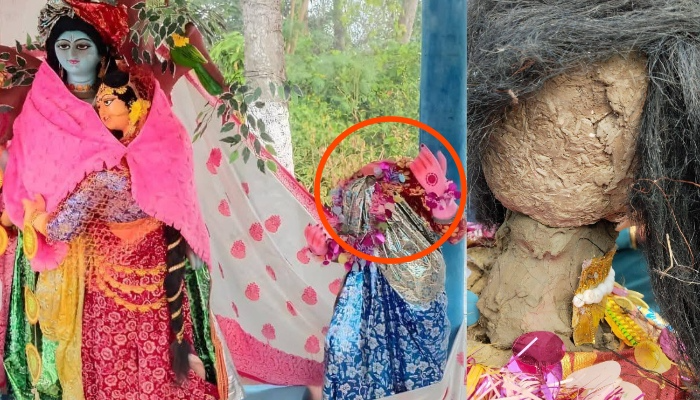
Case Summary
In Raynagar hamlet of the Harinarayanpur Gram Panchayat, located within the Joynagar (Jaynagar Majilpur) assembly constituency of West Bengal, an idol of Goddess Kali was desecrated by a few Muslim miscreants at the Joynagar Radha Krishna Temple. Following this, the local police and authorities attempted a cover-up and downplayed the incident. Even Hindu locals protesting this desecration were subjected to physical assault by the police. According to reports, on 21st December 2025, an idol of Goddess Kali was discovered beheaded in the temple. This incident sparked outrage among the local Hindu residents. The local authorities replaced the vandalised idol with a new one while the perpetrators continued to evade capture, resulting in charges of concealing the offence and further backlash. A video of the locals went viral on social media, where the locals stated that the "Jihadis (Muslims) destroyed the idol". They were also confronting the local authorities for attempting to coverup the incident. Meanwhile, the West Bengal police minimised the crime by referring to the idol as "slightly damaged," undermining the gravity of the instance and stated that attempts remained underway by certain groups to disseminate false information. It stated, "The idol was promptly replaced by the local temple committee with the active assistance of local police. A specific case has been registered, and all-out efforts are on to identify those behind the mischief." Police warned that serious action would follow against anyone who stirred up unrest by circulating inflammatory false information and added, "Citizens are requested not to fall for rumours." However, the state unit of Bharatiya Janata Party (BJP) asserted that the civic police discreetly brought in another idol to replace the damaged figure. The party launched a fierce attack on the blatant attempt at a cover-up, which infuriated the Hindu community and led to protests against the severe injustice. The BJP further questioned, "Mamata Banerjee is the home minister and police minister. Why are the police trying to cover up the issue instead of trying to find the perpetrators." Senior BJP leader Suvendu Adhikari condemned the incident and stated that the police assaulted the local Hindus who demonstrated against the occurrence by obstructing roads. He highlighted, "Not only that, but the local police administration, instead of attempting to apprehend the culprits, had a civic volunteer bring a new idol and tried to install it there." Adhikari further asked, "How much longer like this? How much longer will Hindus have to endure the consequences of Mamata Banerjee’s misgovernance and appeasement policies?" He remarked that, thus far, in cases of this kind, the government held no one accountable, primarily due to vote-bank politics. He further said, "I would urge all Hindus, irrespective of party affiliations, to unite and bring about a change in this government through democratic means as an urgent necessity, otherwise, this shameless administration's slumber would not break, and such attacks on Hindu faith continued to happen repeatedly."
Why it is Hate Crime ?
The primary category in this case is: Attack on Hindu religious representations. The subcategory under this is: Desecration of Hindu religious symbol. Icons and symbols or a religious representation of a spiritual ideal are widely revered in Hinduism. Iconography is of vital significance in the Hindu milieu. It helps connect people’s spiritual beliefs with the real world. Iconography within the Hindu faith takes several shapes and forms. Murtis are of most significance to Hindus, to which daily rituals, prayers and offerings are done. Besides the murtis, there are several other symbols which have deep significance in the Hindu faith – the Om and Swastika for example. Since these Hindu religious symbols hold paramount importance in Hinduism, any desecration of symbols, icons, murtis, religious representations and manifestations, is driven by animosity towards the faith itself which manifests itself through these murtis, icons and symbols. Therefore, any desecration of these Hindu religious symbols and representations is considered religiously motivated hate crimes under this category. The other subcategory selected is: Attack on Temples. In Hinduism, a temple is the abode of the Deity. The Deity in the Temple is consecrated, thereby, making it a real, breathing entity. Hindus believe that not just the Deity but the temple premises itself are sacred to Hindus since Hindus hold the faith that the entire Temple space is an amalgamation of the divine energy of the deity. Given the central significance of Temples in Hindu Dharma, any attack against a Hindu Temple or its peripheral premises is an attack on the faith itself and is born out of animosity towards the faith, of which, the Temple is a central tenet. Any manner of attack against a Temple and/or its premises would therefore be considered a religiously motivated hate crime. Another primary category selected is: Attack not resulting in death. The subcategory selected is: Attacked for opposing radicals or trying to save victim. In several cases, Hindus are attacked for opposing religiously motivated crimes being committed against a fellow Hindu or simply for voicing an opinion opposing radical elements, who either have in the past or continue to persecute Hindus. In such cases, the initial attack against the victim, against which the Hindu was trying to defend the victim, would also need to be classified as a religiously motivated hate crime. Since the initial crime itself was religiously motivated and the subsequent crime of attempting to save the victim or speaking against the radical elements ends up inviting a violent attack, it would also be classified as a religiously motivated hate crime under this category. In this case, the Muslim perpetrators desecrated a sacred idol of Goddess Kali, committing a clear instance of a religiously motivated hate crime against Hindus. This beheading of the idol kept at the Joynagar Radha Krishna Temple exposed profound religious animosity towards the Hindu community, as Hindu idols represent living manifestations of the divine rather than mere decorations. Devotees revere these icons through daily worship, puja rituals, and festivals, viewing them as embodiments of gods like fierce protector Kali, who safeguards dharma (righteousness and faith). Such deliberate vandalism wounded the spiritual heart of Hindus, stripping away symbols central to their faith and daily solace. By targeting this revered deity, the attackers signalled hatred not just for an object but for Hinduism itself, marking a textbook religiously motivated hate crime designed to intimidate, hurt and humiliate the entire Hindu community. The desecration unfolded inside temple premises, elevating it to an assault on the sacred temple ecosystem itself, a clear religiously motivated hate crime against Hindu institutions. Temples serve as sanctuaries where families seek peace, conduct marriages, and honour ancestors; idols form their pulsating core, drawing millions in devotion. Attackers infiltrating this holy space to behead Kali's idol violated the temple's inviolable sanctity, shattering devotees' sense of security. Hindus visit these sacred temples for refuge from worldly strife, yet this intrusion turned worship into trauma. Such targeted sacrilege against a temple's core elements constituted a direct attack on the Hindu faith and its adherents. Local authorities and West Bengal police compounded the hate crime through institutional bias, attempting to whitewash the desecration by downplaying it as "slightly damaged" and swiftly replacing the idol to conceal evidence, a blatant cover-up that demonstrated state prejudice against Hindu victims. This rush to minimise beheading as minor harm dismissed the profound emotional devastation on devotees while shielding perpetrators from accountability. By prioritising narrative control over justice, officials perpetuated discrimination, signalling to Hindus that their sacred losses merit suppression rather than investigation. Such systemic erasure of anti-Hindu violence exemplified state-institutionalised bias, transforming a communal attack into a broader religiously motivated crime where Hindu suffering faces deliberate indifference. West Bengal police assaulted protesting Hindu devotees, beating them for demanding justice over their desecrated idol. This act confirms institutional prejudice that weaponises state force against Hindu victims, solidifying this as a religiously motivated hate crime. Peaceful demonstrators, driven by righteous outrage at their temple's violation, faced physical assault by the police. This violent suppression punished Hindus for resisting radical desecration, inverting justice where Muslim attackers roamed free while victims endured double harm. Police siding with desecrators against aggrieved Hindu devotees exposed a pattern of administrative hostility, where Hindu protests trigger aggression. Such state-backed silencing entrenched discrimination, ensuring perpetrators faced no repercussions while the Hindu community suffers compounded trauma. This pattern of institutional denial and suppression of Hindu grievances is neither isolated nor accidental. Over recent years, West Bengal has witnessed a consistent trend wherein crimes targeting Hindus, their temples, or their symbols are either trivialised, reclassified as non-religious disputes, or blamed on “mentally unstable” individuals. The political and administrative apparatus, under the Mamata Banerjee-led government, has routinely chosen to whitewash or downplay the communal dimension of anti-Hindu violence. The state’s approach has resulted in a form of structural discrimination where Hindus are denied recognition as victims of religious hate. In several incidents—from Basirhat to Murshidabad, Malda, and Uttar Dinajpur—temple desecrations, mob attacks, and communal riots against Hindus by Muslims were dismissed as “local conflicts” or “personal disputes.” The police, in many of these cases, issued statements contradicting eyewitness accounts and ignored video evidence that clearly showed Muslim mobs targeting Hindu homes, temples, and idols. Such denial not only protects the perpetrators but emboldens them, creating a climate of impunity in which violence against Hindus becomes both predictable and unpunished. For example, in the Basirhat case earlier in 2025, where another Kali idol was desecrated, the police instantly declared the perpetrator mentally unstable—an often-repeated tactic to neutralise communal outrage and obscure the religious nature of the crime. Similarly, in Murshidabad and Malda, where Hindu homes and temples were attacked by Muslim mobs, state officials insisted the violence stemmed from local or political tensions, despite clear religious targeting and chants reported from the scene. This systematic obfuscation erodes trust in law enforcement and denies the Hindu community its right to security and justice. The ideological hostility of the state administration is evident in its selective application of law and order. Hindu religious processions during Ram Navami or Hanuman Jayanti are often restricted under the pretext of maintaining peace, while Muslim religious gatherings face no such curbs. Even symbolic expressions of Hindu faith, such as chanting “Jai Shri Ram,” have been criminalised or derided, with several individuals arrested for merely uttering the phrase. Such practices, combined with administrative indifference to temple desecrations and mob violence, reflect a broader anti-Hindu bias institutionalised within the state apparatus. A similar instance of Kali idol desecration by Muslims, along with police cover-up for the crime, was earlier recorded by Hinduphobia Tracker. In October 2025, a sacred idol of Goddess Kali suffered desecration by Muslims in Uttar Chandanpur alias Chandranagar village under the Suryanagar Gram Panchayat area of Kakdwip Assembly, South 24 Parganas District, West Bengal. The idol was beheaded at a puja pandal during the Diwali and Kali Puja celebrations. In this case, the local administration initially attempted to cover up the desecration by locking the temple and intimidating villagers. However, after the villagers protested collectively, the police were forced to open the temple doors and allow photographs. Following this, when Hindu locals gathered to protest the desecration, police removed the headless idol and took it away in a prison van. This showcased that even the current Joynagar incident constituted a well-calculated crime and revealed patterns of anti-Hindu hate crimes in West Bengal. Given that this case meets the parameters of a religiously motivated offence, it is being added to the hate crime database of the Hinduphobia Tracker.


Case Status
Complaint registered


Perpetrators Details
Perpetrators
Muslim Extremists
Perpetrators Range
Unknown
Perpetrators Gender
unknown
 Sources




