Hindu deity’s idol desecrated by Muslims during Kali Puja celebrations in West Bengal; police attempts to cover-up and harasses Hindus
 Kakdwip, West Bengal, India
  20 October, 2025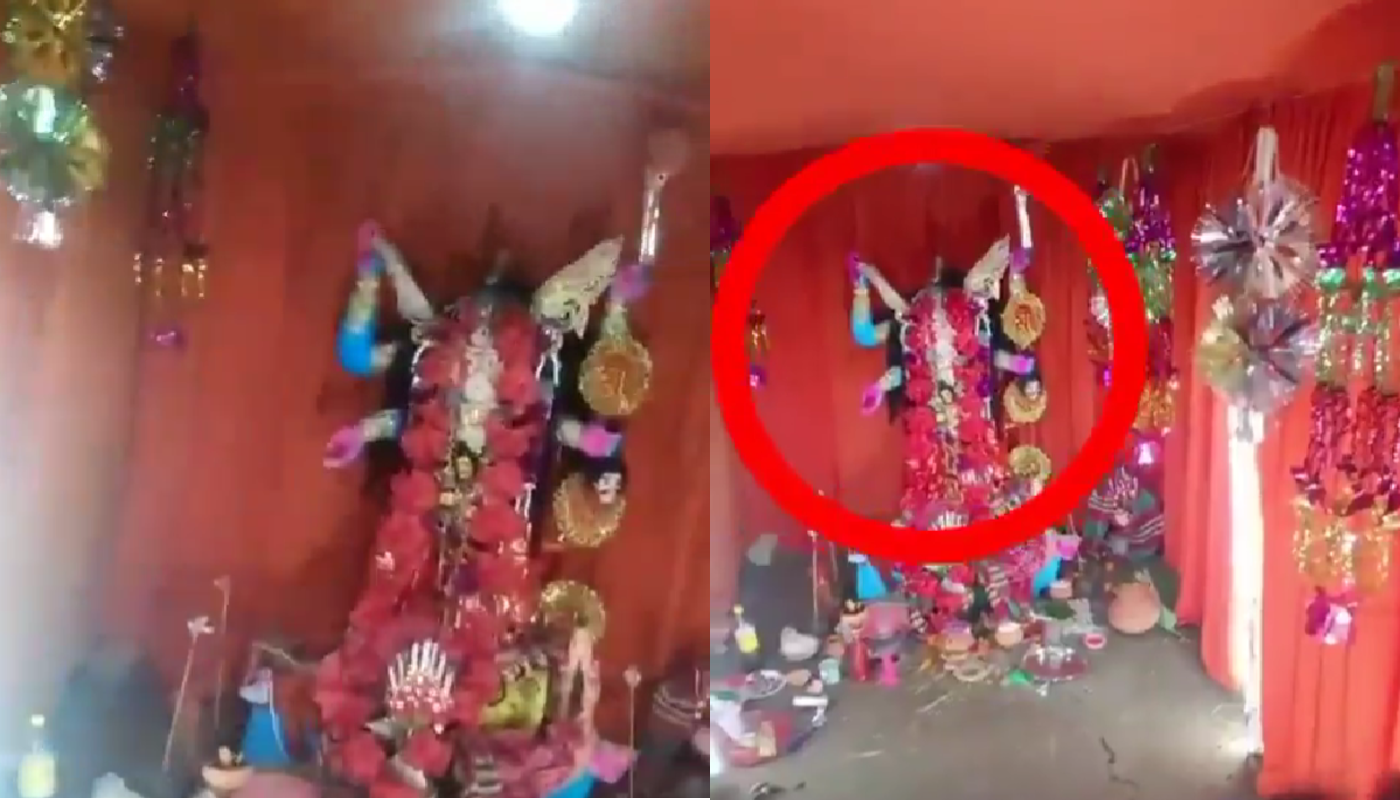
Case Summary
A sacred idol of Goddess Kali was desecrated by Muslims in Uttar Chandanpur alias Chandranagar village under the Suryanagar Gram Panchayat area of Kakdwip Assembly, South 24 Parganas District, West Bengal. The idol was found beheaded at a puja pandal during the Diwali and Kali Puja celebrations. As per reports, the attack took place on the evening of 21 October 2025, triggering outrage among local Hindu residents and political leaders. According to BJP leader Suvendu Adhikari, the attackers, identified as ‘Jihadis' (Muslims), cut off the head of the idol of Maa Kali and fled from the spot. He stated that the local administration initially tried to cover up the desecration by locking the temple and intimidating villagers. However, after the villagers protested collectively, the police were forced to open the temple doors and allow photographs to be taken. Adhikari shared a video on social media showing the idol of Goddess Kali without the head and stated that the state government is allowing anti-Hindu elements to thrive. He said, “A conspiracy is underway to turn West Bengal into West Bangladesh. If Hindus do not wake up now, great danger awaits in the coming days.” He further stated that Hindus in the state were suffering due to the ruling Trinamool Congress’s politics of appeasement. The following morning, when Hindu locals gathered to protest the desecration, police removed the headless idol and took it away in a prison van. Adhikari stated that Koteshwar Rao, the Superintendent of Sundarban Police District, fled with the broken idol in a prison van, accompanied by a large police force. He also released a video showing the damaged idol being taken away amidst protests by villagers.
Why it is Hate Crime ?
The primary category in this case is: Attack on Hindu religious representations. The subcategory under this is: Desecration of Hindu religious symbol. Icons and symbols or a religious representation of a spiritual ideal are widely revered in Hinduism. Iconography is of vital significance in the Hindu milieu. It helps connect people’s spiritual beliefs with the real world. Iconography within the Hindu faith takes several shapes and forms. Murtis are of most significance to Hindus, to which daily rituals, prayers and offerings are done. Besides the murtis, there are several other symbols which have deep significance in the Hindu faith – the Om and Swastika for example. Since these Hindu religious symbols hold paramount importance in Hinduism, any desecration of symbols, icons, murtis, religious representations and manifestations, is driven by animosity towards the faith itself which manifests itself through these murtis, icons and symbols. Therefore, any desecration of these Hindu religious symbols and representations is considered religiously motivated hate crimes under this category. Another subcategory under this is: Violence against religious structures or centres. In Hinduism, a religious structure is also considered divine. Hindus believe that not just the Deity but the religious structure itself is sacred. In this sub-category, we would document attacks against religious structures which are not consecrated temple spaces. Such religious spaces could be temporary in nature – for example – the religious spaces erected specifically for festivals like Durga Puja etc. This category would also document cases of attacks against religious centres. These spaces in their own right may not be ‘sacred’ per se, however, are often spaces where religious gurus live, religious teaching is imparted, or belong to religious institutions. Any attack against religious structures is a result of animosity towards the religion itself, which manifests itself through the religious spaces and therefore, such attacks are considered religiously motivated hate crimes. Religious centres are also manifestations of the religion, its teachings or gurus and therefore, attacks against such centres would be considered religiously motivated hate crimes. This case has been added to the tracker because it represents a clear instance of a hate crime against Hindus, manifesting through the deliberate desecration of a sacred Kali idol by Muslims during the most auspicious and religiously significant period of Diwali and Kali Puja. The beheading of the idol of Maa Kali at a puja pandal in Kakdwip was not a random act of vandalism but a deliberate attack on the religious beliefs, customs, and sacred symbols of the Hindu faith. The mutilation of a deity’s idol, particularly during the festival devoted to her worship, demonstrates calculated religious animosity aimed at humiliating and terrorising the Hindu community. In Hinduism, murtis (idols) are not mere artistic representations but consecrated embodiments of divinity. To destroy or defile them is to strike at the heart of Hindu devotees' spiritual and religious identity. The deliberate beheading of the Kali idol during Diwali and Kali Puja celebrations underscores a symbolic attempt to assert dominance over Hindu faith expression. Such acts are designed to provoke fear and diminish the community’s confidence in publicly celebrating their religion. The fact that the attack occurred at night, during an ongoing festival, and specifically targeted the centrepiece of worship—a sacred murti of the Goddess—makes it evident that this was a hate-motivated act rather than an ordinary crime. Desecration of idols has long been one of the most common forms of religious persecution against Hindus, employed historically to insult, demoralise, and break the collective spiritual resistance of the community. Equally concerning is the manner in which the local administration and police responded. Instead of safeguarding the sanctity of the site or treating the desecration as a communal offence, the authorities tried to conceal the incident. Reports state that the police locked the temple and intimidated villagers to prevent images or videos of the desecrated idol from surfacing. Only after public outrage did they reopen the temple for documentation. The following morning, the headless idol was removed and taken away in a prison van, further reinforcing suspicions of a cover-up. Such actions not only portray administrative bias but also deprive the Hindu community of justice and acknowledgement. This pattern of institutional denial and suppression of Hindu grievances is neither isolated nor accidental. Over recent years, West Bengal has witnessed a consistent trend wherein crimes targeting Hindus, their temples, or their symbols are either trivialised, reclassified as non-religious disputes, or blamed on “mentally unstable” individuals. The political and administrative apparatus, under the Mamata Banerjee-led government, has routinely chosen to whitewash or downplay the communal dimension of anti-Hindu violence. The state’s approach has resulted in a form of structural discrimination where Hindus are denied recognition as victims of religious hate. In several incidents—from Basirhat to Murshidabad, Malda, and Uttar Dinajpur—temple desecrations, mob attacks, and communal riots against Hindus by Muslims were dismissed as “local conflicts” or “personal disputes.” The police, in many of these cases, issued statements contradicting eyewitness accounts and ignored video evidence that clearly showed Muslim mobs targeting Hindu homes, temples, and idols. Such denial not only protects the perpetrators but emboldens them, creating a climate of impunity in which violence against Hindus becomes both predictable and unpunished. For example, in the Basirhat case earlier in 2025, where another Kali idol was desecrated, the police instantly declared the perpetrator mentally unstable—an often-repeated tactic to neutralise communal outrage and obscure the religious nature of the crime. Similarly, in Murshidabad and Malda, where Hindu homes and temples were attacked by Muslim mobs, state officials insisted the violence stemmed from local or political tensions, despite clear religious targeting and chants reported from the scene. This systematic obfuscation erodes trust in law enforcement and denies the Hindu community its right to security and justice. The ideological hostility of the state administration is evident in its selective application of law and order. Hindu religious processions during Ram Navami or Hanuman Jayanti are often restricted under the pretext of maintaining peace, while Muslim religious gatherings face no such curbs. Even symbolic expressions of Hindu faith, such as chanting “Jai Shri Ram,” have been criminalised or derided, with several individuals arrested for merely uttering the phrase. Such practices, combined with administrative indifference to temple desecrations and mob violence, reflect a broader anti-Hindu bias institutionalised within the state apparatus. This case thus fits squarely within the categories of the hate crime database. It reveals both the active hatred of the Muslim perpetrators, as stated by Suvendu Adhikari, who desecrated the idol, and the passive complicity of the state machinery, which attempted to suppress the truth. The combination of these factors transforms this incident from a local act of vandalism into a systemic act of religious oppression. The desecration of a murti of Goddess Kali—particularly in Bengal, where she is deeply revered—is not only an assault on a physical object but a violation of the cultural and spiritual identity of millions of Hindus. It strikes at the heart of Sanatan Dharma’s (Hinduism) living traditions and symbolises an attack on the idea of faith itself. The failure of the police to acknowledge the communal nature of the attack, and their subsequent attempt to erase evidence illustrates how state institutions have become instruments of denial rather than justice. This incident, therefore, stands as a stark reminder of the growing institutional and societal Hinduphobia in West Bengal and justifies its inclusion in the Hinduphobia Tracker as a grave hate crime against the Hindu community.


Case Status
Unknown


Perpetrators Details
Perpetrators
Muslim Extremists
Perpetrators Range
Unknown
Perpetrators Gender
unknown
 Sources




