Revered Hindu icon Rabindranath Tagore's portrait once again desecrated in Khulna, Bangladesh; same portrait was defaced 16 days earlier
 Khulna, Khulna District, Bangladesh
 20 November, 2026
Case Summary
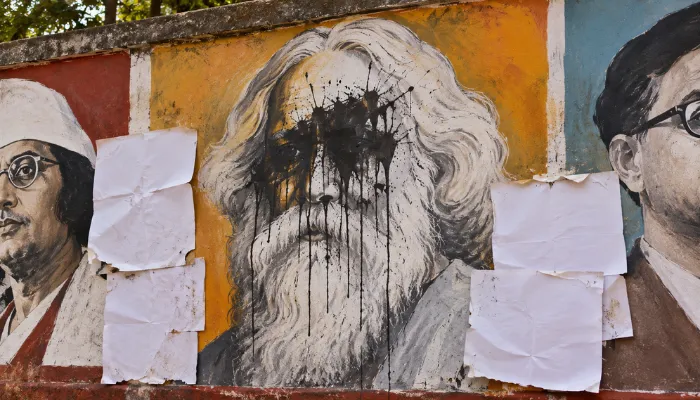
In Khulna, Bangladesh, a mural depicting Rabindranath Tagore, the celebrated Hindu literary icon and Nobel laureate, was defaced with ink by unidentified miscreants on November 21, 2026. The defacement occurred for the second time within the past 16 days, with black ink smeared across Tagore's face. The mural was located on the railway boundary wall opposite the Khulna Development Authority (KDA) building at Shibbari intersection, near Khulna Railway Station. The wall featured portraits of several prominent personalities, including Fakir Lalon Shah, painter S. M. Sultan, Rabindranath Tagore, Kazi Nazrul Islam, former Prime Minister Khaleda Zia, former President Ziaur Rahman and Michael Madhusudan Dutta. Tagore's portrait was positioned between those of S. M. Sultan and Kazi Nazrul Islam. However, while the other portraits remained untouched, Tagore's portrait was repeatedly singled out for desecration. Local residents noticed the latest damage on the morning of November 22, 2026. According to local observations, the portrait had remained intact until the night of November 21, 2026. Only Tagore's face was found smeared with black ink, indicating that the vandalism had taken place under the cover of darkness. Hinduphobia Tracker had previously documented that the same portrait was defaced on November 6, 2026, just 16 days before the latest incident. During that incident, unidentified miscreants smeared black ink across Tagore's face and pasted several anti-Tagore posters on the railway boundary wall. One of the posters stated, “There is no place for Tagore, who was hostile to Muslims and East Bengal, in Titumir's Bengal. There is no place for glorifying India.” Following the November 6, 2026 incident, the Khulna City Corporation (KCC) initiated restoration work on the damaged mural. The portrait was repainted on November 7, 2026, under the supervision of KCC Administrator Nazrul Islam Manju. However, despite its restoration, the same portrait was targeted again within a fortnight, with black ink once again smeared across Tagore's face. The repeated targeting of Tagore's portrait drew concern from local art and literature enthusiasts, who questioned why his portrait was being repeatedly defaced while those of the other prominent personalities displayed on the same wall remained untouched. They expressed concern that the desecration reflected hostility towards Tagore as an important figure associated with Bengali literature, culture and Hindu religious identity. They also called for an investigation into whether a communal motive was behind the repeated attacks. Khulna City Corporation Administrator Nazrul Islam Manju condemned the repeated defacement, describing the act as disrespectful and hateful. He said that smearing black ink across the portrait amounted to an act of violence and demonstrated disrespect towards a globally renowned poet. He further stated that erasing a portrait did not mean that a person could be erased or denied. Manju said that the KCC had asked the police to identify those responsible, would repaint the portrait again and would strengthen police patrols to ensure that the wall murals remained intact. Cultural activist Shariful Islam Salim, General Secretary of Nattyalok, also condemned the incident and expressed concern that the repeated attacks could be part of a wider pattern targeting prominent cultural personalities. He pointed out that similar incidents had taken place in Dhaka and called for those responsible to be identified and brought to justice. Describing Tagore's literature and philosophy as an inspiration for free thought, secularism and human dignity, he emphasised that Tagore remained an inseparable part of Bengali identity. Khulna Sadar Police Station Officer-in-Charge Lokman Hossain Ripon confirmed that the police were aware of the latest incident. Police personnel visited the scene and initiated an investigation to identify those responsible. However, no individual had been identified or arrested in connection with the latest defacement at the time of the report. Following the repeated vandalism, local residents demanded increased surveillance around the mural and strict action against those responsible. This incident occurred against the broader backdrop of the longstanding persecution of Hindus in Bangladesh. The Hindu minority has faced discrimination, targeted violence and religious hostility over decades, with attacks intensifying during periods of political and social instability. The latest major escalation began after the ouster of Sheikh Hasina’s government in August 2024, continued after the death of Sharif Osman Bin Hadi in December 2025, and resurfaced immediately after Bangladesh’s 13th National Parliamentary Election in 2026. Following Sheikh Hasina’s ouster, attacks on Hindu homes, temples and religious institutions were reported alongside intimidation, arson and mob violence targeting Hindu localities. The Hinduphobia Tracker recorded 336 incidents involving the Hindu minority during this period, reflecting the scale of the escalation and the vulnerability of Hindus amid the political upheaval. Another spurt of violence followed the death of Sharif Osman Bin Hadi, a Muslim political activist and student leader known for his anti-Hindu and anti-India rhetoric, in December 2025. In the aftermath, Hindu communities faced retaliatory violence, with Hindu homes and properties selectively attacked and several families reportedly forced to flee. Among the victims was Dipu Chandra Das, who was lynched and whose body was subsequently set ablaze by a Muslim mob over false blasphemy allegations. The Hinduphobia Tracker documented 51 incidents of anti-Hindu violence in the period following Hadi’s death alone, illustrating how hostility towards the Hindu minority intensified amid communal mobilisation. During this period, posters and written material calling for the extermination of Hindus were also displayed in public spaces. Viewed alongside reports of arson, vandalism, assault and targeted intimidation, such rhetoric pointed to a recurring pattern in which hostility towards Hindus intensified during periods of unrest. The most recent escalation followed the 13th National Parliamentary Election in 2026. In the immediate aftermath of the election results, Hindu families in districts including Noakhali, Rangpur, Nilphamari, Sylhet, Thakurgaon and Dinajpur faced attacks involving arson, looting, assault and vandalism of Hindu homes and temples. In several instances, Hindu properties were reportedly singled out, and families faced threats of displacement.
Why it is Hate Crime ?
The primary category selected in this case is: Restriction/ban on Hindu practices. The subcategory selected is: Restriction on expression of Hindu identity. An example of the state-affected prejudicial and targeted orders against the Hindu community would be a government denying the right of a Hindu or a group of Hindus to hold a religious procession owing to the animosity of non-Hindu groups. Denial of the religious right of the Hindus to assuage the non-Hindu group which harbours animosity to a point where it could lead to violence against Hindus is not only a failure of law and order but is a prejudicial order against Hindus, denying them their fundamental rights to express their religious identity. An example of a hate crime against Hindus by a non-Hindu would be a non-Hindu institution forcing its Hindu employees to abandon religious symbols that a Hindu would wear as an expression of faith owing to inherent prejudice against the faith professed by the victim or a non-Hindu group of people restricting a Hindu group from constructing a place of worship simply because the demography of the area in which the temple is being built is dominated by non-Hindus. Such actions are driven by religious animosity and/or prejudice against Hindus and their faith and would therefore be categorized as a hate crime. This incident is a clear example of anti-Hindu hatred, as the perpetrators deliberately desecrated a portrait of Rabindranath Tagore, a revered Hindu literary and cultural icon, by smearing black ink across his face. Notably, Rabindranath Tagore was not merely a celebrated Bengali poet but also a revered Hindu literary and cultural figure whose writings, philosophy, songs and ideas became deeply woven into the identity of Bengali Hindus. His contribution to Bengali literature and civilisation holds immense cultural and emotional significance for Hindus in West Bengal, Bangladesh and across the subcontinent. Generations have grown up reading his works, singing his compositions and drawing inspiration from his thoughts on humanity, dignity and freedom. His legacy forms an inseparable part of Bengal's cultural heritage and Hindu literary tradition. The selective targeting of his portrait, while leaving those of other prominent Muslim personalities on the same wall untouched, demonstrated that this was not indiscriminate vandalism but a deliberate act directed at a figure deeply revered by the Hindu community. The desecration of his portrait amounted to an affront to the religious and cultural sentiments of Hindus in Bangladesh. This incident cannot be viewed in isolation. Hinduphobia Tracker had previously documented the desecration of the same portrait on November 6, 2026, when unidentified miscreants smeared black ink across Tagore's face and pasted anti-Tagore posters on the wall. One of the posters declared, “There is no place for Tagore, who was hostile to Muslims and East Bengal, in Titumir's Bengal. There is no place for glorifying India.” The posters explicitly rejected Tagore's place in Bengal's cultural heritage and denounced the glorification of India. Despite the portrait being restored on November 7, 2026, it was targeted again on November 21, 2026. The repeated defacement of the same portrait, even after its restoration, demonstrated that this was not an isolated act of vandalism but a continuation of the hostility directed towards Tagore and the Hindu cultural identity he represented. The rejection of Tagore's place in Bengal, coupled with the explicit opposition to glorifying India, also carried wider cultural and civilisational implications. For Bengali Hindus in Bangladesh, Tagore represents an important part of their shared literary, religious and cultural inheritance. His legacy transcends geographical boundaries and connects Bengali communities across India and Bangladesh. The attempt to discredit him and deny him a place in Bengal's cultural heritage, alongside the rejection of India's cultural influence, struck at these shared historical and civilisational connections. It also reflected an exclusionary attitude towards Hindu contributions to Bengal's cultural landscape and raised concerns about the growing hostility towards Hindu-associated cultural figures. The repeated targeting of Tagore's portrait further demonstrated how Hindu-associated cultural figures and symbols can become targets of intimidation and humiliation. Such acts do not merely attack the individual or symbol being targeted; they also denigrate the Hindu communities for whom these figures hold deep cultural and religious significance. In this instance, the repeated selective defacement of Tagore's portrait, the anti-Tagore posters displayed during the November 6 incident and the explicit rejection of glorifying India collectively exposed the hostility accompanying the attacks. For Bangladesh's Hindu community, the repeated defacement of Tagore's portrait therefore went beyond the destruction of a public mural. It involved the deliberate humiliation of a revered Hindu cultural figure, the rejection of his place in Bengal's heritage and the denigration of cultural connections integral to Bengali Hindu identity. The recurrence of the attack within 16 days, despite the restoration of the portrait, demonstrated persistent hostility rather than indiscriminate vandalism. Considered alongside the anti-Tagore and anti-India messages displayed during the previous incident, the attack constituted a targeted expression of hostility towards Hindu cultural and religious identity and an affront to the sentiments of the Hindu community in Bangladesh. Given that this incident meets the parameters of a religiously driven offence, it is being added to the hate crime database of the Hinduphobia Tracker.


Case Status
Complaint filed

Perpetrators Details
Perpetrators
Unknown
Perpetrators Range
Unknown
Perpetrators Gender
unknown
 Sources