Revered Hindu icon's portrait desecrated with black ink, anti-Hindu hatred posters plastered across public walls in Khulna, Bangladesh
 Khulna Division, Bangladesh
 5 November, 2026
Case Summary
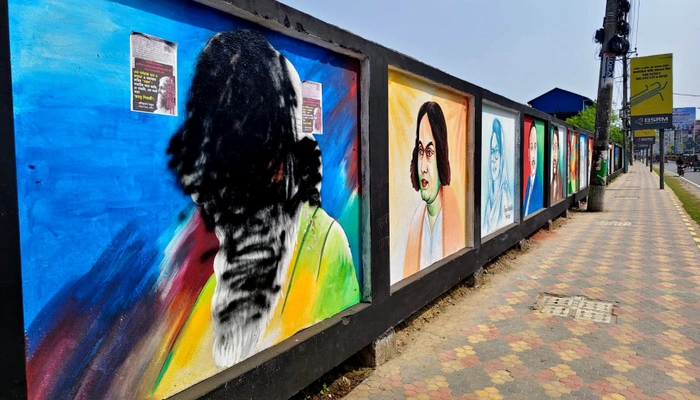
In Khulna, Bangladesh, a mural of revered Hindu literary icon and Nobel laureate Rabindranath Tagore was desecrated with black ink, completely covering his face, while several anti-Tagore and anti-Hindu posters were plastered on the same public wall. The posters accused Tagore of hostility towards Muslims and East Bengal and explicitly opposed the glorification of India. The incident came to light on Friday, 6 November 2026, at the boundary wall of Khulna Railway Station, along the road connecting Shibbari intersection to the railway station in Khulna, Bangladesh. Khulna City Corporation (KCC) commissioned the murals as part of a city beautification initiative ahead of Prime Minister Tarique Rahman’s scheduled visit. The initiative sought to showcase the country’s history, heritage, culture and distinguished personalities through murals and graffiti on various city walls. The railway station boundary wall featured portraits of Fakir Lalon Shah, painter S. M. Sultan, Rabindranath Tagore, Kazi Nazrul Islam, former Prime Minister Khaleda Zia, former President Ziaur Rahman and Michael Madhusudan Dutta. Of all the portraits, only Tagore’s had been defaced. Several anti-Tagore posters had also been pasted on the same wall. One of them read, “There is no place for Tagore, who was hostile to Muslims and East Bengal, in Titumir’s Bengal. There is no place for glorifying India.” Sazzad Hossain, an employee at a nearby shop, noticed the damage and stated that the mural had been intact the previous day, Thursday, 5 November 2026. He suspected unidentified individuals defaced it under cover of darkness on Thursday night. Businesses across the road remained closed on Friday, 6 November 2026, making it difficult to determine who was responsible for the vandalism and when it took place. Khulna City Corporation Administrator Nazrul Islam Manju condemned the vandalism, saying the portraits were created to encourage free thinking among children and adolescents. Condemning the act, he stated, “By defacing the portrait, they have exposed their narrow-mindedness and sick mentality.” He emphasised the importance of preserving public artwork intended to foster cultural awareness and independent thinking among younger generations. Shariful Islam Salim, a cultural activist and General Secretary of Nattyalok, said an organised group orchestrated the incident and warned that other eminent personalities could also become targets. Referring to similar incidents in Dhaka, he stated, “They have carried out similar acts in Dhaka as well. These incidents are being orchestrated deliberately. Those responsible must be identified and brought to justice. This may not stop with Rabindranath; they could target other eminent personalities too.” He further noted that Tagore’s literature and philosophy had inspired generations to embrace free thought, secularism and human dignity. Describing Tagore as an inseparable part of Bengali identity and a source of inspiration, Salim called upon people from all walks of life to unite against those responsible. He also expressed concern that some young people were being misled into participating in such disgraceful acts. Officer-in-Charge (OC) Lokman Hossain of Khulna Sadar Police Station said the police had not yet identified those responsible for the vandalism. He confirmed that police personnel had visited the scene and initiated an investigation. He assured that the authorities would investigate the matter seriously, gather further information and take the necessary action. The incident followed the defacement of another Rabindranath Tagore mural in Dhaka in October 2026. In connection with that separate incident, police detained four individuals, including Al Nur Mohammad Ayash, Member Secretary of the State Dialogue Forum. Shariful Islam Salim referred to the Dhaka incident while expressing concern over what he viewed as a possible pattern of deliberate attacks against prominent cultural figures. Following widespread condemnation, Khulna City Corporation initiated restoration work on the damaged mural. This incident occurred against the broader backdrop of the longstanding persecution of Hindus in Bangladesh. The Hindu minority has faced discrimination, targeted violence and religious hostility over decades, with attacks intensifying during periods of political and social instability. The latest major escalation began after the ouster of Sheikh Hasina’s government in August 2024, continued after the death of Sharif Osman Bin Hadi in December 2025, and resurfaced immediately after Bangladesh’s 13th National Parliamentary Election in 2026. Following Sheikh Hasina’s ouster, attacks on Hindu homes, temples and religious institutions were reported alongside intimidation, arson and mob violence targeting Hindu localities. The Hinduphobia Tracker recorded 336 incidents involving the Hindu minority during this period, reflecting the scale of the escalation and the vulnerability of Hindus amid the political upheaval. Another spurt of violence followed the death of Sharif Osman Bin Hadi, a Muslim political activist and student leader known for his anti-Hindu and anti-India rhetoric, in December 2025. In the aftermath, Hindu communities faced retaliatory violence, with Hindu homes and properties selectively attacked and several families reportedly forced to flee. Among the victims was Dipu Chandra Das, who was lynched and whose body was subsequently set ablaze by a Muslim mob over false blasphemy allegations. The Hinduphobia Tracker documented 51 incidents of anti-Hindu violence in the period following Hadi’s death alone, illustrating how hostility towards the Hindu minority intensified amid communal mobilisation. During this period, posters and written material calling for the extermination of Hindus were also displayed in public spaces. Viewed alongside reports of arson, vandalism, assault and targeted intimidation, such rhetoric pointed to a recurring pattern in which hostility towards Hindus intensified during periods of unrest. The most recent escalation followed the 13th National Parliamentary Election in 2026. In the immediate aftermath of the election results, Hindu families in districts including Noakhali, Rangpur, Nilphamari, Sylhet, Thakurgaon and Dinajpur faced attacks involving arson, looting, assault and vandalism of Hindu homes and temples. In several instances, Hindu properties were reportedly singled out, and families faced threats of displacement.
Why it is Hate Crime ?
The primary category selected in this case is: Restriction/ban on Hindu practices. The subcategory selected is: Restriction on expression of Hindu identity. An example of the state-affected prejudicial and targeted orders against the Hindu community would be a government denying the right of a Hindu or a group of Hindus to hold a religious procession owing to the animosity of non-Hindu groups. Denial of the religious right of the Hindus to assuage the non-Hindu group which harbours animosity to a point where it could lead to violence against Hindus is not only a failure of law and order but is a prejudicial order against Hindus, denying them their fundamental rights to express their religious identity. An example of a hate crime against Hindus by a non-Hindu would be a non-Hindu institution forcing its Hindu employees to abandon religious symbols that a Hindu would wear as an expression of faith owing to inherent prejudice against the faith professed by the victim or a non-Hindu group of people restricting a Hindu group from constructing a place of worship simply because the demography of the area in which the temple is being built is dominated by non-Hindus. Such actions are driven by religious animosity and/or prejudice against Hindus and their faith and would therefore be categorized as a hate crime. The other primary category selected is: Hate Speech against Hindus. Within this, the subcategory selected is: Anti-Hindu slurs, mocking faith. Anti-Hindu slurs and the deliberate mocking of the Hindu faith owing to religious animosity involve the usage of derogatory terms, stereotypes, or offensive references to religious practices, symbols, or figures. One of the common anti-Hindu slurs used against Hindus is “cow-worshipper” and “cow piss drinker”. The intention of using this term is to demean and mock Hindus as a group and their religious beliefs since Hindus consider the cow holy. Additionally, some symbols and the slurs attached to them have a historical context that exacerbates the insult, hate, stereotyping, dehumanisation and oppression against Hindus. Cow worship has been used for centuries to denigrate Hindus, insult their faith and oppress Hindus specifically as a religious group. There has been overwhelming documentation about how cow slaughter has been used to persecute Hindus with cow meat being thrown in temples and places of worship. There has also been overwhelming documentation where cow meat (beef) has been force-fed to Hindus to either forcefully convert them to Islam or denigrate their faith. Apart from cow worship, the Swastika – which holds deep religious significance for the Hindus – has also been misinterpreted and distorted to use as a slur against Hindus. Similarly, the worship of the Shivling has been used by supremacist ideologies and religions to denigrate Hindus owing to religious animosity. Such slurs and denigration stem out of inherent animosity and hate towards Hindus and their faith, therefore, it is categorised as hate speech targeted at Hindus specifically owing to their religious identity. This case constituted a religiously motivated attack on Hindu cultural and religious identity through the deliberate defacement of Rabindranath Tagore’s portrait and the display of posters rejecting his place in Bengal's cultural heritage. Tagore was not merely a celebrated Bengali poet. He was a revered Hindu literary and cultural figure whose writings, philosophy, songs and ideas became deeply woven into the identity of Bengali Hindus. Generations have grown up reading his works, singing his songs and drawing inspiration from his thoughts on humanity, dignity and freedom. His contribution forms an important part of Bengal's literary and cultural inheritance. By defacing his portrait while leaving other portraits untouched, those responsible singled out a figure who holds immense cultural and emotional significance for Hindus. This was not indiscriminate vandalism but the selective targeting of a Hindu-associated cultural icon. The posters placed alongside the defaced portrait made the hostility even more explicit. One declared that there was no place for Tagore, accusing him of being hostile towards Muslims and East Bengal. This was more than a disagreement with his views or literary legacy. It was an attempt to deny him a place in Bengal's cultural identity. Tagore's contribution to Bengali civilisation cannot be erased through ideological slogans, nor can his place in the region's history be dismissed because of political or communal differences. By portraying him as someone who did not belong in Bengal, the posters sought to discredit a figure whom generations of Hindus have regarded with immense respect and affection. The message also raised serious concerns about the growing hostility towards Hindu-associated cultural figures and the space being left for their contributions in Bangladesh's cultural landscape. The poster declaring that there was no place for glorifying India added another important dimension to the incident. Displayed alongside the rejection of Tagore, it connected hostility towards the poet with an explicit rejection of India's cultural influence. For Hindus in Bangladesh, India represents far more than a neighbouring country. Shared religious traditions, historical ties, literature, cultural practices and civilisational connections have linked the two societies for generations. Tagore himself occupies an important place in this shared heritage and is celebrated across the subcontinent. Rejecting India's cultural influence while simultaneously defacing his portrait sent a message that admiration for India and respect for a literary figure associated with its wider cultural heritage were unwelcome. This was particularly hurtful to Bengali Hindus, for whom these connections remain an important part of their collective identity. The incident also needs to be viewed against the wider history of religious divisions in the subcontinent. The Partition of India was shaped by the two-nation theory, which presented Muslims as a separate nation whose political identity could not be accommodated within a united India. Extremist ideologies have continued to draw upon hostility towards India's civilisational identity, viewing its Hindu cultural foundations as something to be weakened or erased. Historically, Islamic conquests have involved not only military campaigns but also psychological coercion, forced conversions and the destruction or erasure of indigenous religious and cultural traditions. The targeting of Hindu-associated cultural figures and the rejection of India's cultural influence reflect how such hostility can also find expression through modern forms of cultural intimidation and exclusion. For Bangladesh's Hindu community, this incident therefore extended well beyond the destruction of a portrait. It involved the public humiliation of a revered cultural figure, the rejection of his place in Bengal's heritage and the dismissal of the wider civilisational connections that Hindus continue to cherish. The deliberate targeting of Tagore, the attempt to deny him a place in Bengal and the rejection of India's cultural influence reflect a profound disregard for Hindus and their cultural heritage and stem from underlying animosity toward Hinduism. This incident exemplifies an intentional effort to insult religious sentiments, warranting its inclusion as a serious offence motivated by hatred.


Case Status
Complaint filed


Perpetrators Details
Perpetrators
Muslim Extremists
Perpetrators Range
Unknown
Perpetrators Gender
unknown
 Sources



