100-year-old Shiva lingam desecrated by Muslim men for the second time in a month in Uttar Pradesh's Banda district
 Banda, Uttar Pradesh, India
 11 November, 2026
Case Summary
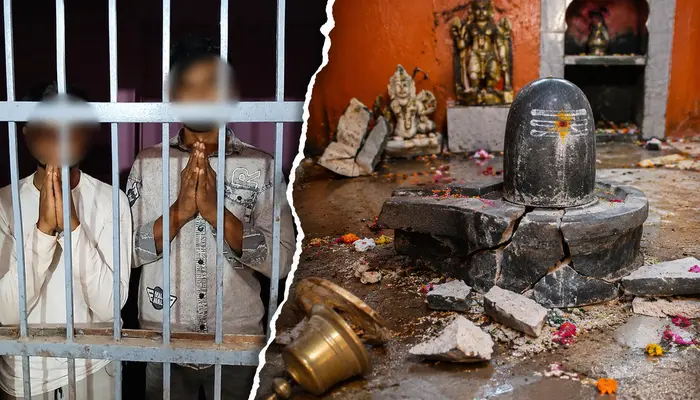
In Korrahi village, under the Bisanda police station area of Banda district, Uttar Pradesh, a 100-year-old idol of Shiva lingam at Kodauwa Baba Temple was desecrated by Muslim men, Salman and Rehan, for the second time within a month. The first attack saw the ancient Shiva lingam brutally shattered and its sacred remains dumped into a well. After the lingam was replaced, the temple was targeted again. The Shiva lingam was again desecrated, its jalhari (the supporting base of the lingam) broken, and visible marks of damage were inflicted on the idol. Other idols and sacred religious objects within the temple were also vandalised. The second desecration of the Shiva lingam took place on the night of Thursday, 12 November 2026. At around 6 am the following morning, villagers arriving at the temple for morning prayers discovered that the replaced Shiva lingam had been damaged. Its jalhari was broken, and the idol bore visible signs of impact. Other idols and sacred objects in the temple were also damaged. The discovery sparked outrage among residents, who promptly alerted the Bisanda police. Police personnel reached the temple, led by Baberu Circle Officer Krishna Kant Tripathi and Additional Superintendent of Police Shivraj, who inspected the site. Local resident Akhilesh submitted a written complaint, and police registered a case against unidentified persons. The Bisanda police, assisted by the Special Operations Group (SOG), collected physical, technical and forensic evidence and began investigating the incident. Representatives of the Vishwa Hindu Parishad (VHP) and Bajrang Dal visited the temple and condemned the desecration, demanding the immediate identification and arrest of those responsible, strict legal action and stronger security arrangements. Within a few hours of the complaint, police arrested two local youths, Salman and Rehan, in connection with the second incident. Baberu Circle Officer Krishna Kant Tripathi said evidence had implicated the two men. During questioning, they accepted that they had damaged the temple while intoxicated. They expressed remorse and apologised in a video statement, saying they had acted foolishly under the influence of alcohol. The court produced the two accused and remanded them to judicial custody. Meanwhile, the administration announced plans to install another Shiva lingam at an auspicious time and equip the entire temple premises with CCTV cameras. The Block Development Officer was instructed to take the necessary steps. Police said the situation in the village was under control and that normality had been restored. The latest attack came less than a month after the first desecration, which took place on the night of 15 October 2026 and was discovered the following morning. On that occasion, the Shiva lingam was shattered and thrown into a nearby well. Villagers raised concerns over the lack of police patrolling, particularly during Navratri, and questioned the failure to identify those responsible. Following police intervention, a replacement Shiva lingam was installed at the same location, and the temple was renovated, allowing worship to resume. Police never identified the perpetrators of the first attack.
Why it is Hate Crime ?
The primary category selected in this case is: Attack on Hindu religious representations. The subcategory selected is: Desecration of Hindu religious symbol. Icons and symbols or a religious representation of a spiritual ideal are widely revered in Hinduism. Iconography is of vital significance in the Hindu milieu. It helps connect people’s spiritual beliefs with the real world. Iconography within the Hindu faith takes several shapes and forms. Murtis are of most significance to Hindus, to which daily rituals, prayers and offerings are done. Besides the murtis, there are several other symbols which have deep significance in the Hindu faith – the Om and Swastika for example. Since these Hindu religious symbols hold paramount importance in Hinduism, any desecration of symbols, icons, murtis, religious representations and manifestations, is driven by animosity towards the faith itself, which manifests itself through these murtis, icons and symbols. Therefore, any desecration of these Hindu religious symbols and representations is considered religiously motivated hate crimes under this category. The other subcategory selected is: Attack on Temples. In Hinduism, a temple is the abode of the Deity. The Deity in the Temple is consecrated, thereby, making it a real, breathing entity. Hindus believe that not just the Deity but the temple premises itself are sacred to Hindus since Hindus hold the faith that the entire Temple space is an amalgamation of the divine energy of the deity. Given the central significance of Temples in Hindu Dharma, any attack against a Hindu Temple or its peripheral premises is an attack on the faith itself and is born out of animosity towards the faith, of which the Temple is a central tenet. Any manner of attack against a Temple and/or its premises would therefore be considered a religiously motivated hate crime. The incident constituted a hate crime because it involved the deliberate desecration of a sacred idol of a Hindu deity, Lord Shiva, for the second time in a month by Muslim men. To understand the severity of this case, one must understand the religious significance of Hindu temples and the idols placed inside them. Hindu temples hold profound religious and spiritual importance, serving as places of worship, devotion, religious learning, and the observance of sacred rituals and traditions. They provide devotees with a space to connect with the divine and participate in community religious practices. Similarly, in Hindu traditions, a murti is not merely a physical object or artistic representation but a sacred form through which a deity is worshipped and invoked during rituals, prayers, offerings and darshan. The Shivalinga holds particular religious significance as a revered representation of Shiva and occupies a central place in Hindu worship. Therefore, the intent behind these repeated actions could only possibly be that of provoking Hindus and showing disrespect towards their faith. Since such a callous act can only stem from a profound contempt for the Hindu religion, this case deserves to be recorded in this hate tracker. It is important to note that although those responsible for the first attack were never identified, the temple was targeted again within a very short span, strongly suggesting a pattern of deliberate and repeated targeting. The second attack also raises the possibility that the same perpetrators returned to desecrate the shrine, even after the replacement Shiva lingam had been installed and worship had resumed. If that was the case, it would point to a clear intent to demean and mock Hindus as a group and their religious beliefs. Some may also argue that the perpetrators carried out the act under the influence of alcohol. However, intoxication does not justify the deliberate desecration of a Hindu place of worship or negate the religious dimension of the offence. The Muslim perpetrators specifically entered a temple, damaged its premises, broke liquor bottles inside the sacred compound, threw puja materials outside, and violated objects associated with Hindu religious practice. If the act was solely due to intoxication, the perpetrator could have targeted any non-religious property or non-Hindu religious sites such as a mosque, church or gurudwara. The selective targeting of a Hindu temple demonstrates that the act was directed to hurt the religious sentiments of the Hindu community. This overall showcases his inherent hostility towards Hinduism and its adherents.


Case Status
Arrested


Perpetrators Details
Perpetrators
Muslim Extremists
Perpetrators Range
From 2 To 5
Perpetrators Gender
male
 Sources



