Hindu festival secularised and subjected to de-Hinduisation; Indian politician describes Diwali as “Eid of happiness”
 Delhi, India
 7 November, 2026
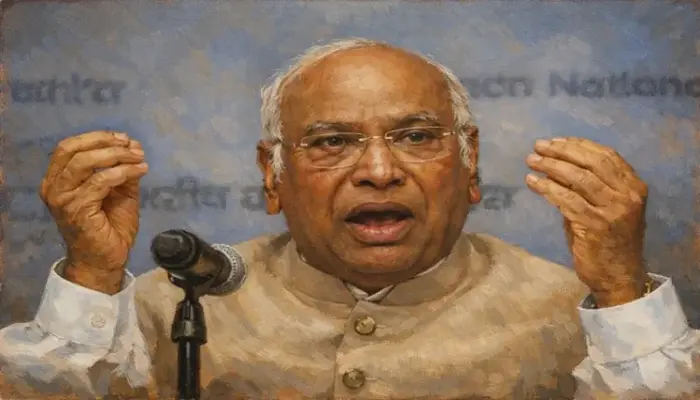
Case Summary
Congress president Mallikarjun Kharge attempted to secularise and de-Hinduise Diwali after describing the Hindu festival as an “Eid of happiness” while extending festive greetings to the people. During a conversation with journalists in New Delhi on 8 November 2026, Kharge wished the country on Diwali and described it as a festival of happiness, referring to it as “khushiyon ka Eid”. He also stated that the festival of lights represented peace, harmony and national brotherhood. He said that festivals celebrated by different communities brought people closer and appealed to people to strengthen unity and eliminate social divisions. Kharge's comparison of Diwali with Eid drew criticism from political leaders and triggered reactions on social media and in political circles. BJP leaders stated that Congress was resorting to appeasement and vote-bank politics by invoking an Islamic festival while extending greetings for one of Hinduism's most significant festivals. BJP national spokesperson Pradeep Bhandari criticised the Congress leadership and described its approach as anti-Sanatan. He stated that the party had deliberately associated a Hindu festival with an Islamic festival, thereby undermining Diwali's distinct cultural and religious identity. Other BJP leaders also criticised the remark, including Vadodara MP and Bharatiya Janata Yuva Morcha national president Hemang Joshi, who questioned the political message behind Kharge's comparison. The remark also drew criticism from AIMIM spokesperson Waris Pathan, who described it as a political stunt intended to secure electoral benefits. Pathan stated that Diwali was a major festival for Hindus and was celebrated with great enthusiasm, just as Eid was an important festival for Muslims. He maintained that equating the two festivals in this manner amounted to a political stunt aimed at appeasing a particular voter community. He further stated that voters had become more aware and would respond appropriately in the forthcoming elections. Shiv Sena leader Anand Dubey also criticised Kharge's statement and questioned the need to associate Diwali with Eid. He stated that Diwali symbolised the return of Lord Ram to Ayodhya after 14 years of exile, when the people of Ayodhya had celebrated his return by lighting diyas and bursting firecrackers. Dubey said that while all religions and festivals deserved respect, Diwali should be allowed to remain Diwali and Eid should remain Eid, as both had their own distinct significance. Congress leaders and supporters defended Kharge, claiming that his intention was to promote communal harmony, mutual respect and national unity. They claimed that the word Eid had been used in the broader sense of happiness and that the comparison was intended to convey a message of togetherness between different communities. Congress leader Rashid Alvi also came forward in Kharge's defence and supported his choice of words. Alvi stated that Eid was commonly used as an example when expressing happiness and referred to the popular expression used for someone who appeared after a long time, 'Kya tum Eid ka chaand ho gaye ho?' He maintained that Eid symbolised happiness and that Kharge's statement reflected a sentiment that only a secular person could express.
Why it is Hate Crime ?
The primary category in this case is: Hate speech against Hindus. The subcategory under this is: Anti-Hindu subversion and prejudice. Hate speech is defined as any speech, gesture, conduct, writing, or display that is prejudicial against a specific individual and/or group of people, which is leading to or may lead to violence, prejudicial action or hate against that individual and/or group. Media plays a specific and overarching reach in perpetuating prejudicial attitudes towards a community owing to unfair, untrue coverage and/or misrepresentation/misinterpretation, selective coverage and/or omission of facts of/pertaining to issues affecting a specific religious group. This type of bias can dehumanise the victim group, making it easier for others to justify harmful actions against them, which aligns with the objectives of hate speech laws aimed at preventing such harm. It is often observed that the media takes a prejudicial stand against the Hindu community driven by their need to shield the aggressor community which happens to be a numeric minority, however, is the one perpetrating violence against Hindus. For example, the media is often quick to contextualise religiously motivated crimes against Hindus, omit or misrepresent facts that point towards religiously motivated hate crimes, justify and/or downplay religiously motivated hate crimes or simply present fake news to stereotype Hindus. Such media bias leads to the denial of persecution and is often used to dehumanise Hindus, leading to justification for violence against them. For example, the media covered several fake allegations of Hindus targeting Muslims and forcing them to chant Jai Shree Ram. Most of these cases were proved false and fabricated after police investigation. These fake news reports were subsequently never retracted or clarified. Such fake news led to the justification of violence and dehumanisation of Hindus based on the argument that since Hindus targeted Muslims and forced them to chant Jai Shree Ram, the dehumanisation of Hindus and violence against them was par for the course and merely a retaliation. Such media bias leads to prejudicial portrayal of Hindus and offers a justification for violence against them and therefore, is considered hate speech under this category. The incident reflected the secularisation and de-Hinduisation of Hindu religious festivals through the deliberate removal and dilution of their distinct religious and cultural identity. Diwali, also known as Deepavali, held profound religious, spiritual and civilisational significance for Hindus and was one of the most important festivals in Hinduism. The festival commemorated the return of Bhagwan Shri Ram to Ayodhya after 14 years of exile and his victory over the demon king Ravana, symbolising the triumph of dharma over adharma and good over evil. It was celebrated through the lighting of diyas, worship of Bhagwan Lakshmi and Bhagwan Ganesha, prayers, family rituals, distribution of sweets and other religious customs deeply rooted in Hindu tradition. For Hindus, Diwali was not merely a general celebration of happiness, lights or togetherness, but an occasion intrinsically connected to their faith, scriptures, deities and cultural heritage. Its significance extended beyond festivities to the reaffirmation of religious values, devotion, righteousness and the preservation of Hindu traditions across generations. However, instead of acknowledging the festival in its own religious and cultural context, Congress president Mallikarjun Kharge chose to describe it as an “Eid of happiness”. This was not simply an interchangeable expression of happiness. It introduced an Islamic religious reference while describing a distinctly Hindu festival, effectively framing Diwali through the vocabulary of another faith. The concern was not the recognition of Eid or the celebration of religious harmony, but the unnecessary imposition of an external religious identity upon a Hindu festival. The underlying problem with this approach was that it reduced a distinctly Hindu religious occasion to a generic celebration of happiness, stripping it of the religious and civilisational context that gave it its identity. Diwali is deeply connected with Hindu religious traditions, and by describing it through an Islamic religious expression, Kharge's formulation displaced this distinct Hindu context with a generic idea of interfaith celebration. Such an approach contributed to the secularisation of Hindu festivals, wherein their religious foundations were overlooked in favour of presenting them as universal occasions that transcended their original religious identities. This was particularly significant because the language of secularism and communal harmony was used to justify the dilution of a Hindu festival's distinct identity. There was no inherent contradiction between wishing Muslims on Eid and celebrating Diwali as a Hindu festival. Both could be respected and celebrated in their own religious contexts without one being used to define the other. However, framing Diwali as an “Eid of happiness” suggested that its significance could be communicated only by drawing a comparison with an Islamic festival. This approach effectively subordinated the independent identity of a Hindu religious occasion to an interfaith vocabulary. Secularism did not require the erasure of religious distinctions or the universalisation of Hindu festivals. Rather, genuine religious equality required acknowledging and respecting each tradition in its own right. The subsequent defence offered by Congress leader Rashid Alvi further reinforced this pattern of secularising Hindu religious expression. Rather than simply explaining that Kharge had intended to convey happiness and goodwill, Alvi defended the use of Eid as a reference point for expressing happiness and described Kharge's sentiment as something only a secular person could express. This framing implicitly positioned the use of an Islamic religious expression to describe Diwali as an indicator of secular credentials. It also suggested that acknowledging the distinct Hindu identity of Diwali, without incorporating terminology from another religion, was somehow incompatible with secularism. Such reasoning was problematic because it conflated respect for other religions with the dilution of one's own religious traditions. The incident also assumed significance in the context of earlier controversies involving the treatment of Hindu festivals in corporate advertising and public discourse. In 2021, Fabindia had faced widespread criticism after naming its Diwali clothing collection “Jashn-e-Riwaaz”, an Urdu expression, while its advertising campaign featured Rajasthani traditions and Diwali celebrations. The controversy arose because a distinctly Hindu festival had been marketed through a title that did not reflect its religious or cultural identity. Similarly, Axis Bank's 2025 promotional campaign had incorporated Santa Claus, a Christian symbol associated with Christmas, into Navratri Garba and Diwali celebrations. Both incidents had generated criticism over the tendency to secularise, universalise or introduce external religious references into Hindu festivals while diluting their distinct character. Kharge's description of Diwali as an “Eid of happiness” reflected a similar pattern in political discourse, where a Hindu festival was once again presented through a religious reference belonging to another faith. The remarks were particularly significant because they came from senior political leaders whose public statements influenced how religious and cultural identities were represented in national discourse. The central concern in this incident was therefore the normalisation of a framework in which Hindu festivals were repeatedly detached from their religious foundations and presented as generic celebrations of happiness, love, light and togetherness. When the distinct Hindu identity of a festival was displaced by external religious terminology or universalised messaging, it risked making Hindu religious expression less visible and gradually weakening the association between Hindu communities and their own traditions. The same standard of religious sensitivity that protected the distinct identity of Eid and Christmas should have applied to Diwali. Equal respect for religions did not require the absorption of one religious tradition into the vocabulary of another.


Case Status
Unknown


Perpetrators Details
Perpetrators
Others
Perpetrators Range
One Person
Perpetrators Gender
male
 Sources



