Hindu sentiments outraged as Indian clothing brand attempts to de-Hinduise Diwali in its advertisement
 India
India  8 October, 2021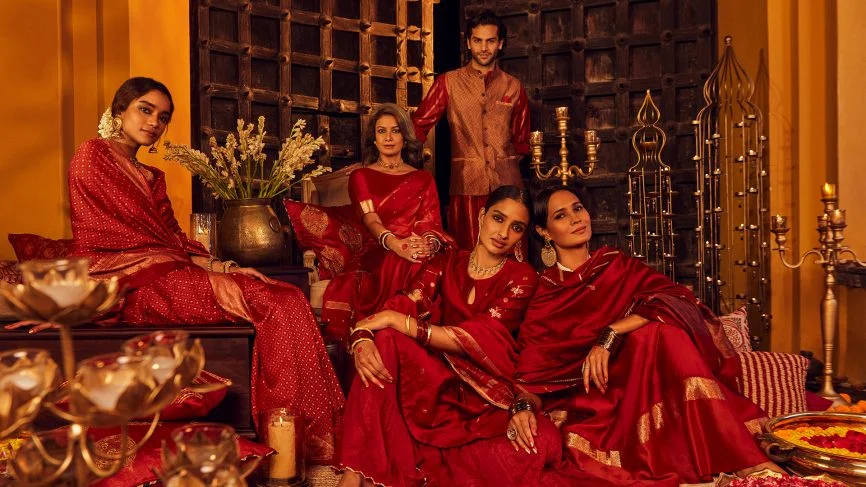
Case Summary
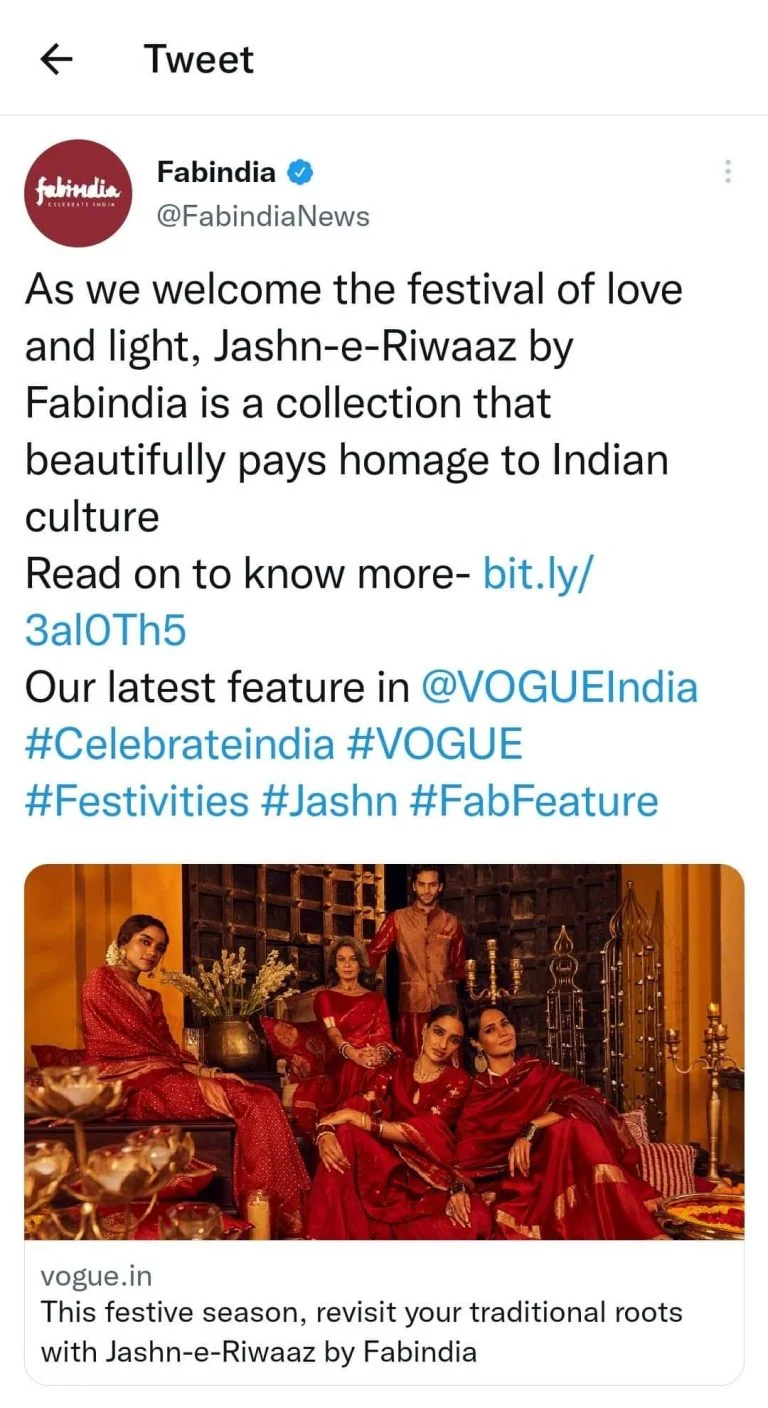
The Diwali festival was targeted for de‑Hinduisation as a clothing brand named 'Fab India' labelled its Diwali clothing collection as “Jashn‑e‑Riwaaz”, an Islamic term. This advertisement, which was uploaded on YouTube on 9 October 2021, drew major backlash from the Hindu community members, who called this an attempt to Islamise Hindu festivals. Author, speaker and textile enthusiast Shefali Vaidya slammed Fab India for “de‑Hinduising” festivals. “Wow @FabindiaNews, great job at de‑Hinduising Deepawali! Call it a ‘festival of love and light’, title the collection ‘Jashn‑e‑Riwaaz’, take bindis off the foreheads of models but expect Hindus to buy your overpriced, mass‑produced products in the name of ‘homage to Indian culture’!” she tweeted on X (formerly Twitter). Janani Sampath Veeravalli, an X user, questioned, “I'm an Indian, and I have never celebrated Jashn‑e‑Riwaaz. Never heard of it. What on earth is this festival?” Taking a jibe at the brand, another user, Vivek Iyer, said, “So @FabindiaNews has renamed #MiladUnNabi as #JashneRiwaaz … Wish them good sales … but personally feel the colours are too gaudy … A green tone would have set it right …” Professor Anand Ranganathan of Jawaharlal Nehru University (JNU) tweeted, “All this is great, but can you please clarify which festival you are talking about, and which religion it belongs to, given that all festivals are celebrations of love and light and not hate and darkness? You can DM me the festival’s name if you are too scared. Thanks.” Several X users gave a call to boycott the brand and called it an 'Islamisation' of Hindu festivals. Following this social media outrage, Fab India deleted every single tweet carrying the name or hashtag “Jashn‑e‑Riwaaz.” Reports confirmed that the advertisement campaign released by the brand was a complete mismatch with the title chosen for the Diwali collection. Fab India’s “Jashn‑e‑Riwaaz” video campaign ironically featured the rich culture and tradition of Rajasthan. The campaign started with a Rajasthani lad taking a group of friends belonging to different ethnicities to his home to celebrate the festival of Diwali. While driving amidst the varied traditional aspects of Rajasthan, the boy wondered how his friends might be perceiving the time‑honoured traditions and history of the state. The advertisement then focused on Rajasthani traditions, rituals, food and, finally, the couture to highlight the richness, heritage and legacy of Diwali, a festival celebrated by lighting diyas, bursting crackers and distributing sweets, among other customs, to mark the victory of good over evil.
Case Images
Why it is Hate Crime ?
This case is being added to the tracker under the primary category- Hate Speech against Hindus. The subcategory selected is- Anti-Hindu subversion and prejudice. Hate speech is defined as any speech, gesture, conduct, writing, or display that is prejudicial against a specific individual and/or group of people, which is leading to or may lead to violence, prejudicial action or hate against that individual and/or group. Media plays a specific and overarching reach in perpetuating prejudicial attitudes towards a community owing to unfair, untrue coverage and/or misrepresentation/misinterpretation, selective coverage and/or omission of facts of/pertaining to issues affecting a specific religious group. This type of bias can dehumanise the victim group, making it easier for others to justify harmful actions against them, which aligns with the objectives of hate speech laws aimed at preventing such harm. It is often observed that the media takes a prejudicial stand against the Hindu community driven by their need to shield the aggressor community which happens to be a numeric minority, however, is the one perpetrating violence against Hindus. For example, the media is often quick to contextualise religiously motivated crimes against Hindus, omit or misrepresent facts that point towards religiously motivated hate crimes, justify and/or downplay religiously motivated hate crimes or simply present fake news to stereotype Hindus. Such media bias leads to the denial of persecution and is often used to dehumanise Hindus, leading to justification for violence against them. For example, the media covered several fake allegations of Hindus targeting Muslims and forcing them to chant Jai Shree Ram. Most of these cases were proved false and fabricated after police investigation. These fake news reports were subsequently never retracted or clarified. Such fake news led to the justification of violence and dehumanisation of Hindus based on the argument that since Hindus targeted Muslims and forced them to chant Jai Shree Ram, the dehumanisation of Hindus and violence against them was par for the course and merely a retaliation. Such media bias leads to prejudicial portrayal of Hindus and offers a justification for violence against them and therefore, is considered hate speech under this category. This is a clear case of a crime motivated by anti-Hindu prejudice because the clothing brand Fab India deliberately attempted to Islamise a Hindu festival, Diwali, by giving it an Islamic-sounding Urdu name, Jashn e Riwaaz, in its advertisement campaign. By rebranding a core Hindu festival through the language and terminology associated with Islam, the campaign engaged in a subtle but targeted erasure of Hindu cultural identity in the public sphere. Using the medium of media and advertising as a powerful tool for shaping perception, the brand reduced a distinctively Hindu religious and cultural event to a generic linguistically Muslim-coded phrase, which offended Hindu sensibilities and contributed to a broader pattern of symbolic marginalisation. This amounts to a religiously motivated act of Hinduphobia where a Hindu festival is framed as if it belongs more to an Islamic or Urduate context than to its own tradition. Diwali is one of the most significant Hindu festivals, deeply rooted in Hindu scripture, epics and community life. It commemorates the return of Lord Shri Ram to Ayodhya after defeating the demon king Ravana, symbolising the victory of good over evil, light over darkness and knowledge over ignorance. The festival is marked by lighting diyas, bursting crackers, offering prayers to deities such as Lakshmi and Ganesha, exchanging sweets, wearing new clothes and performing family rituals that are intrinsically Hindu in theology and practice. Despite knowing this fact, Fab India deliberately tried to Islamise this Hindu festival by launching a Diwali-themed collection and in its advertisement calling it “Jashn‑e‑Riwaaz”, an Islamic-derived Urdu phrase that has no traditional connection to Diwali. This showcases a subtle, indirect attempt to de-Hinduise a Hindu festival to remove Hindus from their own cultural and religious self-representation and in a way to mock the festival’s sanctity because Diwali and Hinduism have no organic link to Islam or Urdu. By choosing an Islamic Urdu formulation instead of a Sanskrit or plainly Hindu-derived term, the brand showcased a clear bias against Hinduism. Had the intent been genuinely neutral or inclusive, it could have used a Sanskrit or pan Indian Hindi phrase rather than one that leans explicitly Islamic. It is also important to address that some pseudo-secular or anti-Hindu voices may claim that this Fab India advertisement was merely syncretism and not communal or anti-Hindu, yet such brands do not apply the same syncretic logic to Eid or Ramzan; they still use terms like “Eid Mubarak”, “Ramzan”, “Shab Ramadan” or “Shab Eid” without softening or de-Islamising them with Hindu or Sanskrit labels. The selective imposition of Islamic terminology only on Hindu festivals reveals a pattern of bias and targeted cultural undermining, making this a clear case of a religiously motivated Hinduphobic act. When such Islamisation of Hindu festivals is normalised through repeated use in media and advertising, the festival slowly loses its original cultural and religious meaning and becomes diluted in public memory. Over time, this erodes the distinct identity of Diwali as a Hindu festival and threatens to sever the link between the community and its own traditions. This gradual cultural flattening reflects a deep-seated religious animosity towards Hinduism, where the perpetrator prefers to frame Hindu religious life through Islamic language and symbolism rather than allowing it to stand on its own terms. For these reasons, this campaign can be seen as a hate crime by symbolic proxy, not a physical assault, but a sustained institutional-level assault on Hindu religious identity aimed at shrinking its visible space in the public imagination. Given that this case meets several key parameters of a hate crime targeting the Hindu community using symbolic erasure, spreading distortion through mass media and advertising and generating widespread communal offence, it has been recorded in the hate crime database of the Hinduphobia Tracker.


Case Status
Unknown


Perpetrators Details
Perpetrators
Others
Perpetrators Range
Unknown
Perpetrators Gender
unknown
 Sources




