Hindu temple desecrated, cow meat dumped inside its premises during Diwali celebrations; Muslims had previously hurled eggs at the same temple
 Malad, Maharashtra, India
 7 November, 2026
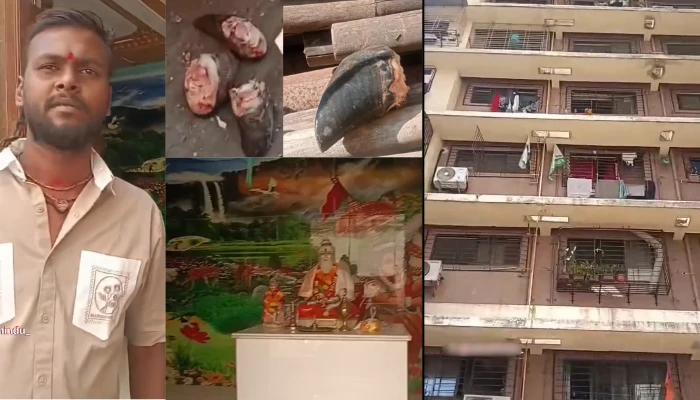
Case Summary
In Malad West, Mumbai, a Hindu temple was desecrated after cow meat was dumped inside its premises by unknown miscreants. The incident occurred on the day of Diwali, 8 November 2026. According to information available, the incident took place at the Shree Valmiki Temple in Gudiya Pada, Malad West. The incident provoked anger among local Hindus and Hindu activists, who viewed the act as a deliberate attempt to desecrate their place of worship and disrupt Diwali celebrations. The incident came to light after Sakal Hindu Samaj, a Maharashtra-based Hindu organisation, posted about it on its official X account, 'Sakal Hindu Samaj Mumbai'. In its post, the organisation stated that cow meat (gau maas) had been dumped inside the Maharshi Valmiki Temple on the morning of Diwali. It also stated that no First Information Report (FIR) had been registered in the matter and urged the Mumbai Police to take legal action against those responsible. A year before this incident, in October 2025, a similar attempt to desecrate the same temple had taken place when a few Muslim individuals hurled eggs at the temple during Shree Valmiki Jayanti celebrations. This earlier incident had also been documented by the Hinduphobia Tracker. Sakal Hindu Samaj stated that no subsequent police action had been taken in that case either, despite an FIR having been registered. The recurrence of such incidents at the same place of worship intensified concerns among local Hindus over repeated attacks on their temple and religious observances. Following the latest incident, members of the local Hindu community appealed to the police to take immediate action, register an FIR and ensure that those responsible were brought to justice. Hindu activists also warned that demonstrations would be organised if the police fails to take action against those responsible.
Why it is Hate Crime ?
The primary category in this case is: Attack on Hindu religious representations. The first subcategory selected under this is: Defiling religious customs. Sanatan Dharma is not a religion of one book, which is to say that while it has religious scriptures that form the central tenets of the faith, there are several traditions followed through thousands of years, mostly passed from generation to generation orally. There are several such customs and traditions that are followed by various Hindus and Hindu sects. Defiling these traditions and customs is a breach of an individual or group’s religious practices. Such practices can range from dietary restrictions like not eating non-vegetarian food for a certain period of the year, not eating non-vegetarian food at all, not eating beef since the cow is considered holy in Hinduism, the sanctity of religious customs followed in the house (like many ISKCON devotees), etc. Any malicious action leading to the breach of such traditions or defilement of these traditions owing to animosity towards the faith or for the sake of activism stems not only from the lack of faith in the religion itself but also from disregard for the faith of the devotees who follow the customs/traditions and implicit bias against the faith, the tradition itself. Since these specific traditions are central to the faith of the devotees of that specific sect of Hindus, any non-compliance with these traditional rules would be considered a religiously motivated hate crime. This case was included in the Hinduphobia Tracker because a Hindu temple was desecrated with cow meat dumped inside its premises on the day of Diwali. The act constituted a violation of the sanctity of a Hindu place of worship and demonstrated hostility towards Hindu beliefs and practices, making it a clear example of a religiously driven hate crime. Hindu temples are consecrated spaces dedicated to the worship of deities and are maintained according to religious customs and traditions that emphasise purity and sanctity. Devotees visit these spaces to offer prayers, perform rituals and observe religious practices. Food and substances considered impure within Hindu religious traditions, particularly non-vegetarian food, are traditionally kept away from such sacred premises. Maintaining the purity of a temple is integral to Hindu worship, and deliberately introducing such substances into its premises constitutes a direct violation of its religious sanctity. Dumping cow meat inside the Shree Valmiki Temple therefore amounted to a deliberate transgression of the customs governing a Hindu place of worship and showed blatant disregard and contempt for the religious beliefs of its devotees. The religious significance of the cow in Hinduism makes the act even more grave. The cow is revered as Gau Mata and holds a sacred position in Hindu belief, symbolising motherhood, compassion, nourishment and divine nurturing. Vedic literature refers to the cow as 'Aghnya', meaning one that should not be harmed or killed. Cow slaughter is regarded as a grave religious transgression, while abstaining from beef reflects the reverence accorded to the animal by Hindu communities. Dumping cow meat inside a Hindu temple therefore amounted to bringing the remains of an animal revered as sacred into a consecrated space dedicated to worship. This deliberate violation of a deeply rooted religious custom defiled the sanctity of the temple, insulted the religious sentiments of its devotees and demonstrated deep-seated contempt for Hindu beliefs. Such an act constituted sacrilege and reflected hostility towards Hinduism and the Hindu community. The timing of the incident further aggravated the religious transgression. The temple was desecrated on the morning of Diwali, one of the most significant festivals in Hinduism, symbolising the victory of light over darkness and good over evil. Diwali is a sacred occasion marked by prayers, worship of deities, the lighting of diyas and religious rituals. Hindus observe the festival with devotion and reverence, visiting temples and participating in religious ceremonies with their families and communities. The festival holds immense religious and cultural significance and represents an important expression of Hindu faith and tradition. The fact that cow meat was dumped inside a Hindu temple while Diwali celebrations were taking place demonstrated hostility towards Hindu religious observances and the community celebrating the festival. Desecrating a place of worship on such a sacred occasion disrupted the sanctity of the festival and deeply hurt the religious sentiments of devotees. Furthermore, this was not the first instance of the same temple being targeted during a Hindu religious observance. In October 2025, during Shree Valmiki Jayanti celebrations, a few Muslim individuals had hurled eggs at the Shree Valmiki Temple in an attempt to desecrate the place of worship. The recurrence of such acts at the same temple, particularly in connection with Hindu religious occasions, demonstrated repeated hostility towards Hindu places of worship and religious celebrations. Such acts reflected contempt for Hindu customs, traditions and sacred spaces. In the present incident, although the perpetrators who dumped the cow meat inside the temple remained unidentified, the nature of the act demonstrated deep-seated hostility towards Hinduism, Hindu religious beliefs and places of worship. Therefore, this case is being added to the hate crime database of the Hinduphobia Tracker.


Case Status
Unknown


Perpetrators Details
Perpetrators
Unknown
Perpetrators Range
Unknown
Perpetrators Gender
unknown
 Sources



