Hindu customs defiled; Muslims hurl eggs at Hindu temple during Valmiki Jayanti celebrations
 Malad, Maharashtra, India
 6 October, 2025
Case Summary
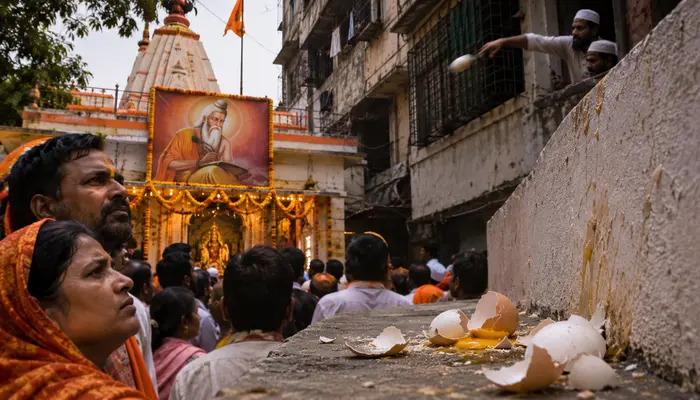
In Malad, Mumbai, Maharashtra, during the occasion of Maharishi Valmiki Jayanti, eggs were hurled just outside the Shri Maharishi Valmiki Temple by members of the Muslim community. The incident occurred on 7 October 2025, during the occasion of Maharishi Valmiki Jayanti. A large number of Hindu devotees had gathered at the temple to celebrate the birth anniversary of Maharishi Valmiki and participate in the religious ceremonies. While the puja was underway, eggs were thrown towards the temple from a nearby residential building by members of the Muslim community, disrupting the religious gathering and hurting the religious sentiments of the devotees present. The incident went viral on social media, showing eggshells near the Hindu temple. A police complaint was filed following the incident, after which the police investigated the matter and examined CCTV footage from the surrounding area to identify those responsible. During the coverage of the incident, Hindu devotees also described repeated instances of hostility towards the temple and the Hindu devotees. They stated that stones had been thrown towards the temple on previous occasions and that people from the nearby building had spat paan-stained saliva towards the temple premises. A female devotee recounted that someone had spat on her as well. The devotees expressed concern over the repeated incidents and stated that such acts had created tension in the surrounding area. Police continued their investigation into the egg-throwing incident.
Why it is Hate Crime ?
This case has been added to the tracker under the primary category of - Attack on Hindu religious representations. Within it, the sub-category selected here is - Defiling religious customs. Sanatan Dharma is not a religion of one book, which is to say that while it has religious scriptures that form the central tenets of the faith, there are several traditions followed through thousands of years, mostly passed from generation to generation orally. There are several such customs and traditions that are followed by various Hindus and Hindu sects. Defiling of these traditions and customs is a breach of an individual or group’s religious practices. Such practices can range from dietary restrictions like not eating non-vegetarian food for a certain period of the year, not eating non-vegetarian food at all, not eating beef since the cow is considered holy in Hinduism, the sanctity of religious customs followed in the house (like many ISCKON devotees), etc. Any malicious action leading to the breach of such traditions or defilement of these traditions owing to animosity towards the faith or for the sake of activism stems not only from the lack of faith in the religion itself but also from disregard for the faith of the devotees who follow the customs/traditions and implicit bias against the faith, the tradition itself. Since these specific traditions are central to the faith of the devotees of that specific sect of Hindus, any non-compliance with these traditional rules would be considered a religiously motivated hate crime. The other sub-category selected here is - Attack on temples. In Hinduism, a temple is the abode of the Deity. The Deity in the Temple is consecrated, thereby, making it a real, breathing entity. Hindus believe that not just the Deity but the temple premises itself are sacred to Hindus since Hindus hold the faith that the entire Temple space is an amalgamation of the divine energy of the deity. Given the central significance of Temples in Hindu Dharma, any attack against a Hindu Temple or its peripheral premises is an attack on the faith itself and is born out of animosity towards the faith, of which, the Temple is a central tenet. Any manner of attack against a Temple and/or its premises would therefore be considered a religiously motivated hate crime. The incident constituted a hate crime because the act was directed at a Hindu religious site at a time when devotees had gathered to observe an important religious occasion. A temple is a sacred place of worship for Hindus, and Maharishi Valmiki Jayanti is an occasion of religious and cultural significance for the community. Targeting the temple during the celebrations interfered with the peaceful observance of a Hindu religious occasion and conveyed hostility towards the religious practices being carried out there. The timing and location of the act were particularly relevant in establishing its communal character. Hindu devotees had assembled at the temple to offer prayers and participate in religious ceremonies when eggs were thrown towards the place of worship while the puja was underway. The act directly disrupted a Hindu religious gathering and targeted a sacred space at a time when devotees were exercising their religious identity and observing an important occasion. Such conduct reflected religious hostility towards the public expression of Hindu religious identity and the places of worship central to its practice. Throwing eggs towards a temple during an ongoing puja insulted the sanctity of the place of worship, disrespected the religious sentiments of the devotees and intimidated the Hindu community gathered there. The earlier incidents described by the devotees further demonstrate the religious animosity surrounding the temple. The acts of throwing stones and spitting towards the temple premises, along with the incident in which a female devotee was spat on, demonstrate religious animosity towards both the Hindu place of worship and its devotees. Considered alongside the egg-throwing during Maharishi Valmiki Jayanti, these acts demonstrated religious animosity towards the Hindu community and its religious practices, rather than an isolated act of mischief. The act reflected religious hostility rooted in the Islamic doctrinal rejection of idol worship, which regards the worship of idols and images as shirk (associating partners with Allah). Hindu idol worship, being a central aspect of Hindu religious practice, directly conflicts with this prohibition. The incident therefore constituted an attempt to humiliate and provoke Hindus on account of their religious identity by targeting a form of worship central to their faith. Such conduct reflected hostility towards Hindu religious beliefs and an intent to insult the community by attacking the sanctity of its place of worship. It demonstrates an attempt to suppress Hindu religious expression because of its doctrinal rejection, transforming the incident into a religiously motivated hate crime.


Case Status
Complaint filed


Perpetrators Details
Perpetrators
Muslim Extremists
Perpetrators Range
Unknown
Perpetrators Gender
unknown
 Sources



