Hindu temple desecrated; Muslim MLA who called for eradication of Sanatana Dharma enters restricted areas of Meenakshi Temple claiming he was ‘entitled’ to do so
 Madurai, Tamil Nadu, India
 9 November, 2026
Case Summary
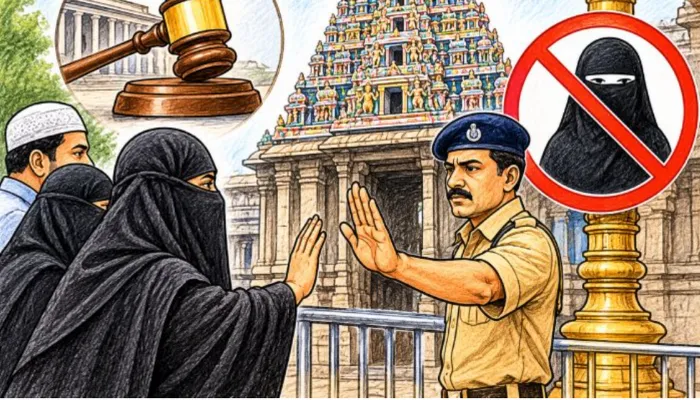
In Madurai, Tamil Nadu, a Muslim MLA, V.M.S. Mustafa, also known as Badrudeen Mustafa, with past anti-Hindu antecedents, visited a temple, invoking his position as an elected public representative. After his election, Mustafa entered restricted sacred areas and climbed the temple tower during the Kumbhabhishekam ceremony, despite the customs and requirements governing entry. He maintained that his position as a public representative "entitled" him to enter the temple and inspect its facilities. The Madras High Court on Friday (October 23, 2026) delivered a strongly worded judgment, strongly criticised MLA Badrudeen Mustafa for entering the Madurai Meenakshi Temple premises and climbing temple towers during a Kumbhabhishekam ceremony under the guise of inspecting amenities. The court emphasised that traditions and customs of Agamic temples cannot be overridden by political optics or actions, noting the contradiction of entering sacred towers while previously making remarks regarding Sanatana Dharma. In its decision dated 23 October 2026, the Madurai Bench of the Madras High Court, comprising Justices G.R. Swaminathan and P. Murugan, addressed political leaders' entry into Hindu temples. The High Court came down heavily on non-Hindu politicians engaging in “egregious breaches” of temple rules and entering Hindu temples without signing the necessary undertaking. The Court cited Badrudeen Mustafa, an MLA representing the Madurai Central Constituency. Pointing out an irony, the Court noted that the politician who called for the eradication of Sanatan Dharma entered the Meenakshi temple soon after his election, in the name of inspection. The Court pointed out another instance where a minister who is a Christian by faith entered the Thiruchendur temple without giving the undertaking required of non-Hindus. It further recalled a viral video on social media showing persons wearing skull caps pushing their way through the Thiruvannamalai Arunachaleswarar temple despite protests from devotees. The court also observed that temple administration staff had remained passive during the incident. The Court observed that such temple visits by politicians have nothing to do with faith and are only meant for optics to impress voters. It mentioned an example of a non-Hindu politician, without mentioning the name, who was a fundamentalist but visited temples and wore a mark on his forehead to “play to the gallery”. “Not only Chamchagiri but also optics matter in a democracy. We know of one political leader who is a fundamentalist subscribing to a non-Hindu faith. But he would make a point of visiting the temple and prominently displaying the religious mark on his forehead. This was to play to the gallery. The vote value of such a display is obvious,” the Court highlighted. It may be recalled that V.M.S. Mustafa, also known as Badrudeen Mustafa, had earlier courted controversy by publicly calling for the eradication of Sanatan Dharma. Hinduphobia Tracker had documented this incident. Speaking to reporters on 13 May 2026, Mustafa said, “We too subscribe to the ideals of Periyar and Ambedkar. We, too, have entered the fray to abolish Sanatana.” His statement quickly triggered reactions from political leaders and social media users. While referring to this remark, the Madras High Court upheld the traditions of Agamic temples barring entry to non-Hindus without showing reverence for the deity.
Why it is Hate Crime ?
This case has been added to the tracker under the primary category: Attack on Hindu religious representations. The sub-category selected is: Breaking rules of place of worship Sanatan Dharma is not a religion of one book, which is to say that while it has religious scriptures that form the central tenets of the faith, there are several traditions followed through thousands of years, mostly passed from generation to generation orally. One of these oral traditions or written traditions is the rules of specific temples. Certain temples have rules which are traditional rules, dependent on the worship of the presiding deities. These rules and traditions have been followed for thousands of years whether they have scriptural mention. Such traditions are based on the nature and rules of worship of the presiding deity of that temple. Any non-compliance with these traditions owing to animosity towards the faith or for the sake of activism stems not only from the lack of faith in the presiding deity but also from disregard for the faith of the devotees of that deity/temple and implicit bias against the faith, the tradition, and the deity itself. Since these specific traditions are central to the faith of the devotees of that specific temple and presiding deity, any non-compliance with these traditional rules would be considered a religiously motivated hate crime. The other sub-category selected here is: Defiling religious customs Sanatan Dharma is not a religion of one book, which is to say that while it has religious scriptures that form the central tenets of the faith, there are several traditions followed through thousands of years, mostly passed from generation to generation orally. There are several such customs and traditions that are followed by various Hindus and Hindu sects. Defiling these traditions and customs is a breach of an individual or group’s religious practices. Such practices can range from dietary restrictions like not eating non-vegetarian food for a certain period of the year, not eating non-vegetarian food at all, not eating beef since the cow is considered holy in Hinduism, the sanctity of religious customs followed in the house (like many ISKCON devotees), etc. Any malicious action leading to the breach of such traditions or defilement of these traditions owing to animosity towards the faith or for the sake of activism stems not only from the lack of faith in the religion itself but also from disregard for the faith of the devotees who follow the customs/traditions and implicit bias against the faith and the tradition itself. Since these specific traditions are central to the faith of the devotees of that specific sect of Hindus, any non-compliance with these traditional rules would be considered a religiously motivated hate crime. In Sanatana Dharma, temple entry rules are governed by longstanding religious customs and traditions. While many Hindu temples and their general areas are open to people of different faiths, certain temples and sacred sections within them are reserved exclusively for practising Hindus. These restrictions are not arbitrary. They are rooted in the religious character of the temple and the traditions that govern worship and preserve the sanctity of sacred spaces. Several prominent Hindu temples follow such customs. The Lingaraj Temple in Bhubaneswar and the Jagannath Temple in Puri restrict entry to non-Hindus. The practice at Jagannath Puri dates back centuries and has been strictly maintained as part of the temple's traditions. Historical accounts even record that a Gajapati King was denied entry because he was married to the daughter of a Mughal soldier. Similarly, the Pashupatinath Temple in Nepal, one of the most revered shrines dedicated to Lord Shiva, reserves its main temple and sanctum for Hindus. The Pashupati Area Development Trust confirms that non-Hindu visitors may access other parts of the complex and observe the temple from the surrounding ghats, but cannot enter the main sanctum. Photography is also prohibited inside it. These restrictions reflect established religious customs governing access to sacred spaces. The same distinction is important in the case of the Madurai Meenakshi Amman Temple. The Meenakshi Amman Temple is the seat of the presiding deity and holds immense religious significance for Hindu devotees. Its identity and sanctity are maintained through established rituals, traditions and rules governing entry and worship. These customs form an essential part of Hindu religious practice and cannot be treated as ordinary administrative formalities. Entry into such an institution requires respect for its religious character and the practices prescribed for its devotees. Despite knowing the rules and customs governing access to such spaces, Mustafa entered the temple's restricted sacred areas, including the garbha griha. His position as an elected representative did not give him the authority to override the temple's religious traditions or claim a special entitlement to enter areas governed by specific rules. Equally important is the MLA's history of statements targeting Hinduism and its religious traditions. He had openly called for the eradication of Sanatana Dharma, expressing hostility towards the very religious tradition to which the Meenakshi Amman Temple belongs. This was not merely a political statement. It demonstrated contempt for Hindu faith and its traditions. Against this backdrop, his subsequent decision to invoke his political position to claim an entitlement to enter and inspect the temple, while disregarding the customs governing access to its sacred spaces, assumes greater significance. His conduct exhibits deliberate disregard of Hindu religious sentiments and the sanctity of its places of worship, warranting inclusion in the tracker.


Case Status
Perpetrator held guilty by court


Perpetrators Details
Perpetrators
Muslim Extremists
Perpetrators Range
One Person
Perpetrators Gender
male
 Sources



