Hindu community targeted; Muslim politician from Tamil Nadu calls for "abolition of Sanatana Dharma"
 Tamil Nadu, India
  12 May, 2026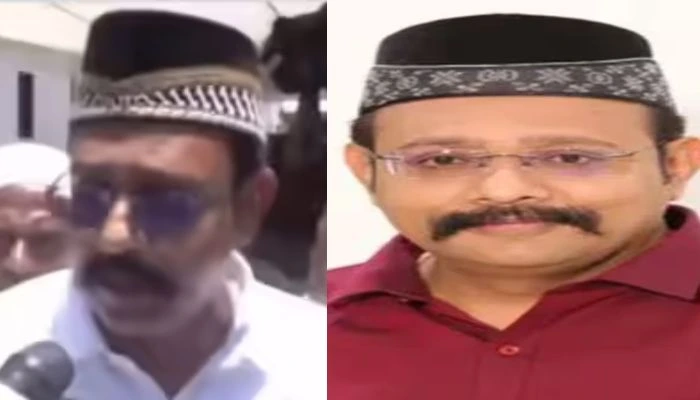
Case Summary
In Tamil Nadu, an anti-Hindu hate speech was made by the ruling Tamilaga Vettri Kazhagam (TVK) party’s Muslim Member of the Legislative Assembly (MLA), VMS Mustafa. He stated that his party followed the ideals of Periyar E. V. Ramasamy and B. R. Ambedkar and had “entered the fight to abolish Sanatana Dharma (Hinduism).” Speaking to reporters on 13 May 2026, Mustafa said, “We too subscribe to the ideals of Periyar and Ambedkar. We, too, have entered the fray to abolish Sanatana.” His statement quickly triggered reactions from political leaders and social media users. Reacting strongly to Mustafa’s remarks, Shanthi Kumar, Vice President of the Bharatiya Janata Party (BJP) Telangana, accused TVK of revealing its “real agenda.” In a post on X, he said, “TVK MLA Mustafa says they entered politics to destroy Sanatana, Udhayanidhi repeats the same old ‘eradicate Sanatan’ line, and silence from Vijay speaks volumes. Hindu votes were taken with folded hands, but now the real agenda is out in the open.” VMS Mustafa’s remarks came a day after Udhayanidhi Stalin, a Dravida Munnetra Kazhagam (DMK) politician, once again repeated his earlier 2023 comments about “eradicating” Sanatana Dharma during a discussion in the Tamil Nadu Assembly on Tuesday, 12 May 2026. This incident was previously reported by the Hinduphobia Tracker. During the discussion, Stalin said, “Sanatana Dharma, which divides people, must certainly be abolished.” Even prior to this, on 2 September 2023, Udhayanidhi Stalin delivered a speech at an event titled the “Sanatana Abolition Conference”, organised by the Tamil Nadu Progressive Writers Forum. During the conference, he compared Sanatana Dharma with mosquitoes, dengue, malaria and coronavirus, and stated that such things should not merely be opposed but eradicated. In the same 2023 speech, Udhayanidhi Stalin further stated that Sanatana Dharma opposed equality and social justice. He said that Sanatana Dharma divided people by caste and segregated communities. Following the 2023 remarks, Tamil Nadu Police registered a First Information Report (FIR) against BJP leader Amit Malviya for distorting Udhayanidhi Stalin’s statements after Malviya publicly criticised the speech. However, on 20 January 2026, the Madurai Bench of the Madras High Court quashed the FIR against Amit Malviya and observed that the remarks made by Udhayanidhi Stalin at the “Sanatana Abolition Conference” amounted to hate speech against the Hindu community. Justice S. Srimathy noted that Hinduism had faced constant attacks over decades and observed that while those reacting to the remarks were booked, no legal action had been initiated against the person who delivered the speech.
Why it is Hate Crime ?
This case is added to the tracker under the primary category- Hate Speech against Hindus. The subcategory selected in this case is- Violent Threats. Violent threats, explicit, implicit or implied, is the most dangerous form of hate speech since it goes beyond discriminatory and prejudicial language to express the intent of causing harm to an individual or a group of people based on their religious identity and faith. There could be several different kinds of threats that are issued to Hindus based on religious animosity. An explicit threat would mean the direct threat of violence towards an individual Hindu, a group of Hindus or Hindus at large. Physical violence, death threats, threats of destruction of property belonging to Hindus and threats of genocide would mean explicit threats against Hindus for their religious identity. Implicit threats may not be a direct threat but implied through the use of symbols of actions – for example – in the Nupur Sharma case, other than explicit threats, there were also implicit threats when Islamists took to the streets to burn and beat her effigies. It implies that they want to do the same to Nupur Sharma – thereby is considered an implicit threat. Violent threats can be delivered in person, through letters, phone calls, graffiti, or increasingly through social media and other online platforms. It would be important to understand that a threat – explicit or implicit, online or offline – to an individual who happens to be a Hindu does not qualify as a religiously motivated threat. Such a threat, while vile and dangerous, could be owing to non-religious reasons and/or personal animosity. To qualify as a religiously motivated threat, it would need to exhibit an indication that the individual is being targeted for religious reasons and/or owing to his/her religious identity as a Hindu. In this case, the accused, VMS Mustafa’s remarks amounted to a clear instance of anti-Hindu hate speech, as the Tamilaga Vettri Kazhagam (TVK) leader openly called for the abolition of Sanatana Dharma, a term widely associated with Hinduism and the Hindu civilisational tradition. While making these remarks, Mustafa invoked the ideological legacy of Dr B. R. Ambedkar and E. V. Ramasamy (Thanthai Periyar), figures whose rhetoric and movements have often been criticised for hostility towards Hindu beliefs, customs and traditions. By declaring that his party had “entered the fray to abolish Sanatana”, Mustafa went beyond political criticism and directly targeted the religious identity and foundational beliefs of millions of Hindus. Calls for the destruction or eradication of a religion carry unmistakable hostile and violent undertones, as they advocate not coexistence or reform, but the complete dismantling of a faith and its spiritual framework. Calling for the abolition of an entire religion amounted to a deeply aggressive expression of religious animosity towards Hinduism and the Hindu community. Hinduism is followed by billions of people as a faith, culture and way of life, and demands for its “eradication” or “abolition” inherently target the existence and continuity of that religious community itself. Such rhetoric demonised and delegitimised Hindu beliefs by portraying the faith as something that needed to be destroyed rather than respected within a pluralistic society. This kind of language fostered hostility against Hindus on the basis of their religious identity and created an atmosphere where hatred towards Hindu traditions and practices was normalised. The use of abolitionist rhetoric against Hinduism reflected an ideological intolerance towards the continued existence of the religion and those who followed it. The seriousness of the remarks was further amplified by the fact that the perpetrator was a Member of the Legislative Assembly (MLA) belonging to the ruling TVK party. When an elected representative associated with the ruling establishment made derogatory and inflammatory remarks calling for the complete abolition of Hinduism or Sanatana Dharma, it carried far greater social and political weight. Statements of this nature from individuals in positions of power could embolden others to express similar hostility towards Hindus and contribute to the normalisation of anti-Hindu rhetoric in public discourse. Such remarks deeply hurt Hindu sentiments and clearly singled out Hindus on the basis of their religious identity. By advocating the destruction of a religion practised by the majority community, the speech amounted to targeted anti-Hindu hate speech directed at the beliefs, traditions and identity of Hindus. Furthermore, the invocation of Dr B. R. Ambedkar and E. V. Ramasamy (Thanthai Periyar) by VMS Mustafa to justify his remarks demonstrated an attempt to frame Hinduism and Sanatana Dharma as inherently casteist and oppressive. By aligning his call for the “abolition of Sanatana” with these anti-Hindu ideological figures, Mustafa sought to portray Hinduism itself as a religion rooted solely in discrimination and social inequality. However, this reflected the personal bias and prejudice of the perpetrator rather than an objective representation of the Hindu faith. Hinduism encompasses diverse philosophical schools, vibrant Bhakti movements and Tantric traditions that have historically emphasised devotion, spiritual experience and personal transformation over birth-based hierarchy, welcoming seekers from varied caste, gender and social backgrounds. Despite this richness and complexity, Mustafa fixated narrowly on caste in order to vilify the entire religion, exposing hostility towards Hindu spiritual heritage and traditions rather than engaging in balanced criticism. Another significant aspect was that this upper-caste versus lower-caste rhetoric mirrored tactics frequently employed by anti-Hindu ideological groups seeking to fracture Hindu unity and weaken the religion from within. By trying to portray Hinduism solely with caste discrimination and presenting Sanatana Dharma as something that must be abolished, Mustafa reinforced a divisive narrative that reduced an ancient and diverse faith to a single social issue. Such rhetoric fostered resentment and polarisation among communities and sought to delegitimise Hindu identity itself. In doing so, the remarks went beyond social commentary and entered the realm of targeted hostility towards Hinduism and its followers, further underscoring the anti-Hindu nature of the speech. The timing of VMS Mustafa’s remarks was also significant, as they came just a day after Dravida Munnetra Kazhagam (DMK) leader Udhayanidhi Stalin once again repeated his earlier statements calling for the “eradication” of Sanatana Dharma by portraying Hinduism as an oppressive religion because of the caste system. Mustafa’s statement, delivered immediately after Stalin’s remarks and using similar abolitionist rhetoric, demonstrated clear ideological support for Stalin’s position and reflected agreement with the narrative that Hinduism itself needed to be dismantled. The back-to-back nature of these statements from leaders belonging to major political parties in Tamil Nadu indicated that such hostility towards Hinduism was not an isolated incident, but part of a wider political ecosystem where anti-Hindu rhetoric was increasingly normalised in public discourse. This was deeply concerning as it fostered religious animosity against Hindus by repeatedly depicting their faith as inherently harmful and illegitimate. When influential political figures openly advocated the abolition or eradication of Hinduism without meaningful condemnation from the broader political establishment, it contributed to the growing normalisation of Hinduphobic rhetoric in Tamil Nadu and intensified fears among Hindus that hostility towards their religion and identity was becoming socially and politically acceptable. Overall, since this current case met the parameters of a religiously driven offence, it is being added to the hate crime database of the Hinduphobia Tracker.


Case Status
Unknown


Perpetrators Details
Perpetrators
State and Establishment
Perpetrators Range
One Person
Perpetrators Gender
male
 Sources




