Hindu devotees assaulted by Christian group at ancient Shiva Temple Hill in Tamil Nadu after questioning religious activities
 Pudukkottai, Tamil Nadu, India
 2 November, 2026
Case Summary
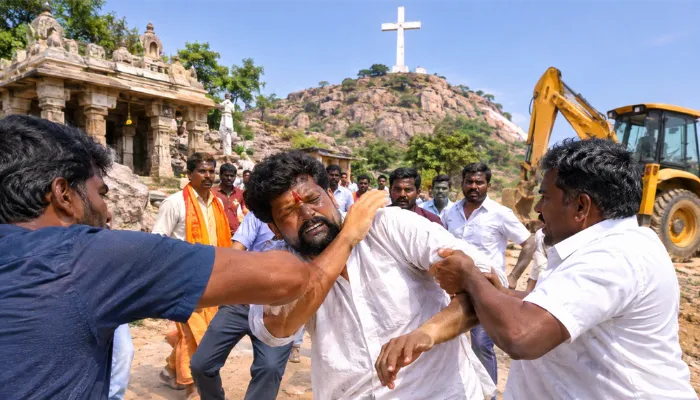
In Lingamalai, Pudukkottai district, Tamil Nadu, Hindu devotees were assaulted by a group of Christians. They questioned the group's religious activities and the installation of illegal structures on the hill, which housed an ancient Shiva temple. Lingamalai is situated near Malampatti village under Perambur Panchayat in Viralimalai block. The hill is home to a 400-year-old Shiva temple and has long been associated with Shaivite worship. It hosts events like the annual Purattasi Pournami Maha Girivalam (circumambulation of the hill on full-moon days), which draws thousands of Hindu devotees. In July 2026, tensions had already surfaced over attempts by Christian missionaries to encroach upon the sacred hill. Reports at the time stated that they had threatened Hindu devotees visiting the temple, vandalised idols and attempted to rename the historically known Lingamalai as 'Kalvari Malai' and 'Saveriyar Malai'. The Revenue Department intervened and issued directions prohibiting both groups from entering the disputed area, conducting prayers or undertaking other activities there. The Madurai Bench of the Madras High Court also directed that no maintenance work be carried out on the cross erected atop the hill. Despite these restrictions, members of the Christian parish and the St. Francis Xavier Youth Club of Malampatti announced another religious gathering at Lingamalai, along with the annual St. Francis Xavier Chariot Festival. An invitation banner announced a flag-hoisting ceremony for 24 November 2026, followed by prayers at the cross and Annadhanam, or community feasting. Christian groups also put up banners announcing prayer meetings and food distribution on days when Hindu devotees gathered for Pournami Girivalam and worship at the Shiva temple. On the morning of the confrontation, members of the Christian group brought a JCB machine to clear the area around the cross. They also installed a solar-powered CCTV camera and lighting system near the site, despite the existing administrative restrictions. When Hindu villagers and devotees reached the hill to question these activities and demand compliance with the Revenue Department's directions, around 30 members of the Christian group assaulted them. A Hindu devotee named Marimuthu sustained serious injuries and was taken to a nearby hospital for treatment. Following the assault, Hindu devotees approached the police and demanded action against those involved. The JCB owner acknowledged that it belonged to him. However, the devotees complained that the police had not taken immediate action against those responsible for the attack. They also objected to being asked to produce further evidence despite having reported the incident. With no immediate action forthcoming, members of Hindu Munnani and the Lingamalai Devotees Committee organised road blockades at Lingamalai and the Perambur Four-Road intersection. They demanded that the police register an FIR, arrest those who had assaulted the Hindu devotees and remove the unauthorised installations from the hill. During the protest, police detained more than 20 Hindu activists and devotees and took them to Avur Lakshmi Mahal community hall. The protesters declared that their agitation would continue until an FIR was registered and action was initiated against those responsible for the assault and the unauthorised activities at Lingamalai. They also demanded protection for the hill's religious identity and restoration of Hindu devotees' right to perform their traditional worship at the 400-year-old Shiva temple.
Why it is Hate Crime ?
The primary category selected for this case is: Attack not resulting in death. The subcategory selected is: Attack against Hindu devotees. Hindu devotees are a few of the easiest targets of religiously motivated hate crimes because during the festival/procession/puja etc, for non-Hindus it is easy to profile their victims on the basis of religion. Hindu devotees come under attack on several occasions by individual non-Hindus or mobs of non-Hindus owing to their animosity against Hinduism, its symbols and tradition/practices. There are several instances of Hindu devotees being attacked while they worship in temples or temporary religious structures, during religious processions, doing bhajan/kirtan/puja in their own homes, in the residential society etc. These attacks are perpetrated by non-Hindus primarily because of their animosity towards Hindus and their faith. In some cases, the trigger for the violence may be non-religious, however, there are two elements that make these hate crimes. First, the Hindus who come under attack are attacked violently while indulging in religious activity. Whether they are in a place of worship or not is immaterial to the crime. When individuals are attacked while indulging in religious practices, the attack in itself is a hindrance to their freedom to practice religion and therefore constitutes a hate crime. Secondly, religious supremacist doctrines and ideologies deem religious practices of Hindus to be offensive ab initio since they are considered “sinful” by these ideologies, worthy to be annihilated by force or coercion. Driven by these religious supremacist ideologies and doctrines, the attacks against Hindu devotees stem from intrinsic animosity towards Hinduism. In some cases, the trigger for the violence may be non-religious, however, it develops into a religiously motivated crime during the course of the violence. Since these attacks stem from animosity towards Hindus and Hinduism, they are considered religiously motivated hate crimes under this category. The next subcategory selected is: Attacked for opposing radicals or trying to save victims. In several cases, Hindus are attacked for opposing religiously motivated crimes being committed against a fellow Hindu or simply for voicing an opinion opposing radical elements, who either have in the past or continue to persecute Hindus. In such cases, the initial attack against the victim, against which the Hindu was trying to defend the victim, would also need to be classified as a religiously motivated hate crime. Since the initial crime itself was religiously motivated and the subsequent crime of attempting to save the victim or speaking against the radical elements ends up inviting a violent attack, it would also be classified as a religiously motivated hate crime under this category. The assault was directed at Hindu devotees in the context of their religious association with Lingamalai. They had gone to the hill to question the activities around the cross and other installations and to protect the ancient Shiva temple and its religious heritage. The violence against them obstructed their efforts to safeguard the sacred site and continue their traditional worship. This was not an ordinary local dispute over the use of land. At its centre was a conflict over activities taking place at a site of longstanding Hindu religious significance. Lingamalai holds particular importance for Hindus because it is home to an ancient Shiva temple and several surviving religious structures and remains. Its inscriptions and sculptures reflect the site's historical and religious significance. The Nandi statue is especially important because Nandi is the sacred bull and the vehicle of Lord Shiva. The remains of the mandapam, a pillared structure associated with religious gatherings and worship, further establish the hill's connection with Hindu religious practices. Lingamalai is therefore not merely a geographical location but a site of Hindu religious and historical heritage. The religious practices of Hindu devotees are equally connected to the hill. Pournami Girivalam, the devotional practice of circumambulating the sacred hill on a full-moon day, is an established tradition that draws thousands of devotees. Against this backdrop, the announcement of the St. Francis Xavier Chariot Festival, prayers at the cross and Annadhanam, along with banners advertising Christian prayer meetings and food distribution on days when Hindus gathered for Pournami Girivalam and temple worship, was particularly provocative. These activities, taking place alongside an existing dispute over the religious character of the hill and despite administrative restrictions, interfered with the traditional religious observances of Hindu devotees. The Hindu religious identity of the victims was central to the confrontation. They were present at Lingamalai as devotees of the Shiva temple and objected to activities that they believed threatened its religious character and their traditional right to worship there. They were assaulted after questioning these activities and demanding compliance with the Revenue Department's directions. Their objection was not rooted in a personal disagreement but arose directly from their association with the sacred hill and their efforts to protect a place of Hindu worship. The violence therefore served to intimidate Hindu devotees who were resisting activities they considered a threat to their religious heritage and traditional worship. By attacking those who questioned the installations and sought to protect the temple site, the perpetrators sought to suppress the Hindu community's efforts to assert its religious rights at Lingamalai. The fundamental motivation behind the assault was hostility towards Hindu devotees defending their sacred place of worship, their religious heritage and their right to practise their faith, making the incident a religiously motivated hate crime against Hindus. Disclaimer: The Hinduphobia Tracker records incidents based on the date on which they occurred or when the victim’s ordeal began, rather than when they were subsequently reported. In this case, the exact date of the incident could not be conclusively established. Therefore, 3 November 2026, the date the incident was brought to public attention, has been recorded as the indicative incident date for documentation purposes only. Victim Count Disclaimer: The report identifies Marimuthu as one Hindu devotee who sustained serious injuries in the assault. Although the Christian group reportedly attacked several devotees present at the site, the exact number of Hindu devotees assaulted has not been established in the available reports. The victim count is therefore based on the confirmed information available and may be updated if further details emerge.
Victim Details
Total Victim
1
Deceased
0
Gender
- Male 1
- Female 0
- Third Gender 0
- Unknown 0
Caste
- SC/ST 0
- OBC 0
- General 0
- Unknown 1
Age Group
- Minor 0
- Adult 1
- Senior Citizen 0
- Unknown 0


Case Status
Complaint registered


Perpetrators Details
Perpetrators
Christian Extremists
Perpetrators Range
From 10 to 100
Perpetrators Gender
both
 Sources



