Hindu religious festival trivialised: Media exposes its anti-Hindu bias through selective outrage and unequal treatment of religious traditions
 India
 22 October, 2021
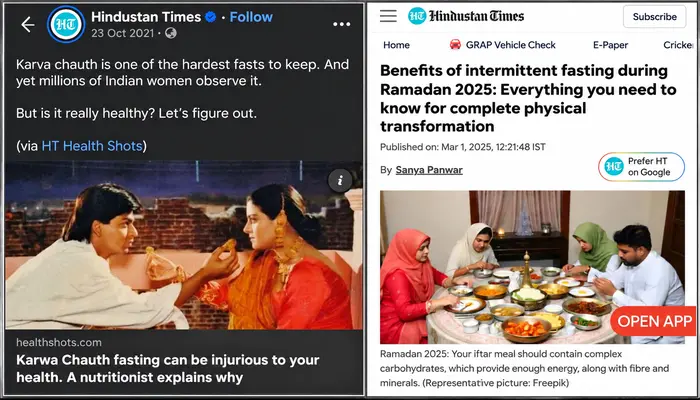
Case Summary
A news media outlet, Hindustan Times, displayed a glaring disparity in its editorial treatment of Hindu and Muslim religious fasting traditions. Its coverage cast the Hindu festival of Karwa Chauth in a negative light, foregrounding potential harm, while its coverage of Ramadan framed fasting through the favourable lens of health benefits and physical transformation. This stark contrast exposed a troubling inconsistency in the publication's editorial standards, demonstrating its selective scrutiny of Hindu religious practices and its unequal treatment of religious traditions. On 23 October 2021, Hindustan Times published a Facebook post concerning Karwa Chauth, stating: “Karwa Chauth is one of the hardest fasts to keep. And yet millions of Indian women observe it. But is it really healthy? Let's figure out.” The accompanying article was headlined, “Karwa Chauth fasting can be injurious to your health. A nutritionist explains why.” The headline placed the potential health risks associated with the Hindu religious observance at the centre of its coverage, establishing a predominantly cautionary narrative around the festival. On 1 March 2025, Hindustan Times published another article, titled “Benefits of intermittent fasting during Ramadan 2025: Everything you need to know for complete physical transformation.” In stark contrast to its coverage of Karwa Chauth, the publication framed fasting during Ramadan positively, highlighting its potential benefits and association with physical transformation. The contrasting headlines highlighted a significant disparity in the publication's editorial framing of the two religious observances. While Karwa Chauth was presented primarily through the lens of potential health risks, Ramadan was framed around potential health benefits and physical transformation. This inconsistency exposed the hypocrisy in Hindustan Times' editorial approach, demonstrating its failure to uphold uniform standards of balance and objectivity when covering different religious traditions. Such selective framing reflected a pattern of disproportionate scrutiny towards Hindu religious customs and a blatant disregard for the sentiments and cultural traditions of the Hindu community. Hinduphobia Tracker covered a similar instance of media bias. An Indian Express journalist had denigrated Karwa Chauth while praising Ramadan fasting for supposed health benefits.
Why it is Hate Crime ?
This case has been added to the tracker under the primary category of: Hate speech against Hindus. The sub-category selected here is: Anti-Hindu subversion and prejudice. Hate speech is defined as any speech, gesture, conduct, writing, or display that is prejudicial against a specific individual and/or group of people, which is leading to or may lead to violence, prejudicial action or hate against that individual and/or group. Media plays a specific and overarching role in perpetuating prejudicial attitudes towards a community owing to unfair, untrue coverage and/or misrepresentation/misinterpretation, selective coverage and/or omission of facts of/pertaining to issues affecting a specific religious group. This type of bias can dehumanise the victim group, making it easier for others to justify harmful actions against them, which aligns with the objectives of hate speech laws aimed at preventing such harm. It is often observed that the media takes a prejudicial stand against the Hindu community driven by their need to shield the aggressor community which happens to be a numeric minority, however, is the one perpetrating violence against Hindus. For example, the media is often quick to contextualise religiously motivated crimes against Hindus, omit or misrepresent facts that point towards religiously motivated hate crimes, justify and/or downplay religiously motivated hate crimes or simply present fake news to stereotype Hindus. Such media bias leads to the denial of persecution and is often used to dehumanise Hindus, leading to justification for violence against them. For example, the media covered several fake allegations of Hindus targeting Muslims and forcing them to chant Jai Shree Ram. Most of these cases were proved false and fabricated after police investigation. These fake news reports were subsequently never retracted or clarified. Such fake news led to the justification of violence and dehumanisation of Hindus based on the argument that since Hindus targeted Muslims and forced them to chant Jai Shree Ram, the dehumanisation of Hindus and violence against them was par for the course and merely a retaliation. Such media bias leads to prejudicial portrayal of Hindus and offers a justification for violence against them and therefore, is considered hate speech under this category. The other subcategory selected here is: Anti-Hindu slurs, mocking faith. Anti-Hindu slurs and the deliberate mocking of the Hindu faith owing to religious animosity involve the usage of derogatory terms, stereotypes, or offensive references to religious practices, symbols, or figures. One of the common anti-Hindu slurs used against Hindus is “cow-worshipper” and “cow piss drinker”. The intention of using this term is to demean and mock Hindus as a group and their religious beliefs since Hindus consider the cow holy. Additionally, some symbols and the slurs attached to them have a historical context that exacerbates the insult, hate, stereotyping, dehumanisation and oppression against Hindus. Cow worship has been used for centuries to denigrate Hindus, insult their faith and oppress Hindus specifically as a religious group. There has been overwhelming documentation about how cow slaughter has been used to persecute Hindus with cow meat being thrown in temples and places of worship. There has also been overwhelming documentation where cow meat (beef) has been force-fed to Hindus to either forcefully convert them to Islam or denigrate their faith. Apart from cow worship, the Swastika – which holds deep religious significance for the Hindus – has also been misinterpreted and distorted to use as a slur against Hindus. Similarly, the worship of the Shivling has been used by supremacist ideologies and religions to denigrate Hindus owing to religious animosity. Such slurs and denigration stem out of inherent animosity and hate towards Hindus and their faith, therefore, it is categorised as hate speech targeted at Hindus specifically owing to their religious identity. This case exemplifies anti-Hindu bias in media, as Hindustan Times displayed blatant double standards in its coverage of Karwa Chauth and Ramadan, portraying the Hindu religious fast as a potential health hazard while glorifying the benefits of fasting during the Muslim religious observance. This selective editorial framing denigrated a Hindu religious tradition by subjecting it to negative scrutiny while extending favourable treatment to another religious practice. Rather than upholding uniform journalistic standards, the publication exposed its deeply discriminatory editorial approach, demonstrating blatant disregard for Hindu religious sentiments and a pattern of unequal treatment towards Hindu customs and traditions. To begin with, the negative framing of Karwa Chauth through an emphasis on potential health hazards amounted to a disparaging portrayal of a deeply rooted Hindu religious observance. Hindustan Times had chosen to foreground the possibility of physical harm, reducing a festival steeped in Hindu faith, devotion and marital commitment to a narrative dominated by health concerns. Karwa Chauth holds profound religious and cultural significance for Hindu women, who observe the fast as an expression of devotion and pray for their husbands' well-being and longevity. Instead of extending due consideration to this religious and cultural significance, the publication had placed the practice under an overwhelmingly negative spotlight. This approach had trivialised the devotion behind the observance, overshadowed its traditional significance and portrayed a Hindu religious custom as a questionable practice requiring public scrutiny. Such framing had demonstrated a blatant disregard for Hindu religious sentiments and had contributed to the denigration of a tradition that formed an important part of Hindu cultural identity. More significantly, the contrasting editorial treatment of Karwa Chauth and Ramadan had exposed glaring double standards in the publication's representation of Hindu and Muslim religious practices. While Karwa Chauth was presented through the language of health hazards and potential harm, Ramadan fasting was promoted through the language of benefits, wellness, and physical transformation. The difference was unmistakable: a Hindu religious observance received a negative portrayal, while a Muslim religious observance received a favourable narrative. This selective presentation cast Hindu traditions in an unfavourable light while extending markedly more positive treatment to another religious practice. This editorial inconsistency reflected an unequal standard of representation, in which Hindu religious customs faced disparaging scrutiny rather than receiving the same respect and consideration. The contrasting narratives had undermined the dignity of Hindu religious observances and had exposed the publication's failure to maintain consistent standards when representing India's religious traditions. Equally concerning was the disproportionate negative scrutiny directed towards a Hindu fasting practice alongside the favourable portrayal of another religious observance, which had reinforced an unequal and disparaging representation of Hinduism. By placing Karwa Chauth under an intensely critical, health-focused lens while highlighting the positive aspects of Ramadan fasting, the publication had subjected a Hindu tradition to an unfavourable standard of scrutiny. This treatment had diminished the standing of Hindu religious customs in public discourse and had conveyed a dismissive attitude towards the faith, devotion and cultural values associated with them. Hindu religious practices had deserved the same dignity and editorial respect as those belonging to every other faith; instead, the contrasting coverage had placed Hindu customs on the receiving end of negative framing while presenting another religious tradition in a celebratory light. Such selective scrutiny had contributed to the denigration of Hindu cultural identity, undermined the sentiments of Hindu devotees and exposed the damaging consequences of unequal religious representation in mainstream media. Overall, this case exemplifies anti-Hindu bias in media through the portrayal of a sacred Hindu festival in a manner that diminished its religious significance and disregarded the sentiments of Hindu women. The incident is therefore being added to the hate crime database of the Hinduphobia Tracker.


Case Status
Complaint not filed


Perpetrators Details
Perpetrators
Others
Perpetrators Range
Unknown
Perpetrators Gender
unknown
 Sources



