Hindu festival Karwa Chauth denigrated by Indian Express journalist, while Ramadan fasting praised for supposed health benefits
 India
 28 October, 2026
Case Summary
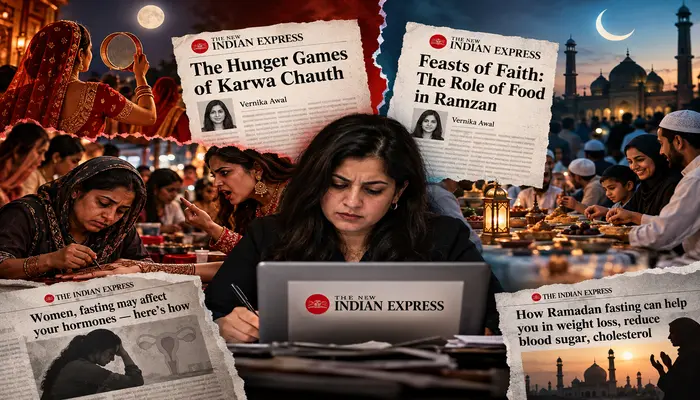
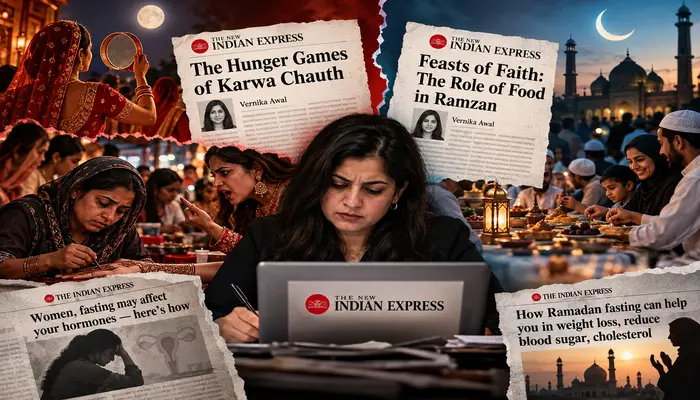
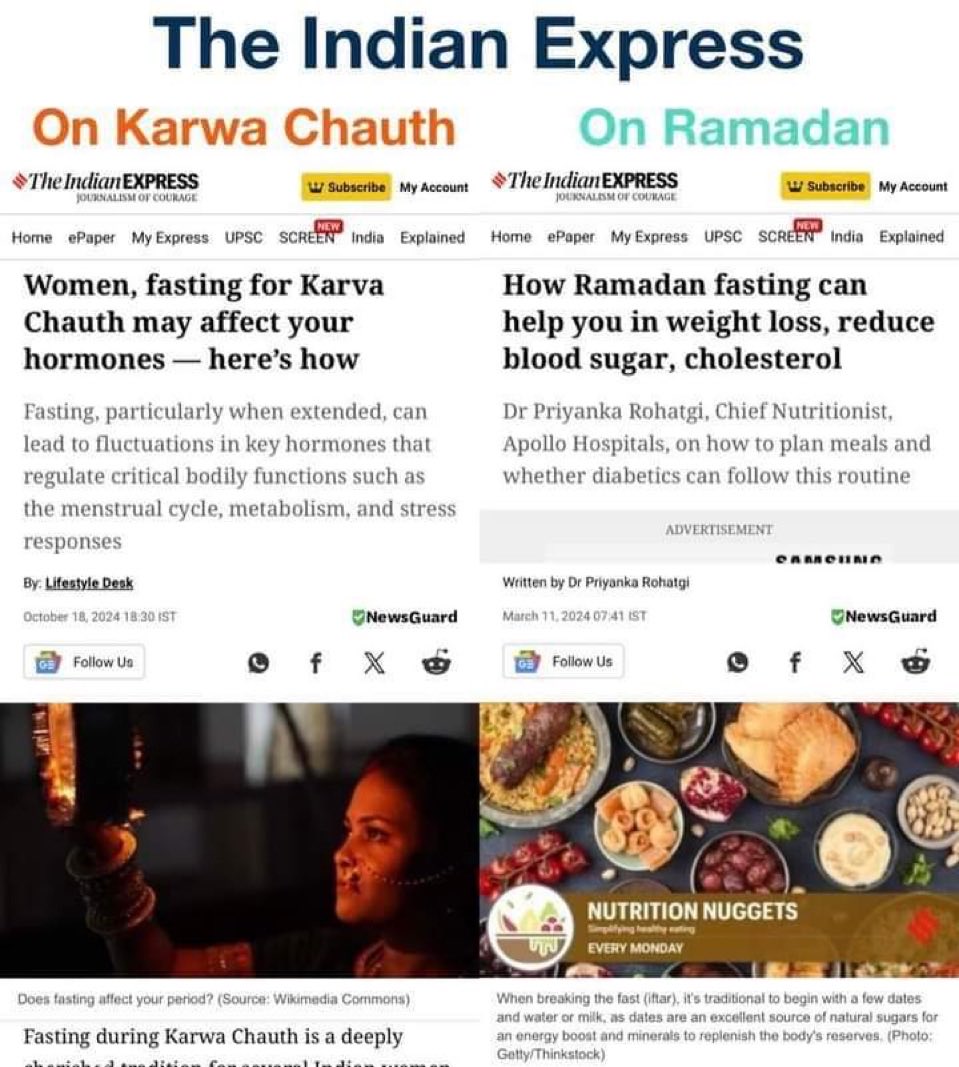
Vernika Awal, a journalist with The New Indian Express, published an article titled ‘The Hunger Games of Karwa Chauth’, in which she denigrated the Hindu festival of Karwa Chauth by portraying it as an occasion of hypocrisy and entitlement among women observing the fast. The article was published on 29 October 2026 and centred on an incident that Awal recounted at the Greater Kailash-2 market in Delhi, where she claimed that mehndi artists from Ahmedabad had travelled to work during the Karwa Chauth rush. According to her account, the artists had been applying mehndi from around 3 pm until past midnight for three consecutive days. She wrote that, at approximately 11:30 pm on 27 October 2026, an argument broke out between the artists and customers waiting for their turn after the artists asked for a short break to eat. One of the artists, Shagufta, 39, was quoted as saying, “Bhook lagi hai humein, khaana nahi khaya hai, tabse mehndi laga rahe hain” (We are hungry. We haven’t eaten, and we’ve been applying mehndi for hours). Awal claimed that one Hindu woman among the customers objected, saying she was paying up to ₹2,500, was already late and had a child to send to school at 6 am. Rather than limiting her criticism to the conduct of the customer involved in the argument, Awal used the incident to pass a broader moral judgement on Karwa Chauth and the Hindu women who observed it. She wrote, “The irony is hard to miss. This is a festival built around hunger.” By describing the festival in these terms, she reduced a religious observance centred on fasting to the physical experience of going hungry, framing that very practice as the basis of an apparent contradiction in the behaviour of its participants. She then wrote, “And yet humility rarely travels beyond the fast itself. Those same women, empty stomachs and all, demand that others serve their ritual on their terms, with little regard for people who do not share their social background and whose hunger counts for less.” Through these words, she attempted to generalise the behaviour of a customer in one incident to all the Hindu women observing Karwa Chauth as a group, portraying them as hypocritical, entitled and indifferent to the suffering of those who served them. The reference to their “social background” further framed the religious observance through a class-based moral judgement, suggesting that the devotion of Hindu women was accompanied by disregard for people they considered socially beneath them. Awal further stated in her concluding remarks: “Going hungry for a day is the easy part. Anyone can do it when they know exactly when it ends. The harder fast is the one in which you hold back your impatience, your entitlement and your sense that the person serving you exists for your convenience. Break the first one at moonrise. Try to keep the second all year.” She presented the fast as the easy and superficial part of the festival, while associating its practitioners with impatience and entitlement; she turned a criticism of individual behaviour into a disparaging characterisation of Hindu women who observed Karwa Chauth. Her article thus treated the religious practice not simply as a tradition that could be examined or criticised, but as a symbol of hypocrisy and moral deficiency among Hindu women. The contrast was particularly evident given that Awal had previously written an article on fasting during Ramzan, titled ‘Feasts of Faith: The Role of Food in Ramzan’, published on 27 March 2025. In that article, she described Ramzan as a “month-long celebration of faith, perseverance, and the profound connection between food and communal identity”, highlighting its spiritual significance, food traditions and role in fostering communal belonging. However, when writing about Karwa Chauth, another religious observance centred on fasting, she adopted a markedly different tone. Rather than acknowledging its religious and devotional significance, she portrayed the fast as an easy and superficial exercise, while associating Hindu women observing it with hypocrisy, entitlement and a lack of consideration for others. Thus, while she presented Ramzan fasting as an expression of faith and community, her portrayal of Karwa Chauth was disparaging towards the Hindu festival and its practitioners. By using the conduct of an individual customer to cast a wider aspersion on women observing Karwa Chauth, Awal denigrated a Hindu religious tradition and portrayed its practitioners in a disparaging manner. The article therefore went beyond criticism of an incident involving customers and service workers, extending its negative characterisation to the Hindu festival and the women who observed it. This was not the first instance in which The Indian Express targeted Karwa Chauth fasting and portrayed it in a negative light while discussing fasting during Ramzan in more favourable terms. On 18 October 2024, the publication carried an article titled ‘Women, fasting may affect your hormones — here’s how’, just two days before Karwa Chauth. The article discussed the possible effects of prolonged or regular fasting on Hindu women’s hormonal health, including fluctuations in insulin and cortisol levels, menstrual irregularities and reproductive health concerns. Although the article discussed fasting in general, its original version included a link to an earlier Karwa Chauth article, thereby placing the health warnings in the context of the Hindu festival. Following criticism over its framing, the publication modified the article and removed the explicit Karwa Chauth context. The contrast became more pronounced when compared with another article published by The Indian Express on 11 March 2024, titled ‘How Ramadan fasting can help you in weight loss, reduce blood sugar, cholesterol’. Written by Dr Priyanka Rohatgi, Chief Nutritionist at Apollo Hospitals, the article highlighted potential benefits of Ramadan fasting, including reductions in body weight, blood sugar, blood pressure and cholesterol. It also offered dietary guidance for those observing the fast. The juxtaposition of these articles showed that the publication had previously presented fasting during Ramzan in terms of its potential health benefits, while its coverage around Karwa Chauth had foregrounded possible health risks. This earlier episode provided context for the criticism of its subsequent coverage of the Hindu festival.
Case Images
Why it is Hate Crime ?
This case has been added to the tracker under the primary category of - Hate speech against Hindus. Within it, the sub-category selected here is - Anti Hindu subversion and prejudice. Hate speech is defined as any speech, gesture, conduct, writing, or display that is prejudicial against a specific individual and/or group of people, which is leading to or may lead to violence, prejudicial action or hate against that individual and/or group. Media plays a specific and overarching reach in perpetuating prejudicial attitudes towards a community owing to unfair, untrue coverage and/or misrepresentation/misinterpretation, selective coverage and/or omission of facts of/pertaining to issues affecting a specific religious group. This type of bias can dehumanise the victim group, making it easier for others to justify harmful actions against them, which aligns with the objectives of hate speech laws aimed at preventing such harm. It is often observed that the media takes a prejudicial stand against the Hindu community driven by their need to shield the aggressor community which happens to be a numeric minority, however, is the one perpetrating violence against Hindus. For example, the media is often quick to contextualise religiously motivated crimes against Hindus, omit or misrepresent facts that point towards religiously motivated hate crimes, justify and/or downplay religiously motivated hate crimes or simply present fake news to stereotype Hindus. Such media bias leads to the denial of persecution and is often used to dehumanise Hindus, leading to justification for violence against them. For example, the media covered several fake allegations of Hindus targeting Muslims and forcing them to chant Jai Shree Ram. Most of these cases were proved false and fabricated after police investigation. These fake news reports were subsequently never retracted or clarified. Such fake news led to the justification of violence and dehumanisation of Hindus based on the argument that since Hindus targeted Muslims and forced them to chant Jai Shree Ram, the dehumanisation of Hindus and violence against them was par for the course and merely a retaliation. Such media bias leads to prejudicial portrayal of Hindus and offers a justification for violence against them and therefore, is considered hate speech under this category. The article reflected anti-Hindu prejudice through the manner in which it framed and characterised Karwa Chauth, a Hindu religious observance. Criticism of an individual's behaviour towards workers would, by itself, not constitute hostility towards a religious community. However, Awal went beyond addressing the conduct of the customer involved in the incident and used it as a basis for making broader judgements about Hindu women observing the Karwa Chauth festival. Her characterisation of Karwa Chauth as a festival “built around hunger”, followed by her assertions about the entitlement and hypocrisy of Hindu women observing the fast, shifted the focus from an isolated disagreement to a disparaging portrayal of the religious practice and its adherents. The behaviour of one customer was effectively made representative of the conduct and moral character of all the Hindu women participating in the festival. Furthermore, the same journalist in the past has glorified the fasting when talking in the context of Ramadan. Karwa Chauth holds religious and cultural significance among Hindu communities, particularly in North India, where married women traditionally observe a day-long fast for the well-being, prosperity and longevity of their husbands. The fast is undertaken as an expression of devotion, marital commitment and prayer, with women abstaining from food and water until they sight the moon and perform the prescribed rituals before breaking their fast. The festival is also marked by prayers, the worship of the moon, the application of mehndi and the gathering of women for customary rituals. For those who observe it, Karwa Chauth is not merely an exercise in going without food or water, but a deeply cherished religious and cultural tradition rooted in faith, devotion and familial bonds. Her framing was particularly problematic because it presented Hindu religious observance itself as evidence of a supposed moral failing. Karwa Chauth involves women voluntarily undertaking a fast as part of a religious and cultural tradition associated with the well-being and longevity of their husbands. Awal's argument did not merely question the treatment of workers during the festival. Instead, she used the fast as a rhetorical device to portray Hindu women observing it as hypocritical, suggesting that their religious discipline was superficial because they supposedly failed to demonstrate humility and consideration towards others. Her concluding comparison between the supposedly easy task of fasting and the supposedly harder task of overcoming entitlement further reinforced this characterisation. This reduced a religious practice to an occasion for ridiculing the supposed moral shortcomings of its Hindu participants. Furthermore, the distinction in Awal's treatment of Karwa Chauth and Ramzan also provides important context. Both observances involve fasting and abstinence from food and water, making the contrasting manner in which Awal portrayed them particularly noteworthy. In her earlier article on Ramzan, she presented fasting through the language of faith, perseverance, spiritual devotion and communal identity. In contrast, her article on Karwa Chauth foregrounded hunger, hypocrisy, entitlement and social insensitivity. The issue was not that the author discussed the potential difficulties or social dimensions of one religious practice while celebrating another. Rather, it was the markedly different framing: an Islamic fasting tradition was accorded positive religious and cultural significance, whereas a Hindu fasting tradition was subjected to a broad negative characterisation. The disparity was also reflected in The Indian Express's earlier coverage of the two fasting traditions in 2024. On 18 October 2024, just two days before Karwa Chauth, the publication carried an article titled ‘Women, fasting may affect your hormones — here’s how’, which highlighted the potential adverse effects of prolonged or regular fasting on women's hormonal health. Drawing on comments from Dr Pooja C Thukral, a Consultant Obstetrician and Gynaecologist at Cloudnine Group of Hospitals, the article discussed how fasting could affect insulin and cortisol levels, interfere with reproductive hormones such as oestrogen and progesterone, and potentially contribute to menstrual irregularities, mood swings and fatigue. The original version also contained a link to an earlier article specifically discussing Karwa Chauth fasting, thereby placing these health warnings in the context of the Hindu festival. Following criticism over this framing, The Indian Express modified the article and removed the explicit Karwa Chauth reference. Additionally, The Indian Express had previously published a similar article targeting Karwa Chauth by highlighting the potential health risks of the Hindu festival's fasting ritual, while presenting Ramadan fasting in a favourable light. The disparity in this coverage was significant because it reflected a difference in the way The Indian Express framed comparable religious practices. Fasting was presented as a potential health concern when discussed in connection with Karwa Chauth, with emphasis on hormonal disruption, menstrual irregularities and reproductive health risks. However, when the publication addressed Ramadan fasting, it highlighted potential health benefits and presented the practice in terms of improved metabolic health and well-being. This contrast raises questions about the consistency of the publication's approach to religious fasting. Both observances involved abstinence from food and water, yet one was primarily associated with adverse health consequences while the other was discussed in terms of its potential benefits. The fact that the publication had previously placed Karwa Chauth under a negative health-focused framing, while giving Ramadan fasting a more favourable treatment, added context to the disparity in its coverage of Hindu and Islamic religious practices. Such portrayals contribute to an environment in which Hindu religious practices are routinely subjected to dismissive and disparaging interpretations, while comparable practices of other faiths receive more sympathetic treatment. The article did not confine itself to questioning a particular customer's behaviour or discussing the working conditions of mehndi artists. It used the incident to cast aspersions on the religious observance and the women who participated in it, presenting their devotion as hollow and their religious discipline as a cover for entitlement. The contrast with the favourable portrayal of Ramzan fasting further underscored the selective treatment of religious practices. Therefore, the concern in this case was not simply criticism of Karwa Chauth or disagreement with the custom of fasting. It was the use of an isolated incident to disparage a Hindu religious tradition and attribute negative moral characteristics to the women who observed it, while presenting a comparable Islamic religious practice in an affirming manner. This constituted anti-Hindu prejudice and denigration of the Hindu faith and its practitioners.


Case Status
Unknown


Perpetrators Details
Perpetrators
Others
Perpetrators Range
One Person
Perpetrators Gender
female
 Sources



