Hindus targeted for conversion through healing promises and denigrating Hinduism at Christian gatherings in Lucknow, Uttar Pradesh
 Lucknow, Uttar Pradesh, India
 2 November, 2026
Case Summary
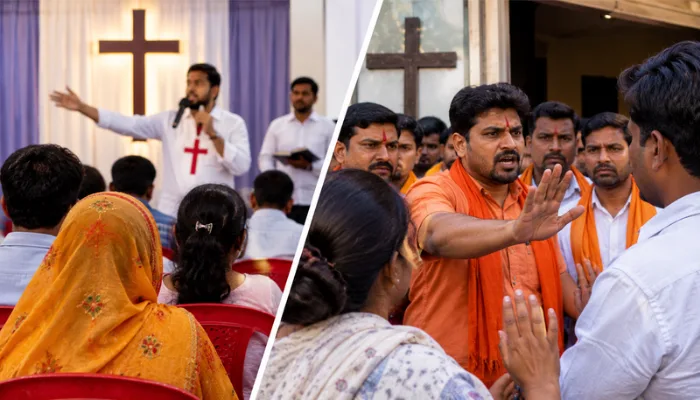
In Lucknow, Uttar Pradesh, Christian missionaries organised a Changai Sabha at a house in Rajajipuram, near Ratnam Eye Hospital, to convert approximately 100 Hindus to Christianity. After learning about the gathering, activists from the Vishva Hindu Parishad (VHP) and Bajrang Dal reached the venue. Some activists entered the house while concealing their identities, claiming they had come to embrace Christianity. According to the activists, attendees were being encouraged to convert to Christianity and were told, “God is nothing, Jesus is everything.” When the Hindu activists opposed the conversion activity, the Christian organisers attempted to push and assault them and drove them away from the venue. After the confrontation, police and administrative officials arrived and took cognisance of the matter. A separate incident involving an attempt to convert Hindus to Christianity also took place in Kanpur, Uttar Pradesh, on 30th October 2026. Bajrang Dal activists intervened at a cultural programme organised by The Grace and Glory Church at the Hariharnath Shastri Art and Culture Centre in Khalasi Line, where approximately 400 Hindus from other districts were being targeted for conversion to Christianity. The programme marked the third anniversary of The Grace and Glory Church, located on 80 Feet Road. Bajrang Dal activists entered the venue and confronted the organisers over the conversion activity taking place during the gathering. Former Bajrang Dal Kanpur coordinator Krishna Tiwari stated that approximately 400 Hindus from other districts had been brought to the programme for conversion to Christianity. When activists questioned several Hindu women attending the event, the women stated that they were being instructed to worship humanity instead of Hindu idols. Most of the attendees were Hindu families. The activists mentioned that several people, including the organisers, left the venue through the rear entrance before the police arrived. Following the incident, Bajrang Dal activists staged a sit-in protest at the police station. Between 1st January 2023 and 2nd November 2026, the Hinduphobia Tracker documented 2046 Predatory proselytisation incidents. These cases point to a recurring pattern in which Hindus are targeted through inducements, deception, pressure, threats and coercion to abandon their faith. The incidents in Lucknow and Kanpur must therefore be viewed in the context of this wider pattern and not as isolated occurrences.
Why it is Hate Crime ?
The primary category selected for this case is: Predatory Proselytisation. The subcategory selected is: Conversion/attempts to convert by inducement. Predatory Proselytisation is not just limited to threats, harassment, force and violence, but it also has contours of stealth. In several cases, the Hindu victim is exploited to convert, with non-Hindus taking advantage of their poverty. In such cases, the Hindu victim who is suffering financially is offered monetary benefits, including lucrative offers for jobs, health treatment, education, etc., to induce the victim to change his/her religion. In such cases, the religious identity of the victim and the aim to disenfranchise him from his faith form the heart of the crime. Also, taking advantage of and exploiting an individual’s economic vulnerabilities is widely acknowledged as exploitation, forms of which are often penalised by law. Such cases therefore are considered religiously motivated hate crimes since the victim’s religious identity forms the very heart of the crime itself. The next subcategory selected is: Attempting to convert/ converting by denigrating Hinduism. In several cases, Hindus are converted, or an attempt is made to convert Hindus by denigrating their faith, Hinduism. In such cases, the Hindus associate with the non-Hindu perpetrators often by choice and then the attempt to convert them by insulting their faith, showing the faith down, etc begins. An example of this would be a non-Hindu gathering where the Hindus are attending the gathering of their own free will. However, once they attend the gathering, there is an explicit attempt to convert them by abusing their faith and hailing the faith of the perpetrator. The denigration of the Hindu faith is often based on misrepresentation of the Hindu faith, its doctrine and scriptures and insult to espoused traditions if not blatant lies about Hindu beliefs and ways. Such conversions or attempts at conversion are driven by animosity towards the Hindu faith and are therefore documented as religiously motivated hate crimes. The religious dimension of these incidents lies in the attempts to convert Hindu attendees to Christianity through organised religious gatherings in Lucknow and Kanpur. The conversion efforts involved using a healing meeting as an attraction and presenting Hindu religious practices as something to be rejected in favour of Christian beliefs. The focus is therefore on the targeting of Hindus and the methods used to influence them to abandon their faith. Firstly, the religious identity of the people targeted is central to both incidents. The gatherings involved Hindu attendees who were being encouraged to embrace Christianity. Their existing faith became the subject of the conversion effort, rather than the gatherings remaining spaces for the voluntary expression of Christian beliefs. Every individual has the right to retain and practise their religion without being subjected to pressure or inducements to abandon it. Secondly, the Christian healing meeting in Lucknow is significant in the context of inducement. Healing is a powerful appeal for people seeking relief from illness or personal hardship. Using the promise or appeal of healing to attract people into a gathering where conversion is promoted can exploit their need for relief to influence their religious choices. Religious assistance must not become a means of securing the abandonment of a person's existing faith. Thirdly, the statements made during the gatherings denigrated Hindu religious beliefs while elevating Christianity. The declaration, “God is nothing, Jesus is everything,” dismissed the religious beliefs of those attending and presented Christianity as the only valid path. Such a contrast undermines the legitimacy of other faiths and places pressure on Hindu attendees to reject their existing religious convictions. Fourthly, the instruction given to Hindu women in Kanpur to worship humanity instead of idols directly disparaged Hindu religious practice. Idol worship is an established form of devotion in Hinduism, through which devotees worship and connect with the divine. Presenting this practice as something that should be abandoned dismisses an integral expression of Hindu faith and uses the denigration of Hindu worship to promote an alternative religious belief. The distinction is between freely sharing Christian beliefs and using religious gatherings to influence Hindus through appeals to healing and the denigration of their faith. The concern in these incidents is not the organisation of Christian gatherings or the expression of Christian beliefs, but the use of inducement and denigration to persuade Hindu attendees to abandon Hinduism. Such conduct undermines their freedom of conscience and their right to retain and practise their faith. Disclaimer: The Hinduphobia Tracker records incidents based on the date on which they occurred or when the victim’s ordeal began, rather than the date of media coverage. In this case, the exact date of the Lucknow incident was not specified in the available coverage. Therefore, 2nd November 2026, the date on which the news portal published the information, has been recorded as the indicative incident date for documentation purposes.
Victim Details
Total Victim
100
Deceased
0
Gender
- Male 0
- Female 0
- Third Gender 0
- Unknown 100
Caste
- SC/ST 0
- OBC 0
- General 0
- Unknown 100
Age Group
- Minor 0
- Adult 0
- Senior Citizen 0
- Unknown 100


Case Status
Unknown


Perpetrators Details
Perpetrators
Christian Extremists
Perpetrators Range
Unknown
Perpetrators Gender
unknown
 Sources



