400 Hindus targeted for conversion by Christian missionaries under guise of a community event in Kanpur
 Kanpur, Uttar Pradesh, India
 31 October, 2026
Case Summary
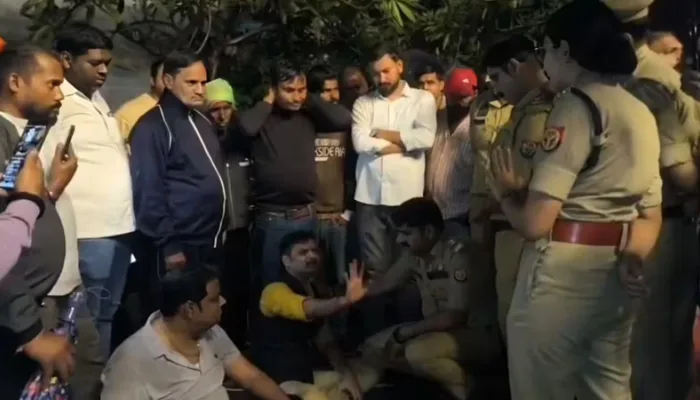
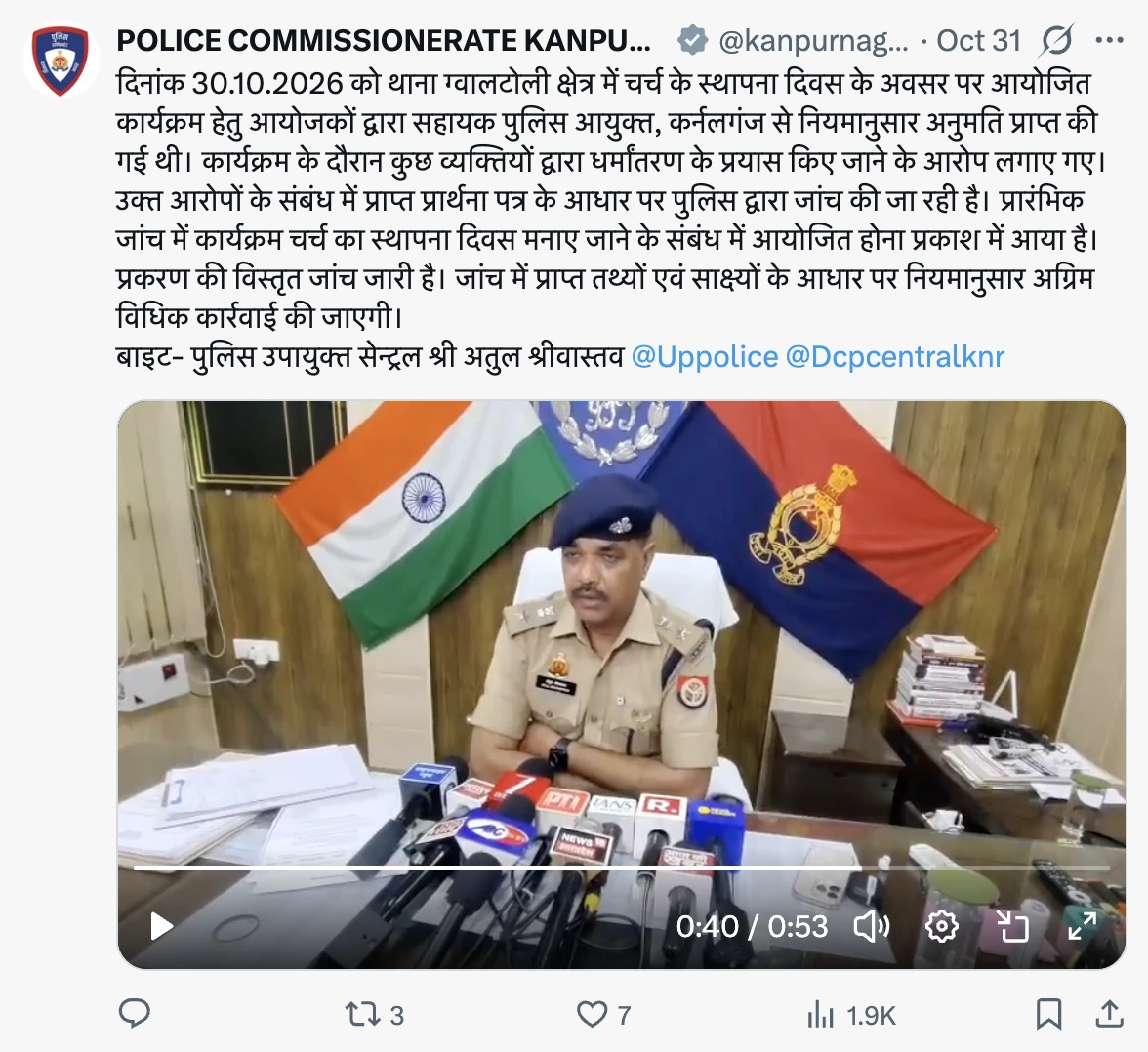
In Kanpur, Uttar Pradesh, Christian missionaries used a Christian community event as a cover to target and convert more than 400 Hindus to Christianity. The Grace and Glory Church organised the event at Shastri Bhavan in the Khalasi Line area, under the jurisdiction of Gwaltoli police station, on 29th October, 2026. The gathering was organised on the occasion of the church's foundation day, with police permission. People belonging to Sanatan Dharma were brought to the venue from distant areas in buses and were lured with promises of financial assistance and encouraged to abandon Hinduism and embrace Christianity. The conversion activity came to light after Hindu organisation representatives received information about the gathering and the presence of a large number of Hindu attendees. Krishna Mohan Tiwari Krishna, Pankaj Jaiswal of Shiv Shakti Akhara, Somnath Mishra, Vishal Bajrangi and Raj Kumar Yadav of the Vishva Hindu Parishad (VHP) reached Shastri Bhavan and informed the police. Krishna Tiwari said nearly 400 families had been brought to the venue, while other accounts put the number at around 400. The organisation representatives demanded an investigation into the conversion activities being conducted under the cover of the Christian community event. When the Hindu organisation workers reached the venue, the main gate was locked from the inside. Krishna Tiwari said they made him wait outside for about 25 minutes while attendees were escorted out through a back entrance. Other activists also witnessed people leaving through a side or back gate instead of the main entrance. They questioned why the main gate had been closed and why participants were being taken out through an alternative exit. The activists further stated that police personnel had reached the venue before them, pushed and manhandled them, delayed their access and helped the organisers escort attendees out through the back entrance. They accused the local police of working in coordination with the event organisers and allowing those involved in the conversion activity to leave. The situation escalated into a protest outside Shastri Bhavan, where workers from a Hindu organisation staged a dharna at the venue's gate. Police personnel from several nearby police stations were deployed to control the situation. One account said forces from around four police stations arrived. ACP Colonelganj IPS Anjana Dahiya and DCP Central Atul Srivastava also reached the spot. The protesters demanded action over the conversion activity and how authorities escorted attendees out of the venue. Several women who came out of the building stated that they had attended a Christian committee programme. One attendee, identified as Meena, said that they were Hindus but had stopped worshipping idols around four years earlier. She stated that the programme taught them to worship humanity. Other women also said that they were Hindus and that they had been instructed during the event not to practise idol worship. They said they no longer worshipped idols and instead believed in humanity. These statements exposed the religious teachings being imparted to Hindu attendees during the gathering and the effort to discourage the practice of Hindu religious traditions. Krishna Tiwari also stated that a network was operating in Kanpur to induce people into religious conversion by offering financial assistance. He questioned the entry arrangements at Shastri Bhavan, saying people were allowed inside without verifying identity documents, including Aadhaar cards. Hindu organisation representatives maintained that attendees had been lured to the venue and pressured to convert to Christianity. DCP Central Atul Srivastava stated that The Grace and Glory Church had obtained permission to organise the gathering for members of the Christian community on the occasion of the church's foundation day. He said that the police would accept a written complaint from the Hindu organisations and investigate the matter. Gwaltoli SHO Ravi Kumar Singh also stated that an investigation was underway and that further legal action would follow. ACP Anjana Dahiya assured the protesters that police would take appropriate action against anyone found responsible. Following the assurance of an investigation, the Hindu organisation workers ended their sit-in and dispersed. The police investigation continued into the conversion activities at the venue, the religious instructions given to Hindu attendees and the circumstances in which participants were escorted out through the back entrance.
Case Images
Why it is Hate Crime ?
The primary category selected for this case is: Predatory Proselytisation. The subcategory selected is: Conversion/attempts to convert by inducement. Predatory Proselytisation is not just limited to threats, harassment, force and violence, but it also has contours of stealth. In several cases, the Hindu victim is exploited to convert, with non-Hindus taking advantage of their poverty. In such cases, the Hindu victim who is suffering financially is offered monetary benefits, including lucrative offers for jobs, health treatment, education, etc., to induce the victim to change his/her religion. In such cases, the religious identity of the victim and the aim to disenfranchise him from his faith form the heart of the crime. Also, taking advantage of and exploiting an individual’s economic vulnerabilities is widely acknowledged as exploitation, and its forms are often penalised by law. Such cases therefore are considered religiously motivated hate crimes since the victim’s religious identity forms the very heart of the crime itself. The next subcategory selected is: Attempting to convert/ converting by denigrating Hinduism. In several cases, Hindus are converted, or an attempt is made to convert Hindus by denigrating their faith, Hinduism. In such cases, the Hindus associate with the non-Hindu perpetrators often by choice and then the attempt to convert them by insulting their faith, showing the faith down, etc begins. An example of this would be a non-Hindu gathering where the Hindus are attending the gathering of their own free will. However, once they attend the gathering, there is an explicit attempt to convert them by abusing their faith and hailing the faith of the perpetrator. The denigration of the Hindu faith is often based on misrepresentation of the Hindu faith, its doctrine and scriptures and insult to espoused traditions if not blatant lies about Hindu beliefs and ways. Such conversions or attempts at conversion are driven by animosity towards the Hindu faith and are therefore documented as religiously motivated hate crimes. The other subcategory selected is: Proselytisation by grooming, brainwashing, manipulation or subtle indoctrination. Within this, the tertiary category selected is: Pattern of targeting Hindus. Religious brainwashing essentially means the often subtle and forcible indoctrination to induce someone to give up their religious beliefs to accept contrasting regimented ideas. Religious grooming or brainwashing also involves propaganda and manipulation. It involves the systematic effort, driven by religious malice and indoctrination, to persuade “non-believers’ to accept allegiance, command, or doctrine to and of a contrasting faith. Cases of such grooming or brainwashing are far more nuanced than direct threats, coercion, inducement and violence. In such cases, it is often seen that there is repeated, subtle and continual manipulation of the victim to induce disaffection towards their own faith and acceptance of the contrasting faith of the perpetrator. While subtle indoctrination is widely acknowledged as predatory, an element which is often understated in such conversions or the attempts of such conversion is the role of loyalty and trust which might develop between the perpetrator and the victim. Fiduciary relationships are often abused to affect such religious conversion. For example, an educator transmitting religious doctrine of a competing faith to a Hindu student. The Hindu student is likely to accept what the teacher is transmitting owing to existence of the fiduciary relationship. The exploitation of the fiduciary relationship to religiously indoctrinate victims would also be included in this category. Since the underlying animosity towards the victim’s faith forms the basis of predatory proselytization, such cases are considered religiously motivated hate crimes. The religious dimension of this case lies in the attempt to use a Christian community gathering to influence Hindu attendees to abandon their existing faith and embrace Christianity. The conduct went beyond inviting people to attend a religious programme. It combined financial inducements with teachings that discouraged Hindu religious practices, making the attendees’ religious identity central to the conversion effort. Firstly, the Hindu identity of the people was targeted. Their existing faith was the starting point of the conversion effort: they were being encouraged to leave Hinduism and adopt Christianity. Religious freedom includes the right to retain one's faith, follow its practices, and refuse to convert. A person's religious identity cannot be treated as an obstacle to be removed through inducements or pressure. Christian missionary conversion is rooted in the objective of spreading the Christian faith and bringing non-Christians into its fold. In exclusivist strands of Christian theology, acceptance of Jesus Christ is regarded as essential to salvation, while other religious traditions may be viewed as spiritually false or incomplete. When this belief is directed towards Hindus, their religious identity and traditions are treated as beliefs to be replaced rather than faiths to be respected. This approach can foster hostility towards Hinduism by portraying its deities, forms of worship, customs and scriptures as inferior or invalid. The objective is not merely to share Christian beliefs but to secure the abandonment of an existing faith in favour of Christianity. When missionary activity adopts this denigrating approach towards Hinduism, it reflects religious hostility towards Hindu beliefs and their adherents and provides the basis for documenting such conduct as religiously motivated hostility. Secondly, the use of financial vulnerability to influence religious choice. Offering monetary assistance to people facing economic hardship can become exploitative when the assistance is tied to abandoning their religion. Financial insecurity can leave individuals with limited options, making promises of material support particularly influential. When such benefits are used to secure religious conversion, the decision is no longer based solely on personal religious conviction. Economic assistance must not become a means of obtaining a person's consent to give up their faith. Thirdly, the denigration of Hindu religious practices, particularly the discouragement of idol worship. Hindu traditions include the worship of deities through sacred images and idols, which serve as important forms of devotion for many Hindus. Such worship is not an absence of spiritual understanding; it is an established expression of faith through which devotees connect with the divine. Telling Hindu attendees that idol worship should not be practised dismisses this form of devotion and presents their existing religious practices as something they should abandon. Promoting an alternative understanding of worship while discrediting Hindu practices creates a direct religious contrast intended to weaken their attachment to Hinduism. Lastly, the use of a Christian community event as the setting for this activity. A community gathering or anniversary celebration can provide an opportunity for people to meet and participate in religious activities. However, presenting an event as a community programme while using it to induce Hindu attendees to change their religion raises a distinct concern about the purpose of the gathering. The religious outreach becomes exploitative when access to financial assistance and teachings that undermine Hindu beliefs are used to influence conversion. There is an important distinction between freely sharing Christian beliefs and seeking to convert people by exploiting their economic circumstances or denigrating their existing faith. Individuals have the freedom to practice their religion and to consider it. That freedom does not extend to using financial hardship as leverage or portraying Hindu religious practices as inferior to secure conversion. Equally, a person must remain free to reject another religion without losing access to assistance or being made to feel that their existing faith of Hinduism is unworthy. Taken together, the financial inducements and the denigration of Hindu worship reveal the two central dimensions of the conversion effort: exploiting economic vulnerability and weakening the religious conviction of Hindu attendees. The use of material incentives and disparagement of Hindu practices to persuade Hindus to abandon their faith. Such conduct undermines freedom of conscience and the right of individuals to retain and practise Hinduism without exploitation or religious denigration. Disclaimer: The victim count has been recorded as approximately 400, based on the figures mentioned in the news coverage available as of now. The exact number of Hindu individuals targeted has not yet been officially confirmed.
Victim Details
Total Victim
400
Deceased
0
Gender
- Male 0
- Female 0
- Third Gender 0
- Unknown 400
Caste
- SC/ST 0
- OBC 0
- General 0
- Unknown 400
Age Group
- Minor 0
- Adult 0
- Senior Citizen 0
- Unknown 400


Case Status
Complaint filed


Perpetrators Details
Perpetrators
Christian Extremists
Perpetrators Range
Unknown
Perpetrators Gender
unknown
 Sources



