Anti-Hindu hatred on display: Bangladeshi Muslim activist calls for genocide of Hindus, hurls communal slurs
 Dhaka District, Bangladesh
 28 October, 2026
Case Summary
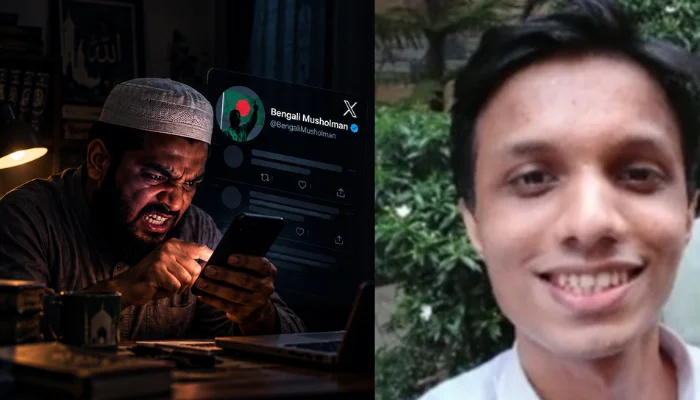
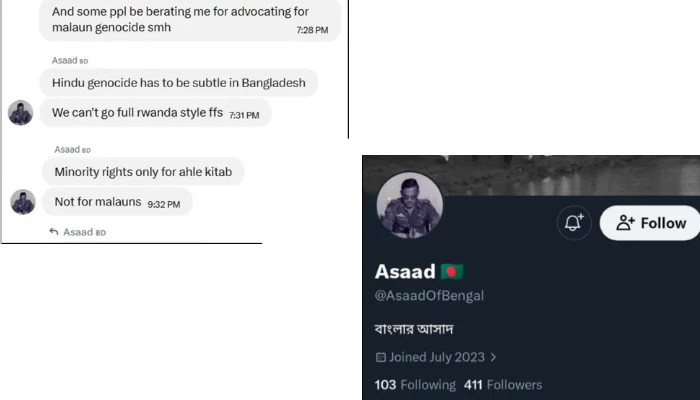
In Muhammadpur, Dhaka, Bangladesh, a Muslim activist named Assad Ul Haq advocated for the genocide of Hindus in the country. He also used communal slurs against Hindus, referring to them as “Malaun", a derogatory term used to refer to Bangladeshi Hindus. According to media reports, while operating his X account, @BangaliMusolman, Assad used social media to whitewash atrocities committed against Hindus in Bangladesh while advocating for the interests of Muslims in India. Screenshots of his private conversations subsequently went viral. In one of the conversations, he was quoted as saying, “Some people berate me for advocating for the genocide of Malauns”, referring to Hindus. He further stated, “The genocide of Hindus in Bangladesh should be subtle. We cannot go full Rwanda style.” In another statement, he asserted, “Minority rights are only for Ahl-e-Kitab, not for Malauns”, using the term “Ahl-e-Kitab” to refer to Muslims while employing the derogatory slur “Malaun” for Hindus. The statement explicitly excluded Hindus from the entitlement to minority rights. He also advocated a sustained campaign of hatred against Hindus, with the stated objective of making them increasingly vulnerable to attacks over trivial disagreements. The proposed campaign sought to create an environment in which Muslims would feel emboldened to commit violence against Hindus with little or no provocation. Following pressure from local journalists, Assad deactivated his social media accounts. At the time of writing this report, his social media account remained deactivated, and no publicly available information indicated whether any legal action had been taken against him for his remarks. This incident occurred against the broader backdrop of the historical persecution faced by Hindus in Bangladesh. While the Hindu minority has endured discrimination, targeted violence, and religious hostility over decades, such persecution has intensified in distinct spurts during periods of political and social instability. The latest major escalation began after the ouster of Sheikh Hasina’s government in August 2024, continued after the death of Sharif Osman Bin Hadi in December 2025, and resurfaced in the immediate aftermath of the 13th National Parliamentary Election in 2026. Following the ouster of Sheikh Hasina, multiple incidents involving attacks on Hindu homes, temples and religious institutions were documented, alongside intimidation, arson and mob violence targeting Hindu localities. The Hinduphobia Tracker recorded 336 incidents involving the Hindu minority during this period, reflecting the scale of the escalation and the continuing vulnerability of Hindus in Bangladesh. A further spurt of violence followed the death of Sharif Osman Bin Hadi, a Muslim political activist and student leader known for his anti-Hindu and anti-India rhetoric, in December 2025. In the aftermath, Hindu communities were subjected to retaliatory violence, with Hindu homes and properties selectively attacked and several families forced to flee. Among the victims was Dipu Chandra Das, who was lynched by a Muslim mob over false blasphemy allegations, after which his body was set ablaze. The Hinduphobia Tracker documented 51 incidents of anti-Hindu violence in the period following Hadi’s death alone, further illustrating how existing hostility towards the Hindu minority intensified during moments of communal mobilisation. During the same period, posters and written material calling for the extermination of Hindus were also displayed in public spaces. Such rhetoric, when viewed alongside incidents of arson, vandalism, assault and targeted intimidation, reflected an environment in which hostility towards Hindus was not merely episodic but repeatedly resurfaced in more intense forms during periods of unrest. The most recent escalation followed the 13th National Parliamentary Election in 2026. In the immediate aftermath of the election results, Hindu families in districts including Noakhali, Rangpur, Nilphamari, Sylhet, Thakurgaon and Dinajpur faced attacks involving arson, looting, assault and vandalism of Hindu homes and temples. In several instances, Hindu properties were selectively targeted, and families were threatened with displacement. The present incident therefore occurred within a much longer history of persecution of Hindus in Bangladesh, where hostility towards the community has persisted over time and intensified in repeated spurts. The latest cycle began after the ouster of Sheikh Hasina and continued through subsequent periods of political and communal upheaval, leaving the Hindu minority increasingly vulnerable to targeted violence, intimidation and religious hostility.
Case Images
Why it is Hate Crime ?
This case is being added to the tracker under the primary category: Hate Speech against Hindus. The subcategory selected is: Violent threats. Violent threats, explicit, implicit or implied, is the most dangerous form of hate speech since it goes beyond discriminatory and prejudicial language to express the intent of causing harm to an individual or a group of people based on their religious identity and faith. There could be several different kinds of threats that are issued to Hindus based on religious animosity. An explicit threat would mean the direct threat of violence towards an individual Hindu, a group of Hindus or Hindus at large. Physical violence, death threats, threats of destruction of property belonging to Hindus and threats of genocide would mean explicit threats against Hindus for their religious identity. Implicit threats may not be a direct threat but implied through the use of symbols of actions – for example – in the Nupur Sharma case, other than explicit threats, there were also implicit threats when Islamists took to the streets to burn and beat her effigies. It implies that they want to do the same to Nupur Sharma – thereby is considered an implicit threat. Violent threats can be delivered in person, through letters, phone calls, graffiti, or increasingly through social media and other online platforms. It would be important to understand that a threat – explicit or implicit, online or offline – to an individual who happens to be a Hindu does not qualify as a religiously motivated threat. Such a threat, while vile and dangerous, could be owing to non-religious reasons and/or personal animosity. To qualify as a religiously motivated threat, it would need to exhibit an indication that the individual is being targeted for religious reasons and/or owing to his/her religious identity as a Hindu. The other subcategory selected is: Anti-Hindu slurs, mocking faith. Anti-Hindu slurs and the deliberate mocking of the Hindu faith owing to religious animosity involve the usage of derogatory terms, stereotypes, or offensive references to religious practices, symbols, or figures. One of the common anti-Hindu slurs used against Hindus is “cow-worshipper” and “cow piss drinker”. The intention of using this term is to demean and mock Hindus as a group and their religious beliefs since Hindus consider the cow holy. Additionally, some symbols and the slurs attached to them have a historical context that exacerbates the insult, hate, stereotyping, dehumanisation and oppression against Hindus. Cow worship has been used for centuries to denigrate Hindus, insult their faith and oppress Hindus specifically as a religious group. There has been overwhelming documentation about how cow slaughter has been used to persecute Hindus with cow meat being thrown in temples and places of worship. There has also been overwhelming documentation where cow meat (beef) has been force-fed to Hindus to either forcefully convert them to Islam or denigrate their faith. Apart from cow worship, the Swastika – which holds deep religious significance for the Hindus – has also been misinterpreted and distorted to use as a slur against Hindus. Similarly, the worship of the Shivling has been used by supremacist ideologies and religions to denigrate Hindus owing to religious animosity. Such slurs and denigration stem out of inherent animosity and hate towards Hindus and their faith, therefore, it is categorised as hate speech targeted at Hindus specifically owing to their religious identity. The incident constituted a clear example of a religiously motivated hate crime, as the Muslim perpetrator called for the genocide of Hindus and hurled communal slurs at the Hindu community. Firstly, the perpetrator's call for the genocide of Hindus demonstrated his deep-seated hostility towards Hinduism and its followers. Hindus constitute a religious minority in Bangladesh and have faced decades of persecution, making his explicit advocacy for their extermination particularly significant. Calling for the elimination of an entire religious community went beyond expressing prejudice and reflected an extreme form of religious bigotry rooted in the denial of that community's right to exist. His statements exposed an Islamic supremacist worldview in which people belonging to non-Muslim faiths, particularly Hindus, were viewed as undeserving of equal rights and protection. By advocating the systematic elimination of Hindus, he demonstrated his contempt for their religious identity, existence and fundamental rights. Secondly, the perpetrator's insistence that the genocide should be subtle rather than carried out in the manner of the Rwandan genocide demonstrated the calculated nature of his hostility. His remarks were not merely an impulsive expression of anger but outlined an approach to targeting Hindus while avoiding the visibility associated with large-scale mass killings. His preference for a less overt campaign of extermination demonstrated his awareness of the international condemnation and scrutiny that openly orchestrated mass violence would attract. This exposed the calculated and malicious nature of his anti-Hindu ideology, which extended beyond verbal abuse to advocating a sustained and concealed campaign of violence. It further demonstrated that he viewed the persecution and elimination of Hindus as an acceptable objective. Thirdly, the perpetrator's statement that minority rights should be reserved for Muslims and not extended to Hindus exposed his religiously supremacist worldview. By invoking religious classification to exclude Hindus from minority rights, he demonstrated a discriminatory outlook towards communities belonging to other faiths. His statement effectively denied Hindus equal recognition, dignity and protection on account of their religious identity. This exclusionary understanding of minority rights exposed his unwillingness to recognise Hindus as deserving of the same fundamental protections as other religious communities. It further reinforced the religious supremacy and anti-Hindu hostility underlying his rhetoric. Furthermore, the perpetrator's contrasting positions on the treatment of religious minorities in India and Bangladesh demonstrated his deep-seated communal prejudice. While he advocated for the protection of Muslims in India, he simultaneously called for the genocide of Hindus in Bangladesh. This selective concern for minority rights exposed the communal nature of his worldview, in which religious affiliation determined whose rights and security deserved protection. His position reflected the transnational solidarity associated with the Muslim Ummah, which prioritised religious allegiance over national boundaries. The same Islamic supremacist mindset contributed to the Partition of India, as Muslims supported the idea that Islam was a separate nation unto itself that could not coexist with India, which they perceived as a Hindu collectivity. This ideology ultimately led to the creation of Pakistan, including present-day Bangladesh. The perpetrator's simultaneous advocacy for Muslims in India and calls for the genocide of Hindus in Bangladesh reflected this same transnational religious solidarity and exposed his Islamic supremacist outlook and deep-seated anti-Hindu hostility. Moreover, the perpetrator's use of social media to minimise atrocities committed against Hindus in Bangladesh further demonstrated his hostility towards the community. Hindus in Bangladesh have faced decades of religious persecution, including attacks on temples, destruction of property, communal violence, intimidation and forced displacement. The political upheaval following Sheikh Hasina's departure from Bangladesh in August 2024 was accompanied by widespread attacks on Hindu communities and their places of worship. Against this backdrop, the perpetrator used his social media presence to whitewash atrocities against Hindus and downplay the violence directed at them. Minimising such religiously driven persecution while simultaneously advocating the genocide of the Hindu community demonstrated a consistent pattern of anti-Hindu hostility rather than an isolated expression of prejudice. His conduct exposed his disregard for the suffering and security of Hindus and reflected the communal bigotry underpinning his statements. Finally, the perpetrator's use of the derogatory slur “Malaun” to refer to Hindus further exposed the religious hostility underlying his rhetoric. Malaun is a deeply derogatory term used in Bangladesh to refer to Hindus, with its origins in the Arabic word Mal'un, meaning cursed. The term has historically been used to stigmatise and denigrate the Hindu community on religious grounds. By repeatedly employing this slur, the perpetrator reduced Hindus to a derogatory religious label rather than recognising them as members of a community entitled to dignity and equal treatment. Its use alongside explicit calls for genocide and the denial of Hindu rights demonstrated the extent of his contempt for the Hindu community. Such language reinforced the exclusionary and dehumanising outlook reflected throughout his statements and further established the nature of his hostility towards the Hindu community. Notably, this is not the first time the anti-Hindu slur “Malaun” has been used to target Hindus in Bangladesh. Hinduphobia Tracker has previously documented multiple incidents where the slur was used alongside violence, intimidation, and organised anti-Hindu persecution, demonstrating that it functions as a recurring tool of religious hatred rather than an isolated insult. For example, in August 2024, following the fall of Sheikh Hasina's government, Hindu businessman Swapan Pal's brick factory and fishery in Faridpur were attacked by armed Muslim men. During the assault, manager Niranjan Kumar Das was brutally beaten and abused with the slurs “Malaun” and “Shuorer Baccha,” before being threatened and told to go to India, reflecting explicit anti-Hindu hostility. Similarly, in November 2024, Hinduphobia Tracker documented a coordinated online hate campaign in Bangladesh in which Islamist groups popularised the slogan “TMD – Total Malaun Death.” More than 200,000 social media posts used the slur “Malaun” to dehumanise Hindus and openly call for their annihilation, turning the term into a rallying cry for anti-Hindu hatred. In July 2025, in Magura Sadar Upazila, a Hindu man was brutally murdered by a Muslim man and his accomplices. After killing the victim, the main accused hurled the dehumanising slur “Malaun” at him, underscoring that anti-Hindu abuse continued even after the fatal assault and highlighting the religious hostility underlying the crime. In September 2026, a Hindu man was assaulted by a group of Muslim men. During the attack, the perpetrators repeatedly identified him as a Hindu and asked whether he was an ISKCON follower. They repeatedly hurled the anti-Hindu slur “Malaun” at him and made hateful remarks against the entire Hindu community. Overall, as the present case met the parameters of a religiously motivated hate crime, it was added to the Hinduphobia Tracker's hate crime database. Disclaimer: The Hinduphobia Tracker records incident dates based on when the crime occurred rather than when it was reported in the media. However, in the present case, media reports did not specify the exact date of the incident. Therefore, the date of its first media publication, 29 October 2026, has been recorded as the indicative incident date for documentation purposes only.


Case Status
Unknown


Perpetrators Details
Perpetrators
Muslim Extremists
Perpetrators Range
One Person
Perpetrators Gender
male
 Sources



