Hindu man attacked and subjected to derogatory anti-Hindu slurs by Muslim men in Bangladesh
 Bangladesh
  23 September, 2026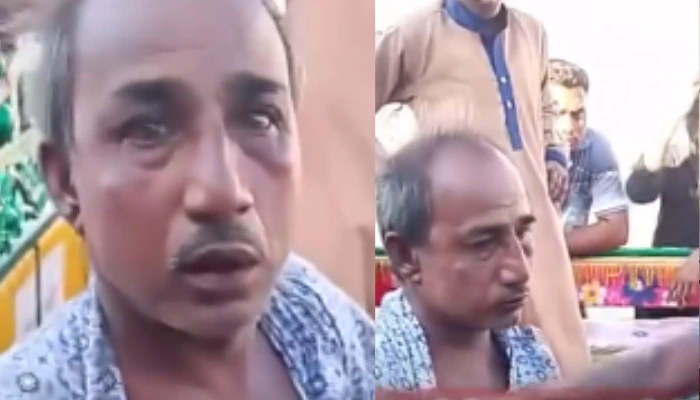
Case Summary
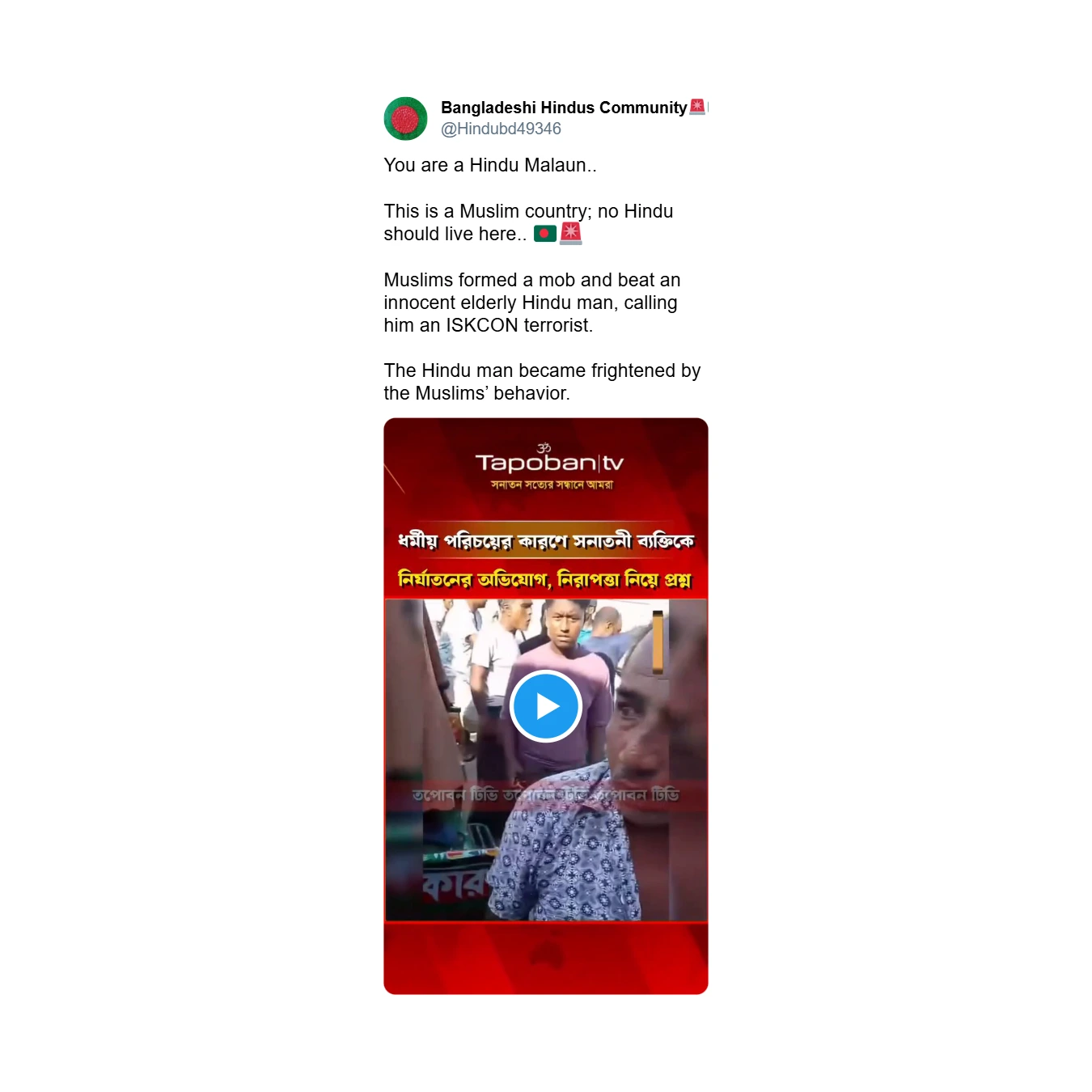
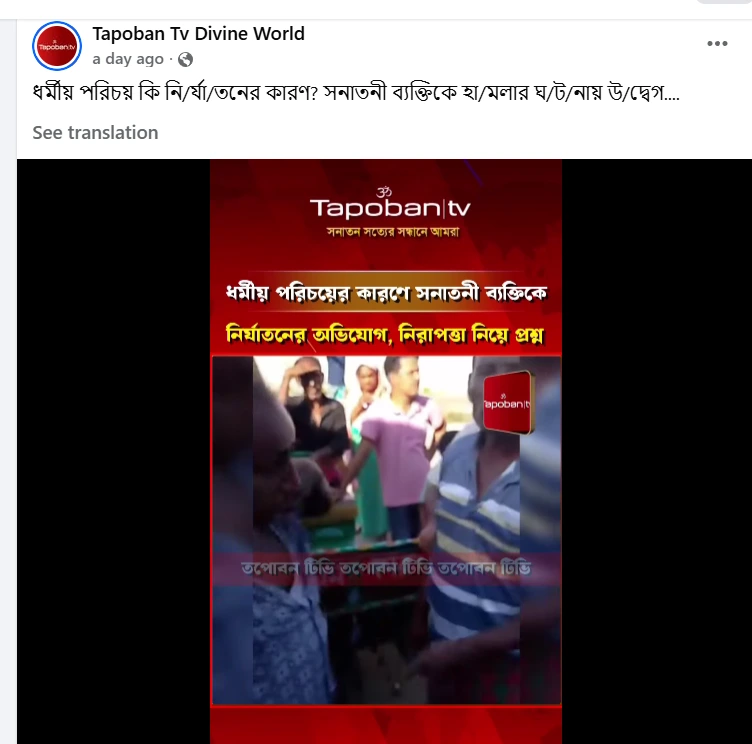
In Bangladesh, a Hindu man was assaulted by a group of Muslim men after being accused of molesting Muslim women. During the attack, the perpetrators repeatedly identified him as a Hindu and asked whether he was an ISKCON follower. They repeatedly hurled the anti-Hindu slur “Malaun” at him and made hateful remarks against the entire Hindu community. The incident came to light after a video of the assault went viral on social media and was subsequently reported by local news outlets in Bangladesh. According to the footage, the Hindu man was forced to bow down in front of two to three burqa-clad Muslim women and made to ask for forgiveness, while the Muslim men accused him of molesting them. Moments later, the situation escalated into a violent assault as he was surrounded, beaten, and verbally abused. During the assault, the perpetrators shouted, “See, he is a Hindu. He is an ISKCON follower,” and made inflammatory anti-Hindu remarks alleging that all Hindus and ISKCON followers trap Muslim girls and traffic them to India. They further claimed that Hindus in Bangladesh operate such a network. The video also showed one Muslim man repeatedly confronting the Hindu victim and demanding to know whether he was an ISKCON follower, while the other assailants continued thrashing him and abusing him with the infamous anti-Hindu slur “Malaun.” Notably, “Malaun” is one of the most derogatory anti-Hindu slurs used in Bangladesh to refer to Hindus. Derived from the Arabic word mal'ūn, meaning “accursed” or “cursed,” it is commonly used as a communal insult to demean, dehumanise, and target Hindus on the basis of their religious identity. This incident occurred against the broader backdrop of the historical persecution faced by Hindus in Bangladesh. While the Hindu minority has endured discrimination, targeted violence, and religious hostility over decades, such persecution has intensified in distinct spurts during periods of political and social instability. The latest major escalation began and continued after the ouster of Sheikh Hasina’s government in August 2024, followed by another surge after the death of Sharif Osman Bin Hadi in December 2025, and subsequently in the immediate aftermath of the 13th National Parliamentary Election in 2026. Following the ouster of Sheikh Hasina, multiple incidents involving attacks on Hindu homes, temples and religious institutions were documented, alongside intimidation, arson and mob violence targeting Hindu localities. The Hinduphobia Tracker recorded 336 incidents involving the Hindu minority during this period, reflecting the scale of the escalation and the continuing vulnerability of Hindus in Bangladesh. A further spurt of violence followed the death of Sharif Osman Bin Hadi, a Muslim political activist and student leader known for his anti-Hindu and anti-India rhetoric, in December 2025. In the aftermath, Hindu communities were subjected to retaliatory violence, with Hindu homes and properties selectively attacked and several families forced to flee. Among the victims was Dipu Chandra Das, who was lynched and whose body was subsequently set ablaze by a Muslim mob over false blasphemy allegations. The Hinduphobia Tracker documented 51 incidents of anti-Hindu violence in the period following Hadi’s death alone, further illustrating how existing hostility towards the Hindu minority intensified during moments of communal mobilisation. During the same period, posters and written material calling for the extermination of Hindus were also displayed in public spaces. Such rhetoric, when viewed alongside incidents of arson, vandalism, assault and targeted intimidation, reflected an environment in which hostility towards Hindus was not merely episodic but repeatedly resurfaced in more intense forms during periods of unrest. The most recent escalation followed the 13th National Parliamentary Election in 2026. In the immediate aftermath of the election results, Hindu families in districts including Noakhali, Rangpur, Nilphamari, Sylhet, Thakurgaon and Dinajpur faced attacks involving arson, looting, assault and vandalism of Hindu homes and temples. In several instances, Hindu properties were selectively targeted, and families were threatened with displacement. The present incident therefore occurred within a much longer history of persecution of Hindus in Bangladesh, where hostility towards the community has persisted over time and intensified in repeated spurts. The latest cycle began after the ouster of Sheikh Hasina and continued through subsequent periods of political and communal upheaval, leaving the Hindu minority increasingly vulnerable to targeted violence, intimidation and religious hostility.
Case Images

Why it is Hate Crime ?
This case is being added to the tracker under the primary category: Attack on Hindu religious representations. The subcategory selected is: Attacked for Hindu identity. In several cases, Hindus are attacked merely for their Hindu identity without any perceived provocation. A classic example of this category of religiously motivated hate crime is a murder in 2016. 7 ISIS terrorists were convicted for shooting a school principal in Kanpur because they got ‘triggered’ seeing the Kalava on his wrist and tilak that he had put. In this, the Hindu victim had offered no provocation except for his Hindu religious identity. The motivation for the murder was purely religious, driven by religious supremacy. Such cases where Hindus are targeted merely for their religious identity would be documented as a hate crime under this category. The other primary category selected is: Hate speech against Hindus. The subcategory selected is: Anti-Hindu slurs, mocking faith. Anti-Hindu slurs and the deliberate mocking of the Hindu faith owing to religious animosity involve the usage of derogatory terms, stereotypes, or offensive references to religious practices, symbols, or figures. One of the common anti-Hindu slurs used against Hindus is “cow-worshipper” and “cow piss drinker”. The intention of using this term is to demean and mock Hindus as a group and their religious beliefs since Hindus consider the cow holy. Additionally, some symbols and the slurs attached to them have a historical context that exacerbates the insult, hate, stereotyping, dehumanisation and oppression against Hindus. Cow worship has been used for centuries to denigrate Hindus, insult their faith and oppress Hindus specifically as a religious group. There has been overwhelming documentation about how cow slaughter has been used to persecute Hindus with cow meat being thrown in temples and places of worship. There has also been overwhelming documentation where cow meat (beef) has been force-fed to Hindus to either forcefully convert them to Islam or denigrate their faith. Apart from cow worship, the Swastika – which holds deep religious significance for the Hindus – has also been misinterpreted and distorted to use as a slur against Hindus. Similarly, the worship of the Shivling has been used by supremacist ideologies and religions to denigrate Hindus owing to religious animosity. Such slurs and denigration stem out of inherent animosity and hate towards Hindus and their faith, therefore, it is categorised as hate speech targeted at Hindus specifically owing to their religious identity. This case is a clear example of a hate crime because the assault on the Hindu man was marked by explicit religious hostility directed at his Hindu identity. The perpetrators did not merely assault him physically; they repeatedly identified him as a Hindu, branded him an ISKCON follower, and subjected him to derogatory anti-Hindu abuse while beating him. The violence was therefore accompanied by targeted hate speech, making his religious identity the basis of the attack and demonstrating clear animosity towards Hinduism. Here it is important to note that even if the allegation of molestation were true, molesting any woman is a serious criminal offence that must be dealt with through lawful investigation and the justice system. However, nothing justifies communal violence or religious persecution. Instead of allowing the matter to be addressed through legal channels, the Muslim men used the allegation as a pretext to publicly humiliate, assault, and target the victim because he was Hindu, revealing that the violence was driven by religious hostility rather than the pursuit of justice. A key indicator of this religious hatred was the perpetrators' repeated emphasis on the victim's faith. Throughout the assault, they shouted, “He is a Hindu” and “He is an ISKCON follower,” not as neutral identifiers but as accusations intended to stigmatise him because of his religion. By repeatedly invoking his Hindu identity while attacking him, the assailants transformed the incident from a criminal accusation into an act of anti-Hindu hate speech and communal intimidation, exposing their contempt for Hinduism. The perpetrators went even further by making sweeping allegations that all Hindus and ISKCON followers in Bangladesh trap Muslim girls and traffic them to India. Rather than confining their accusations to the individual before them, they attributed criminality to an entire religious community. Such rhetoric vilifies all Hindus as a collective, promotes dangerous communal stereotypes, and reflects a deep-seated hatred that portrays Hindu identity itself as inherently suspicious and predatory. This collective demonisation is a hallmark of Hinduphobia. Even if one individual is accused of wrongdoing, it does not justify branding an entire community as traffickers or predators. The perpetrators' remarks were not directed at establishing guilt; they were designed to incite hostility against Hindus by generalising an allegation of molestation into a communal narrative. Using the purported protection of Muslim women as a justification for demonising all Hindus reveals blatant religious prejudice rooted in hostility towards Hinduism. The repeated use of the slur “Malaun” further establishes the hate-driven nature of the assault. “Malaun” is among the most derogatory anti-Hindu slurs used in Bangladesh, derived from the Arabic word mal'ūn, meaning “accursed” or “cursed.” It is widely used to dehumanise Hindus and mark them as religiously inferior. Its repeated use during the assault demonstrates that the victim was targeted not merely as an individual, but because of his Hindu faith, reflecting overt anti-Hindu religious hatred. Notably, this is not the first time the anti-Hindu slur “Malaun” has been used to target Hindus in Bangladesh. Hinduphobia Tracker has previously documented multiple incidents where the slur was used alongside violence, intimidation, and organised anti-Hindu persecution, demonstrating that it functions as a recurring tool of religious hatred rather than an isolated insult. For example, in August 2024, following the fall of Sheikh Hasina's government, Hindu businessman Swapan Pal's brick factory and fishery in Faridpur were attacked by armed Muslim men. During the assault, manager Niranjan Kumar Das was brutally beaten and abused with the slurs “Malaun” and “Shuorer Baccha,” before being threatened and told to go to India, reflecting explicit anti-Hindu hostility. Similarly, in November 2024, Hinduphobia Tracker documented a coordinated online hate campaign in Bangladesh in which Islamist groups popularised the slogan “TMD – Total Malaun Death.” More than 200,000 social media posts used the slur “Malaun” to dehumanise Hindus and openly call for their annihilation, turning the term into a rallying cry for anti-Hindu hatred. In July 2025, in Magura Sadar Upazila, a Hindu man was brutally murdered by a Muslim man and his accomplices. After killing the victim, the main accused hurled the dehumanising slur “Malaun” at him, underscoring that anti-Hindu abuse continued even after the fatal assault and highlighting the religious hostility underlying the crime. In this case, the repeated references to the victim as an ISKCON follower are equally significant in the Bangladeshi context. In recent years, Muslim extremists have repeatedly targeted ISKCON with false allegations of extremism and terrorism despite the absence of credible evidence substantiating such claims. As one of the country's most prominent Hindu religious organisations, ISKCON has been subjected to sustained campaigns of vilification and anti-Hindu propaganda. Invoking ISKCON while assaulting the victim reflects this broader pattern of ideological hostility towards Hinduism and its religious institutions. This attack also occurred against the backdrop of the sustained persecution of Hindus in Bangladesh following the ouster and exile of former Prime Minister Sheikh Hasina in August 2024. In the aftermath of the political upheaval, Hindu homes, temples, businesses, and communities were subjected to widespread attacks across the country, creating an atmosphere of fear and insecurity for the Hindu minority. The continued targeting of a Hindu man through communal abuse and violence reinforces the broader pattern of entrenched anti-Hindu hostility that has persisted during this period. Since the victim was physically assaulted while being identified, abused, and dehumanised for his Hindu faith through anti-Hindu slurs, communal stereotyping, and inflammatory rhetoric, this case clearly meets the parameters of a religiously motivated hate crime. It is therefore being included in the Hinduphobia Tracker database as a documented instance of targeted anti-Hindu violence in Bangladesh. Disclaimer: Hinduphobia Tracker records incident dates based on when the victim's ordeal occurred, rather than when the incident was reported in the media. In this case, media reports did not specify the exact date of the crime. Since the incident was first reported on 24 September 2026, this date has been selected as the indicative incident date solely for documentation purposes.
Victim Details
Total Victim
1
Deceased
0
Gender
- Male 1
- Female 0
- Third Gender 0
- Unknown 0
Caste
- SC/ST 0
- OBC 0
- General 0
- Unknown 1
Age Group
- Minor 0
- Adult 1
- Senior Citizen 0
- Unknown 0


Case Status
Unknown


Perpetrators Details
Perpetrators
Muslim Extremists
Perpetrators Range
Unknown
Perpetrators Gender
male
 Sources




