Hindu residents barred from celebrating Navratri at housing society in Mira Road, Mumbai
 Mumbai, Maharashtra, India
 8 October, 2026
Case Summary
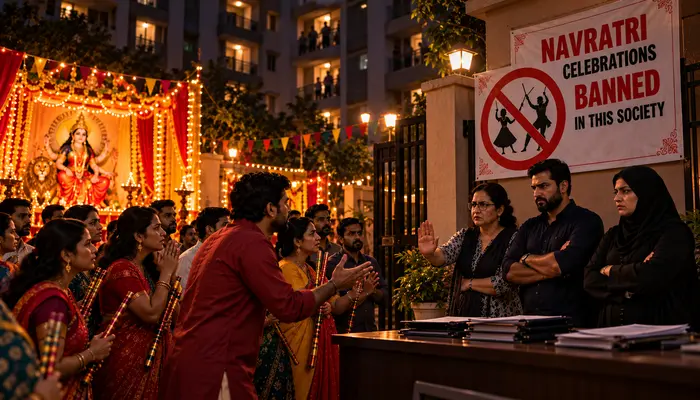
Navratri celebrations were banned at a housing society in Mira Road, Mumbai, by its office-bearers, Rupa Pinto, Danish Sheikh and Minaz Sheikh. This occurred despite Hindu residents assuring the administration that they would comply with all government rules and regulations to maintain law and order, cleanliness and public safety. The incident came to light after around 120 Hindu families residing in the Poonam Estate Cluster-1 housing complex sought a No Objection Certificate (NOC) to organise Garba, Dandiya and other religious programmes in the common area during Navratri. The complex comprised 625 flats and was home to residents belonging to different religious communities. However, the society's office-bearers rejected the application, preventing Hindu residents from organising the celebrations as planned. Following the rejection, local resident Umashankar Nag lodged a complaint with the Registrar of Cooperative Societies against the decision. He stated that Hindus were being treated unfairly despite having the fundamental right to conduct religious activities and celebrate festivals while complying with the prescribed rules. Subsequently, the Deputy Registrar of Cooperative Societies, Thane Taluka, directed the housing society to take appropriate action in accordance with the law. Hindu residents of the area demanded immediate intervention by the administration and called for permission to celebrate Navratri with faith and enthusiasm. The incident occurred against the backdrop of an earlier dispute during Bakri Eid in the same housing complex, which the Hinduphobia Tracker had previously documented. On 24 May 2026, tensions erupted after Muslim residents brought around 25 goats into the complex ahead of Bakrid and kept them in an enclosure constructed in the common area. Hindu residents objected to the arrangement, stating that it violated society rules and that the enclosure had been authorised without the consent of the wider housing community. Following complaints, the Mira-Bhayandar Municipal Corporation demolished the shed and imposed restrictions on keeping goats and conducting animal sacrifice within the building premises. On 26 May 2026, tensions escalated again when Muslim residents attempted to rebuild the demolished structure. During the ensuing confrontation, a Muslim man, Sheikh Abul Rahim Sheikh, attacked a Hindu youth with a blade. Three Hindus sustained serious injuries in the violence, and the police subsequently arrested Sheikh Abul Rahim Sheikh in connection with the attack.
Why it is Hate Crime ?
This case is being added to the tracker under the primary category: Restriction/ban on Hindu practices. The subcategory selected is: Restriction on expression of Hindu identity. An example of the state-affected prejudicial and targeted orders against the Hindu community would be a government denying the right of a Hindu or a group of Hindus to hold a religious procession owing to the animosity of non-Hindu groups. Denial of the religious right of the Hindus to assuage the non-Hindu group which harbours animosity to a point where it could lead to violence against Hindus is not only a failure of law and order but is a prejudicial order against Hindus, denying them their fundamental rights to express their religious identity. An example of a hate crime against Hindus by a non-Hindu would be a non-Hindu institution forcing its Hindu employees to abandon religious symbols that a Hindu would wear as an expression of faith owing to inherent prejudice against the faith professed by the victim or a non-Hindu group of people restricting a Hindu group from constructing a place of worship simply because the demography of the area in which the temple is being built is dominated by non-Hindus. Such actions are driven by religious animosity and/or prejudice against Hindus and their faith and would therefore be categorized as a hate crime. This incident constitutes a clear example of a religiously driven hate crime and an incident of religious discrimination against Hindus. Navratri celebrations were banned at a housing society despite Hindu residents assuring the administration that they would comply with all government rules and regulations concerning law and order, cleanliness and public safety. The blanket prohibition, imposed despite these assurances, demonstrates religious bias and animosity against Hindu residents and their right to express their faith through collective religious celebrations. Navratri is one of the most significant festivals in Hinduism, dedicated to the worship of the Divine Feminine, particularly Goddess Durga and her various manifestations. Garba and Dandiya are integral to Navratri celebrations, combining devotional expression, music, dance and community participation in honour of the Goddess. These are not merely recreational activities; they are deeply rooted in Hindu religious and cultural traditions and form an important part of how devotees celebrate the festival. Banning Navratri celebrations altogether therefore restricts an important expression of Hindu faith. The decision demonstrates prejudice against Hindu religious practices and communicates to Hindu residents that their faith and its public expression are unwelcome within the housing complex. Such discriminatory treatment undermines Hindu religious sentiments and displays intolerance towards the collective observance of Hindu festivals. The fact that the housing complex accommodated residents belonging to different religious communities did not justify banning Hindu religious celebrations. A multicultural residential society must respect the religious freedoms of all its residents and ensure that no community is unfairly prevented from observing its festivals. Even India's constitutional framework protects every individual and community's right to freely practise their religion. Religious diversity cannot be used as a pretext to exclude Hindu religious expression from shared residential spaces. By prohibiting Navratri celebrations rather than facilitating them under reasonable and uniformly applied rules, the office-bearers demonstrated disregard for the religious rights and sentiments of Hindu residents. The ban reflected an exclusionary approach in which Hindu residents were denied the opportunity to organise their religious festivities despite their willingness to comply with the society's rules. Navratri celebrations involving Garba, Dandiya, prayers, aarti, devotional singing and community gatherings are established forms of Hindu religious observance. These activities are not inherently unlawful or a threat to public order. Any legitimate requirements concerning noise, cleanliness, safety or the use of common areas can be addressed through reasonable regulations applied equally to all residents. In this case, Hindu residents had expressly assured the office-bearers that they would follow all government rules and regulations to maintain law and order, cleanliness and public safety. Nevertheless, their application was rejected. This demonstrates that the residents' willingness to comply with the prescribed requirements did not prevent the ban from being imposed. The decision showcases discriminatory treatment of Hindu religious expression rather than a fair and consistent approach to regulating activities within a residential complex. Some may attempt to justify the Navratri ban by referring to the earlier dispute over Bakrid-related activities in the same housing complex. However, the two situations are fundamentally different. During the earlier dispute, Hindu residents objected to the keeping of goats and arrangements for animal sacrifice within the shared residential premises because these activities violated society rules and raised concerns about public order and public morality. The objection was not to the religious observance of Bakrid itself, but to conducting animal sacrifice in a common residential space shared by people of different faiths. Animal sacrifice involves the killing of an animal, including the cutting of its throat and the presence of blood, which residents may reasonably object to when such acts are carried out in shared residential surroundings. The concern was therefore about the location and manner of the practice, its compliance with society regulations and its impact on people sharing the premises. Religious practices conducted within designated religious spaces, subject to applicable laws, are distinct from carrying out animal sacrifice in common residential areas. The distinction is crucial: Hindu residents did not demand that Bakrid or any Islamic festival be banned. They objected to a particular practice being carried out within a shared residential space in violation of society rules and in circumstances they considered detrimental to public order and the common residential environment. Residents of a multicultural housing society have the right to raise objections to specific activities that violate applicable regulations or affect the shared use of their premises. That right does not translate into a justification for prohibiting an entire religious festival. In contrast, the Navratri ban prevented Hindu residents from organising Garba, Dandiya and associated devotional and cultural programmes altogether, despite their assurances that they would comply with the rules. Equating objections to animal sacrifice in a common residential area with a blanket prohibition on Navratri is therefore a false equivalence. The two situations cannot be treated as identical: one concerned objections to a specific practice in shared premises, while the other involved denying Hindu residents permission to celebrate an entire religious festival. By preventing Hindu residents from organising Navratri celebrations while disregarding their assurances of compliance, the housing society office-bearers displayed hostility towards the public expression of Hindu faith and undermined Hindu religious sentiments. The contrast with the earlier Bakrid dispute further demonstrates why objections to a particular activity cannot be used to justify the blanket prohibition of another community's religious festival. The incident constitutes a clear instance of religious discrimination against Hindus and demonstrates intolerance towards Hindu religious practices and their collective expression. Overall, since this case meets the parameters of a religiously driven hate crime, it is being added to the hate crime database of the tracker. Disclaimer: Hinduphobia Tracker records incident dates based on when the crime occurred rather than when it was reported by the media. However, in this case, media reports did not specify the exact date on which the ban was imposed. The only date mentioned was 9 October 2026, when the incident was reported by the media. Henceforth, this date has been selected as the indicative incident date for documentation purposes only. While the Hinduphobia Tracker acknowledges that three individuals were identified as perpetrators in this case, for documentation purposes, the religion of the perpetrators has been recorded as Muslim, as two of the three individuals, Danish Sheikh and Minaz Sheikh, were identified as Muslims. The religious identity of the third individual, Rupa Pinto, was unclear at the time of documentation. Since the majority of the perpetrators were Muslim, the case has been categorised under a single perpetrator religion for consistency in categorisation. This approach ensures clarity in data representation while accounting for the involvement of all three individuals. In this case, approximately 120 Hindu families residing in the Poonam Estate Cluster-1 housing complex sought permission to organise Navratri celebrations. However, the exact number of individuals belonging to these families was not specified. For documentation purposes, the Hinduphobia Tracker has adopted an average household size of five members, resulting in an estimated total of 600 individuals. This has been recorded as the victim count. As media reports did not provide a gender-wise breakdown of the individuals belonging to the 120 Hindu families, the Hinduphobia Tracker has applied a proportional demographic estimate based on India’s Census 2011 and NFHS-5 (2019–21) urban population data for documentation purposes. Accordingly, the estimated 600 individuals have been categorised as 300 males (50%) and 300 females (50%), reflecting an equal gender distribution. As the age-wise segregation was also not specified in media reports, the Hinduphobia Tracker has applied a proportional demographic estimate. Accordingly, the estimated 600 individuals have been categorised as 420 adults (70%) and 180 minors (30%).
Victim Details
Total Victim
600
Deceased
0
Gender
- Male 300
- Female 300
- Third Gender 0
- Unknown 0
Caste
- SC/ST 0
- OBC 0
- General 0
- Unknown 600
Age Group
- Minor 180
- Adult 420
- Senior Citizen 0
- Unknown 0


Case Status
Complaint filed


Perpetrators Details
Perpetrators
Muslim Extremists
Perpetrators Range
From 2 To 5
Perpetrators Gender
both
 Sources



