200-year-old Ram Leela temple in Pakistan faces demolition for commercial plaza; parts of temple structure damaged
 Dera Ismail Khan, Khyber Pakhtunkhwa, Pakistan
 17 October, 2026
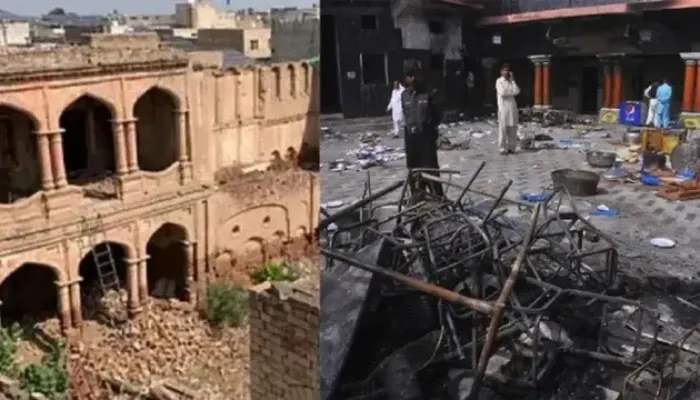
Case Summary
In Dera Ismail Khan, Khyber Pakhtunkhwa, Pakistan, the nearly 200-year-old historic Ramleela Temple in Rahim Bazaar was targeted for demolition to make way for a commercial plaza. Parts of the temple structure had already been damaged when members of the local Hindu community and social activists intervened and opposed the work, following which the authorities took control of the premises and sealed the temple. The incident came to light when demolition activity began inside the temple complex. Upon learning that the temple was being dismantled, Sohail Ahmad Azmi, head of the Dera Civil Society and Traders Association, arrived at the scene with local citizens and representatives of the Hindu community. The person carrying out the work stated that he had been given a contract to demolish the structure. The Hindu community and social activists immediately objected to the demolition and questioned how permission had been granted to use the temple land for commercial construction. They convened an emergency meeting and demanded an investigation into the ownership of the property, the legality of the proposed plaza and the role of officials who had permitted the work. They also urged public representatives to raise the matter in Pakistan’s National Assembly. The Ramleela Temple is among the historic properties recognised by the Evacuee Trust Property Board, which oversees minority religious properties and assets left behind after Partition. Dera civil society representatives stressed that demolishing the temple and replacing it with a commercial structure would erase an important part of Dera Ismail Khan’s religious and cultural heritage. Following the protests, the local administration intervened and halted all demolition and construction activity at the temple. The Evacuee Trust Property Board subsequently sealed the premises, preventing further work. Hindu community representatives and the civil society members continued to demand accountability and protection for the temple. Haroon Sarab Dayal, president of the All Pakistan Hindu Rights Movement, also sought a broader investigation into minority religious properties that had been sold, transferred or occupied between 2013 and 2026. The Bangladesh Hindu Sammelan Sangha separately condemned the attempt to close and demolish the Ramleela Temple and expressed solidarity with the local Hindu community resisting the destruction of the historic place of worship. Notably, this was not the first instance of a Hindu temple being razed in Pakistan. The Hinduphobia Tracker had earlier documented similar cases involving the demolition of ancient Hindu temples. For instance, on 21 August 2026, members of Tehreek-e-Labbaik Pakistan (TLP) demolished a 100-year-old Hindu temple in Siraj village, Narowal district, Punjab province, to make way for the construction of a Madarsa on the adjoining land. According to the news agency Press Trust of India (PTI), the temple was estimated to be 100 to 125 years old and stood on approximately 1,000 square metres of land, about 130 kilometres from Lahore. The temple had served as a historic place of worship for the local Hindu community. This case highlights the persecution faced by the Hindu minorities in Pakistan, marked by systemic discrimination, violence, and forced conversions. Hindu women, particularly young girls, are often abducted, forcibly converted to Islam, and married off to Muslim men with little to no legal recourse. Temples are frequently vandalised or destroyed, and Hindu communities are subjected to social and economic marginalisation. Blasphemy laws are disproportionately used against Hindus, leading to false accusations and severe punishments. Many Hindu families are forced to flee their homes due to religious intolerance, living in constant fear of attacks. This sustained persecution highlights the dire conditions for Hindus in Pakistan, where their religious identity makes them targets of oppression.
Why it is Hate Crime ?
This case has been added to the tracker under the primary category: Attack on Hindu religious representations. The sub-category selected is: Attack on Temples. In Hinduism, a temple is the abode of the Deity. The Deity in the Temple is consecrated, thereby making it a real, breathing entity. Hindus believe that not just the Deity but the temple premises themselves are sacred to Hindus, since Hindus hold the faith that the entire Temple space is an amalgamation of the divine energy of the deity. Given the central significance of Temples in Hindu Dharma, any attack against a Hindu Temple or its peripheral premises is an attack on the faith itself and is born out of animosity towards the faith, of which the Temple is a central tenet. Any manner of attack against a Temple and/or its premises would therefore be considered a religiously motivated hate crime. The other category selected for this case is: Desecration of Hindu religious symbol. Icons and symbols or a religious representation of a spiritual ideal are widely revered in Hinduism. Iconography is of vital significance in the Hindu milieu. It helps connect people’s spiritual beliefs with the real world. Iconography within the Hindu faith takes several shapes and forms. Murtis are of most significance to Hindus, to which daily rituals, prayers and offerings are done. Besides the murtis, there are several other symbols which have deep significance in the Hindu faith – the Om and Swastika, for example. Since these Hindu religious symbols hold paramount importance in Hinduism, any desecration of symbols, icons, murtis, religious representations and manifestations is driven by animosity towards the faith itself, which manifests itself through these murtis, icons and symbols. Therefore, any desecration of these Hindu religious symbols and representations is considered religiously motivated hate crimes under this category. This case was included in the Hinduphobia Tracker because the attempted demolition of the nearly 200-year-old Ramleela Temple directly targeted a sacred Hindu place of worship and threatened to erase a long-standing marker of Hindu religious presence in Dera Ismail Khan. The temple was not an ordinary building awaiting redevelopment. It was a historic Hindu religious site associated with generations of worship, community memory and religious continuity. Replacing such a temple with a commercial plaza would have permanently removed the sacred character of the site. A Hindu temple is not merely a piece of property or an old architectural structure. In Hindu Dharma, it is a consecrated religious space associated with the presence of the deity, where devotees offer prayers, perform rituals and maintain their connection with the faith. The religious significance of such a place does not diminish with age. In the present case, the Ramleela Temple had existed for nearly two centuries, making it both a place of worship and a surviving expression of the historical Hindu presence in the region. Its proposed demolition therefore threatened not only a physical structure but also generations of Hindu religious heritage. The proposed conversion of the temple premises into a commercial plaza further strengthened the religious dimension of the case. Such a transformation would have extinguished the religious identity of the property altogether. A sacred space maintained for Hindu worship would have been reduced to commercial use, depriving the Hindu community of a place connected with its faith and collective memory. This distinguishes the matter from an ordinary redevelopment dispute involving secular property. The damage already caused to portions of the temple also carried significance beyond ordinary structural damage. Hindu temples, their architecture and their premises themselves form part of the religious representation of the faith. Interfering with or dismantling such a structure therefore affects the community through a visible and sacred manifestation of Hinduism. The fact that demolition activity had already begun before Hindu representatives and civil society intervened demonstrated how close the community came to losing the temple altogether. The temple's recognition among the historic properties associated with the Evacuee Trust Property Board added another layer of importance. A religious structure with both heritage and devotional significance deserved preservation, not commercial replacement. The intervention by the Hindu community and civil society ultimately forced the authorities to halt the work and seal the premises, preventing further demolition. That intervention itself reflected the seriousness with which local Hindus viewed the threat to the temple. The case also has to be understood in the broader context of concerns surrounding the protection of Hindu religious properties in Pakistan. The available material referred to demands for investigation into minority religious properties that had been sold, occupied or transferred and to the previous destruction of Hindu temples. In such an environment, an attempt to dismantle another historic Hindu temple raises concerns extending beyond a simple dispute over land ownership. It affects the ability of a minority community to preserve its religious spaces and maintain continuity with its own heritage. Taken together, the attempted demolition of a nearly 200-year-old Hindu temple, the damage already caused to the structure, and the plan to replace the sacred premises with a commercial plaza constituted a direct attack on a Hindu religious institution and the religious representation embodied by it. The conduct threatened to erase both the sacred character of the site and a visible marker of Hindu history in the region and also demonstrated disregard for the sanctity of Hindu worship and the religious rights of Hindus. These circumstances make the case appropriate for documentation as a religiously motivated hate crime against Hindu religious representations. Disclaimer: The Hinduphobia Tracker records incident dates based on when the incident occurred, rather than when it was subsequently published by the media. In this case, the exact date on which the demolition activity at the historic Ramleela Temple began could not be ascertained from the available information. Therefore, 18th October 2026, the earliest date the attempted demolition and proposed commercial construction came to public attention through the available source, has been selected as the indicative incident date for documentation purposes.


Case Status
Unknown


Perpetrators Details
Perpetrators
State and Establishment
Perpetrators Range
Unknown
Perpetrators Gender
unknown
 Sources



