Anti-Hindu hate on display: American Christian conservative threatens to demolish Lord Hanuman statue in Texas
 Sugar Land, Texas, United States
  19 September, 2026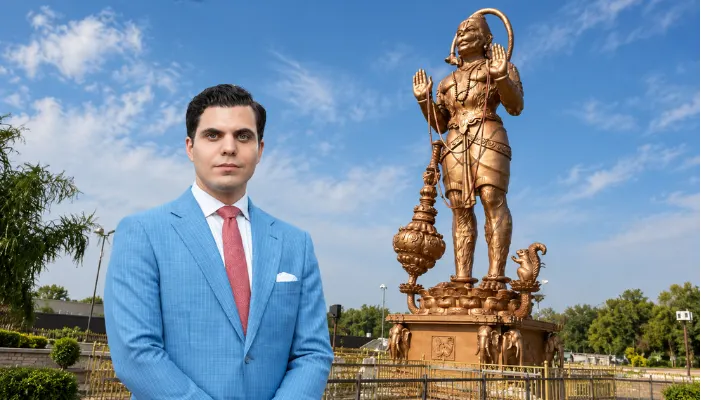
Case Summary
In Texas, United States, a 90-foot statue of Lord Hanuman was targeted by Jesse Hughes, a Christian conservative YouTuber and MAGA activist. Hughes publicly called for the demolition of the statue. On 20 September 2026, Hughes shared a photograph of the statue, known as the “Statue of Union”, on X and wrote, “Btw, when we win, we are tearing this down.” The post immediately drew backlash from Hindu Americans, Hindu organisations and others, who called it a threat directed at a Hindu religious structure. An X user, Ruchir Bakshi, who described himself as a United States Army combat veteran and Hindu American, condemned Hughes’s statement. Bakshi said that he had served alongside Christians, Jews, Muslims, atheists and other Hindus and that he had not served in the military so that someone could threaten another American community’s faith. He described Hughes’s statement as a “threat against Hinduism itself” and said that vandalising another American community’s house of worship because of hostility towards its faith amounted to targeting the Hindu community’s religion. The Coalition of Hindus of North America (CoHNA), an American Hindu organisation, and Carl Wheless, a United States veteran based in Texas, supported Bakshi’s response. CoHNA said it shared concern over “open religious bigotry” being mainstreamed on the platform and expressed support for opposing it. The 90-foot bronze murti of Lord Hanuman was installed at the Sri Ashtalakshmi Temple in August 2024 and consecrated that month. Named the “Statue of Union”, it became the third-tallest statue in the United States, after the Statue of Liberty and the Pegasus and Dragon statue in Florida. The statue stood on private temple property and was funded through donations from Hindu devotees. Since its consecration, it faced opposition from several Christian conservatives, who described it as “un-Christian”. The statue had previously been the site of a Christian demonstration. On 25 August 2024, approximately 25 members of a Christian church demonstrated near the temple, prayed around the site and approached visitors with Christian religious messages. Following concerns about further disturbances, temple officials arranged security guards and planned to install surveillance cameras. Notably, the Hinduphobia Tracker had previously documented several instances in which American Christian conservatives denigrated the 90-foot statue of Lord Hanuman in Texas. On 15 April 2025, Carlos Turcios, a Christian journalist, denigrated the statue of Lord Hanuman and described the deity as “satanic” and a “false god”. He again denigrated Lord Hanuman in 2026 and referred to Hindus as “third world aliens”. Similarly, on 20 September 2025, Alexander Duncan, a Christian politician and Republican Senate candidate, denigrated Lord Hanuman by calling the deity a “false Hindu god” and citing Bible verses while condemning Hindu idol worship. In January 2026, Duncan again targeted the Hanuman statue, calling it an “abomination” and stating, “We need to get rid of these demonic false god idols.” On 21 October 2025, Meghan Basham, a Christian journalist with the right-wing outlet The Daily Wire, targeted the statue in a post mockingly referring to Lord Hanuman as the “giant monkey god”. She also objected to federal government offices adopting an inclusive approach towards Hindu worship and deities. On 23 September 2025, Abraham George, an Indian-American Christian politician and chairman of the Republican Party of Texas, defended Duncan’s remarks while also denigrating the Hanuman statue by referring to Lord Hanuman as a “false god”. George justified the statement by invoking Christian theology. Several other social media accounts associated with Christian conservatives had also repeatedly targeted the Hanuman statue, describing Lord Hanuman as “satanic”, “demonic” or a “false god”, while derogatorily referring to Hindu worship as “idol worship”.
Case Images

Why it is Hate Crime ?
This case is being added to the tracker under the primary category: Hate Speech against Hindus. Within this, the subcategory selected is: Violent Threats. Violent threats, explicit, implicit or implied, is the most dangerous form of hate speech since it goes beyond discriminatory and prejudicial language to express the intent of causing harm to an individual or a group of people based on their religious identity and faith. There could be several different kinds of threats that are issued to Hindus based on religious animosity. An explicit threat would mean the direct threat of violence towards an individual Hindu, a group of Hindus or Hindus at large. Physical violence, death threats, threats of destruction of property belonging to Hindus and threats of genocide would mean explicit threats against Hindus for their religious identity. Implicit threats may not be a direct threat but implied through the use of symbols of actions – for example – in the Nupur Sharma case, other than explicit threats, there were also implicit threats when Islamists took to the streets to burn and beat her effigies. It implies that they want to do the same to Nupur Sharma – thereby is considered an implicit threat. Violent threats can be delivered in person, through letters, phone calls, graffiti, or increasingly through social media and other online platforms. It would be important to understand that a threat – explicit or implicit, online or offline – to an individual who happens to be a Hindu does not qualify as a religiously motivated threat. Such a threat, while vile and dangerous, could be owing to non-religious reasons and/or personal animosity. To qualify as a religiously motivated threat, it would need to exhibit an indication that the individual is being targeted for religious reasons and/or owing to his/her religious identity as a Hindu. This case was a clear example of a hate crime because a Christian conservative activist threatened to demolish a sacred Hindu statue of Lord Hanuman. The open call for the demolition of a Hindu religious representation demonstrated a direct religious motivation behind the statement, making the incident a clear instance of hostility directed at Hindus and their faith. Hindu statues and murtis hold profound religious significance within Hinduism, as they serve as sacred representations through which devotees worship and connect with the divine. They are not merely decorative objects or secular monuments, but integral to Hindu religious practice and devotion. The 90-foot murti of Lord Hanuman at the Sri Ashtalakshmi Temple similarly holds deep religious significance for Hindu devotees. The statue represents Lord Hanuman, a revered Hindu deity associated with devotion, strength, courage and service to Lord Rama, and forms part of the temple’s religious environment. Its installation and consecration therefore transformed the statue from an ordinary artistic structure into a sacred representation of Hindu faith and worship. Therefore, publicly stating that the statue would be demolished and declaring, “when we win, we are tearing this down”, amounted to an expression of religious hostility towards a sacred Hindu representation. A call for the destruction of a religious statue went beyond criticism of a belief or theological disagreement and directly targeted a physical representation of Hinduism. Such a statement also revealed the perpetrator’s mindset and hostility towards Hinduism, as the proposed act was not directed at any unlawful activity but at the destruction of a sacred representation solely because of what it represented. The open declaration that a prominent Hindu religious structure would be torn down created fear and insecurity among Hindus regarding the safety of their sacred symbols and religious institutions. It conveyed the message that Hindu sacred representations could be targeted for destruction because of their religious identity, thereby contributing to an atmosphere of intimidation and hostility towards Hindus. There was also no apparent issue of public interest, legality or competing religious rights that could reasonably explain the demand for the statue’s demolition. The statue stood on private temple property and had been established as part of a Hindu place of worship. It did not prevent American Christians from practising their own faith, interfere with Christian worship or occupy public land. The presence of a Hindu sacred representation on private temple property therefore did not constitute an infringement upon the religious rights of Christians. The fact that the mere presence of a Hindu religious representation became the subject of calls for its demolition indicated that the hostility was directed at what the statue represented rather than at any unlawful activity associated with it. In this context, the demand for its destruction demonstrated religious bigotry towards Hinduism and its sacred representations, making the incident a clear instance of religiously driven hostility rooted in Hinduphobia. Furthermore, the incident did not occur in isolation. The same 90-foot statue of Lord Hanuman had repeatedly been targeted by Christian conservatives, with individuals describing Lord Hanuman as a “satanic”, “demonic”, or “false god” and derogatorily referring to Hindu worship as “idol worship”. The repeated targeting of the same Hindu sacred representation demonstrated a continuing pattern of hostility rather than a single isolated remark. The statue had become a prominent Hindu religious representation in the United States, and repeated attacks against it consequently extended beyond criticism of an individual object to hostility towards the visible presence and expression of Hinduism in public life. The recurrence of such statements demonstrated a pattern of religious bigotry directed at Hindu sacred symbols and contributed to an environment in which Hindus and their religious institutions felt targeted because of their faith. Considering the explicit threat to demolish a sacred Hindu statue, the religious nature of the target, the absence of any legitimate issue involving the statue’s legality or interference with another community’s religious rights, and the repeated history of hostility towards the same Hindu religious representation, the incident demonstrated a clear pattern of religiously motivated hostility towards Hinduism. Therefore, this case was added to the hate crime database of the Hinduphobia Tracker.


Case Status
Unknown


Perpetrators Details
Perpetrators
Christian Extremists
Perpetrators Range
One Person
Perpetrators Gender
male
 Sources




