Attack on Hindu sentiments: Indian-American Christian politician denigrates Hindu deities on social media
 Texas, United States
  22 September, 2025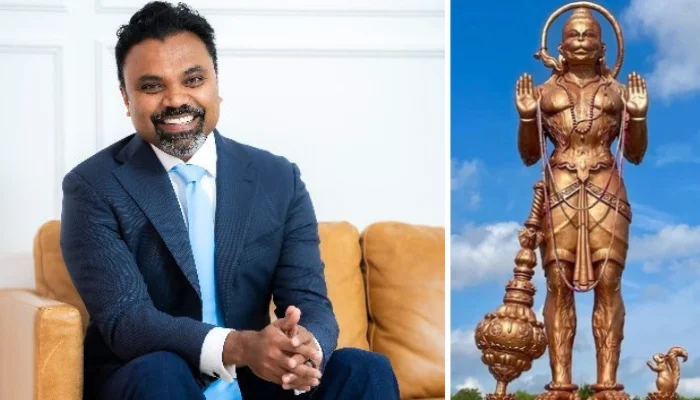
Case Summary
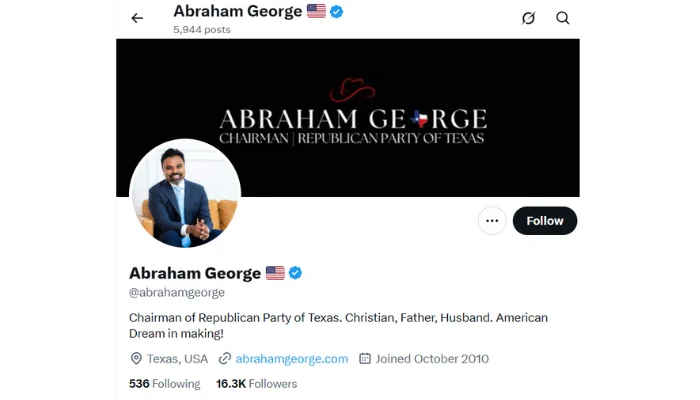
In the United States, a derogatory remark against Hindu deities was made on social media by an Indian-American Republican politician named Abraham George, a Christian by faith. The accused is the chairman of the Republican Party in Texas. This incident began when the official X handle of the Texas GOP (Grand Old Party) posted on 23rd September 2025, stating: “Chairman @AbrahamGeorge will be joining the event this Wednesday in Houston to stand with the brave Stratford High School students targeted for starting a Turning Point USA club.” In this post, a user commented by referencing an anti-Hindu Republican politician named Alexander Duncan, who had repeatedly denigrated Hindu deities. Quoting this background, the user said, “Do better. Your candidates are literally spreading hate and bigotry. The GOP will be losing upcoming elections because of these types of candidates.” In response, on 23rd September 2025, Abraham George denigrated Hindu deities and idols, referring to them as false gods while praising Jesus Christ. He wrote, “I don’t think I’ve met this candidate, and in the primary election, he does not have my endorsement or the Party’s. But as an individual and a Christ follower who was born in India to a Pentecostal preacher’s family, I agree with him that Christians need to be concerned about idols and false gods. There is only one God, and that is Jesus Christ Himself. The commandments are clear: you shall not have any other god, and you shall not worship idols. I know it is not politically correct, but I honestly don’t care.” Notably, the Hinduphobia Tracker has recorded two previous instances of anti-Hindu speech by Republican politician Alexander Duncan. First, in September 2025, he mocked the idol of Lord Hanuman at the Sugar Land Mahalakshmi Temple in Texas, labelling him a ''false god". Similarly, in November 2025, when a large statue of Lord Murugan was planned as part of a new Hindu temple complex in Moncure, North Carolina, Duncan mocked it by calling Hindu gods ''worthless'' and ''disgraceful.
Case Images
Why it is Hate Crime ?
This case is being added to the tracker under the primary category- Hate Speech against Hindus. Within this, the subcategory selected is- Anti-Hindu slurs, mocking faith. Anti-Hindu slurs and the deliberate mocking of the Hindu faith owing to religious animosity involve the usage of derogatory terms, stereotypes, or offensive references to religious practices, symbols, or figures. One of the common anti-Hindu slurs used against Hindus is “cow-worshipper” and “cow piss drinker”. The intention of using this term is to demean and mock Hindus as a group and their religious beliefs since Hindus consider the cow holy. Additionally, some symbols and the slurs attached to them have a historical context that exacerbates the insult, hate, stereotyping, dehumanisation and oppression against Hindus. Cow worship has been used for centuries to denigrate Hindus, insult their faith and oppress Hindus specifically as a religious group. There has been overwhelming documentation about how cow slaughter has been used to persecute Hindus with cow meat being thrown in temples and places of worship. There has also been overwhelming documentation where cow meat (beef) has been force-fed to Hindus to either forcefully convert them to Islam or denigrate their faith. Apart from cow worship, the Swastika – which holds deep religious significance for the Hindus – has also been misinterpreted and distorted to use as a slur against Hindus. Similarly, the worship of the Shivling has been used by supremacist ideologies and religions to denigrate Hindus owing to religious animosity. Such slurs and denigration stem out of inherent animosity and hate towards Hindus and their faith, therefore, it is categorised as hate speech targeted at Hindus specifically owing to their religious identity. This case constitutes a clear instance of hate speech targeted at the Hindu community and their religious beliefs. Abraham George, the accused, deliberately disparaged Hindu gods and idols by labelling them as “false gods.” In Hinduism, deities and idols are not merely decorations; they embody the divine presence and serve as vital focal points of worship, spiritual identity, and cultural continuity for millions of Hindu devotees worldwide. To insult or demean these sacred figures is to wound the religious sentiments of the Hindu community profoundly, constituting an affront to their spiritual dignity and faith. This blatant disrespect qualifies unequivocally as anti-Hindu hate speech, rooted in entrenched animus against Hindus. Moreover, the accused openly expressed religious hostility by elevating Jesus Christ as the sole true God and rejecting the validity of Hindu deities. This posture exemplifies Christian supremacy, reflecting an attempt to assert the exclusivity and dominance of Christianity over other faiths, especially Hinduism. By explicitly stating, “there is only one God, and that is Jesus Christ Himself,” George’s speech transcended personal belief, becoming a vehicle for doctrinal hatred and exclusion. Such proclamations in this context propagate religious intolerance, undercutting the pluralistic respect owed to diverse spiritual traditions. George’s act of supporting Alexander Duncan, a fellow politician notorious for repeated anti-Hindu rhetoric, further reflects the scale of his animosity. Duncan has publicly reviled revered Hindu figures such as Lord Hanuman and Lord Murugan, branding them as “false god” and “worthless.” George’s support and amplification of Duncan’s bigotry illustrate an intentional propagation of religious hatred, fostering an environment of sustained hostility toward Hinduism. This collaboration signals a coordinated effort to legitimise and spread anti-Hindu sentiment in political discourse. Taken together, Abraham George’s actions reveal a deep-rooted theological antagonism towards Hinduism and its practitioners. These attitudes emerge from longstanding Christian doctrinal traditions that denigrate non-Christian faiths, and particularly polytheistic religions, by labelling their gods as false or demonic. This strategy serves to elevate Christianity’s supremacy while perpetuating marginalisation and discrimination against other religious groups, such as Hindus. Importantly, as a prominent Republican politician with a significant following, George’s hateful pronouncements carry considerable influence. His words do not exist in a vacuum; they can exacerbate prejudice, escalate anti-Hindu animosity, and contribute to an environment where hostility can escalate into real-world violence. The reverberations of such public denigration are far-reaching, impacting the social cohesion and safety of the Hindu community. For these reasons, this incident is being formally recorded in the hate crime database of the Hinduphobia Tracker.


Case Status
Unknown


Perpetrators Details
Perpetrators
Christian Extremists
Perpetrators Range
One Person
Perpetrators Gender
male
 Sources




