Ganesh Chaturthi immersion procession halted, route blocked over mosque, idol forced back to temple in Haveri, Karnataka
 Haveri, Karnataka, India
  19 September, 2026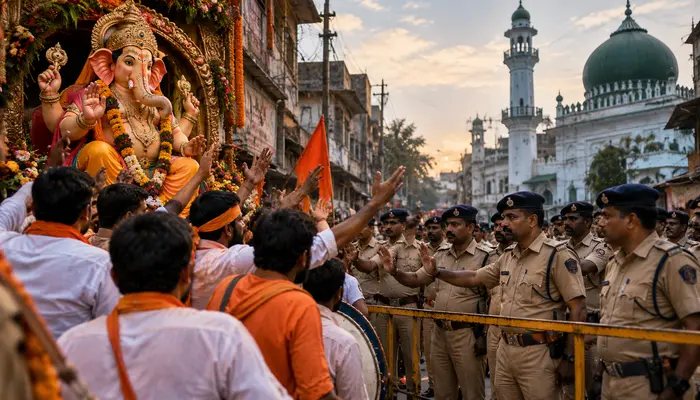
Case Summary
In Savanur, Haveri district, Karnataka, police halted a Ganesh Chaturthi immersion procession and blocked its route through Rajabeedi, citing a mosque along the route as the reason. Devotees were forced to take the Ganesh idol back to the temple and reinstall it instead of immersing it. On 20 September 2026, the Bhavsar Kshatriya Gajanan Yuvak Mandal of Dandin Pete, Savanur, began the Ganesh idol immersion procession from the Ganesh temple, accompanied by traditional cultural troupes. The Ganeshotsav Committee had previously convened a meeting and fixed the date for the procession, while representatives of various Ganesh committees in Savanur had agreed to conduct the immersion processions jointly. As the procession moved towards Rajabeedi, police personnel stopped it and did not permit the organisers to proceed through the main street, where a mosque was situated. The organisers and devotees insisted that the procession be allowed to continue through Rajabeedi, but the police directed them towards the previously designated route on security grounds. By then, the procession had travelled approximately 500 metres. Haveri Superintendent of Police Yashoda Vantagodi held discussions with committee members, but no agreement was reached. The committee continued to insist that the procession be permitted through Rajabeedi, while the police maintained their restriction on the route. The procession was subsequently halted, and the Ganesh idol was brought back from the route to the Ganesh temple in Dandin Pete. The idol was then reinstalled in the temple, ending the planned immersion. The committee maintained that it would not immerse the idol unless the procession was allowed to proceed through Rajabeedi. Mahesh, president of the Savanur Town Ganesh Festival Committee, said that Ganesh festivities had been conducted in Savanur for nearly 30 years without caste-based discrimination or disturbances during immersion processions. He stated that the Muslim community had not objected to the Ganesh procession and questioned the restriction on the Rajabeedi route. He also said the committee would convene another meeting and consider how to conduct future Ganesh idol immersion processions through the main street. A further point of dispute concerned the route's history. The Bhavsar Kshatriya Gajanan Yuvak Mandal maintained that Rajabeedi had traditionally been used for Ganesh immersion processions for approximately three decades. In recent years, the route changed to Market Road because the processions used DJ systems. With restrictions on DJ systems in 2026, the committee sought permission to return to the traditional Rajabeedi route. The police position, as stated by Superintendent of Police Yashoda Vantagodi, was that the Simpigalli Ganesh idol immersion procession should continue along the route it had used for several years. She claimed 250 Ganesh idols had been installed within the jurisdiction of the Savanur Police Station, and 185 had already been immersed peacefully without any dispute. She further claimed that the assertion that the route had been changed because of the mosque was incorrect, and that suddenly moving the procession to a new route would make it difficult to arrange the required security deployment. The police maintained that the established route should be followed in the interests of public peace and law and order. Following the standoff, police deployed additional contingents across Savanur town as a precaution, and tightened security arrangements to prevent any untoward incident and maintain law and order. The Savanur dispute came shortly after a controversy in T. Narasipura, Mysuru district, involving Inspector Dhananjay, whose remarks concerning a Ganesh idol procession in front of a mosque had triggered a separate dispute. The Savanur incident also drew attention because it involved stopping a Ganesh immersion procession from using a traditional route simply because a mosque was there.
Why it is Hate Crime ?
The primary category selected in this case is: Restriction/ban on Hindu practices. Within this, the subcategory selected is: Administration disallows religious procession. The tertiary category selected is: Religious procession. In several cases, it is seen that the administration/state disallows a religious procession owing to prejudicial orders and concerns, targeted specifically against the Hindu community. Such restriction/prohibition would be considered documented as a hate crime because the orders are often a result of pressure by groups that harbour animosity towards Hinduism and Hindus. Often, the restriction by the authorities is driven by bias, hostility, or prejudice against the specific community being stopped from holding a religious procession, by pressure groups that harbour animosity towards Hindus, intrinsic to their faith. Since the religious procession is inherent to the faith of the Hindus, such prejudicial restriction is considered a curtailing of the fundamental rights of the Hindu community. In several cases, for example, the authorities ban a Hindu religious procession due to pressure from groups opposed to the religion. In other instances, the prohibition is selectively enforced against one religious group (Hindus) while others are allowed to proceed. There are still other cases where the authorities preemptively restrict a religious process by Hindus because those who hold animosity towards Hindus may get “provoked” leading to them being violent, thereby assuaging the sentiments of those who hold animosity towards Hindus by curtailing the religious rights of Hindus. Such acts and orders are prejudiced, indicating discriminatory motives owing to the capitulation to groups that harbour animosity towards Hindus and therefore, would be categorized as a religiously motivated hate crime since the original pressure leading to the order itself is a result of hatred/bias/prejudice/religious hate against Hindus. This case is a clear example of religiously driven hostility because the Ganesh immersion procession was prevented from taking its traditional Rajabeedi route on the stated ground that a mosque was located along the way. The restriction therefore went beyond ordinary route management. A Hindu religious procession was stopped because it would pass a Muslim place of worship, placing a specific religious limitation on the devotees and forcing them to abandon their established route. Ganesh Chaturthi is a major Hindu festival dedicated to Lord Ganesha. The immersion procession is an integral part of the celebration, marking the customary conclusion of the period of worship following the installation of the idol. Preventing devotees from completing this procession therefore interfered directly with an established act of Hindu religious observance. The religious significance was further heightened by the fact that Rajabeedi had been used for Ganesh immersion processions for around three decades. Stopping the procession from using this long-established route because of the mosque effectively required Hindu devotees to alter their customary religious practice to accommodate another place of worship. The restriction thus placed the burden of maintaining religious sensitivity on the Hindu procession rather than allowing both religious activities to coexist in the public space. The consequences went beyond a route change. Because the procession could not proceed, the Ganesh idol had to be taken back to the temple in Dandin Pete and reinstalled instead of being immersed. This interrupted the customary concluding ritual of Ganesh Chaturthi and prevented devotees from completing the observance as planned. The incident therefore cannot be viewed simply as a matter of traffic, route planning or public movement. A long-standing Hindu religious procession was stopped because its established route passed a mosque, restricting the devotees’ ability to complete a major Hindu festival and interfering with their fundamental right to freely practise and express their religion. Such a restriction can be viewed as an attempt to curtail the religious rights of the Hindu community in order to accommodate the sensitivities of the local Muslim population. By treating the presence of a mosque as sufficient reason to restrict a Hindu religious procession, the authorities effectively placed the burden of religious accommodation on Hindus and denied them equal space to practise and publicly express their faith. This action was discriminatory and indicative of religious bias, making religion central to the case. It has therefore been documented in the Hinduphobia Tracker’s Hate Crime Database as an instance of religiously motivated hostility against Hindus and their religious practice.


Case Status
Unknown


Perpetrators Details
Perpetrators
State and Establishment
Perpetrators Range
Unknown
Perpetrators Gender
unknown
 Sources




