Ganesh Chaturthi celebrations curtailed by police in Mysore; Hindus warned against taking processions near mosques, bursting crackers or raising Hindu slogans
 Mysore, Karnataka, India
  6 September, 2026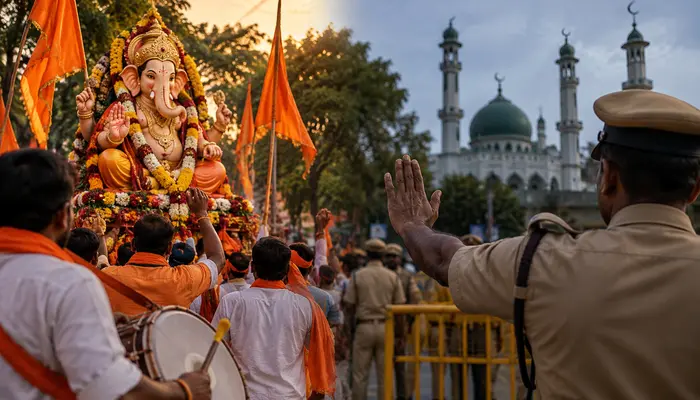
Case Summary
In T. Narasipura in Karnataka’s Mysuru district, Hindu devotees and Ganesh Chaturthi organisers faced restrictions and warnings over their religious celebrations. Police directed them not to take Ganesh processions near mosques, burst firecrackers, stop and dance, or raise Hindu religious slogans at such locations. Police Inspector Dhananjay warned that direct action would be taken if such conduct came to the police’s notice. The restrictions, particularly the refusal to permit a proposed rerouting of the Ganesha procession through an area near a mosque, drew objections from Hindu devotees, who said they were being prevented from freely conducting their traditional Ganesh Chaturthi celebrations. The controversy began at a peace meeting held on 7 September 2026 ahead of Ganesh Chaturthi. T. Narasipura Police Inspector Dhananjay addressed Ganesh Chaturthi organisers and instructed them to follow the procession route designated by the police. He warned them against independently choosing another route, stopping in front of a mosque, bursting crackers, dancing, or chanting Hindu slogans loudly. He said that if such conduct came to the police’s notice, he would take direct action rather than merely issue a warning. A video of his remarks subsequently circulated on social media and became the focus of widespread backlash. The immediate dispute centred on a proposed rerouting of the Ganesh procession through an area near a mosque, which Dhananjay refused to permit. Dhananjay also told the organisers that people should respect followers of other religions and allow them to celebrate their respective festivals. He said every religion was important to its followers. He added that while people could consider their own religion supreme, another person’s religion was equally important to them. He questioned why anyone should stop and dance in front of a mosque during Ganeshotsava and described such behaviour as the conduct of a few disruptive people rather than something required by religion. The police also told organisers that the procession would not be permitted on T. Narasipura Link Road and would have to follow the route fixed by the authorities. Loudspeaker and DJ-type speaker use during processions was limited to between 8 am and 6 pm. Local BJP leader Arjun Ramesh opposed the restrictions, saying T. Narasipura had historically remained free of communal riots. He objected to officials treating the Link Road as a mosque-related route and warned that Hindu organisations would consider a mass protest if restrictions were imposed on the Ganesh immersion procession. Mysuru-Kodagu Member of Parliament Yaduveer Krishnadatta Chamaraja Wadiyar criticised the restrictions on Hindu festivals and processions. He said Hindu devotees had the right to use public roads and questioned why a procession should face restrictions merely because it passed a mosque or temple. He said genuine law-and-order concerns could instead be addressed through security arrangements or an alternative route. He also referred to the Chamundi Hill issue while criticising what he described as obstacles created in the name of secularism. Former Mysuru-Kodagu Member of Parliament Pratap Simha criticised Dhananjay’s manner of addressing the Ganesh festival organisers. He questioned the Inspector’s authority to publicly threaten young Hindu devotees and compared his manner of speaking to that of officials during the British period. Simha also raised the issue of loudspeaker use at mosques and said the protest would continue day and night unless Dhananjay was suspended. He warned the Inspector against repeating his remarks. On 13 September 2026, Karnataka Leader of the Opposition R. Ashoka joined the BJP’s protest against the restrictions. He said the T. Narasipura police officer had warned Ganesh festival organisers against going near mosques, taking processions there, bursting crackers or raising slogans. Ashoka said similar warnings had been issued elsewhere in Karnataka and accused the Congress government of creating obstacles to Ganeshotsava. He also referred to Maddur and Kolar, where he said organisers faced similar restrictions and had to obtain multiple permissions for installing idols and conducting processions. Ashoka pointed out that Ganapati celebrations had played a role in the freedom struggle against British rule and questioned why devotees needed permission to celebrate the festival. He called the Karnataka government a “Taliban government” and a “one-sided government” and described its approach as Hindu-hostile. He also challenged Deputy Chief Minister D. K. Shivakumar over his commitment to Hinduism, referring to his temple visits, application of kumkum and bathing in rivers during election periods as “election-time Hinduism”. He challenged Shivakumar to suspend the officer concerned. The BJP then organised a protest in T. Narasipura involving Ashoka, Yaduveer Wadiyar, Pratap Simha, BJP MLA Srivatsa, BJP workers and Hindu activists. The protesters carried a Ganesh idol and sought to proceed with a procession as part of their demonstration. Police stopped and detained Ashoka, Yaduveer Wadiyar, Pratap Simha, Srivatsa and other BJP leaders, workers and Hindu activists. Additional police personnel were deployed in the town as tensions increased, and the detained protesters were subsequently released. Before the detention, the BJP delegation met senior police officials at the T. Narasipura Government Guest House. The delegation included Mysuru Superintendent of Police Mallikarjun Baladandi, the Additional Superintendent of Police, the Deputy Superintendent of Police and the Assistant Commissioner. They did not receive an assurance that Dhananjay would be suspended. Ashoka then announced an overnight protest outside the T. Narasipura police station and said the protesters would celebrate Ganeshotsava inside the police station premises if the Inspector was not suspended. He said Ganesh Chaturthi should not be reduced to a “police festival” and questioned why loudspeaker use during processions was restricted to 8 am–6 pm. Ashoka maintained that public roads belonged to every citizen and that Hindu devotees should be able to conduct their traditional celebrations peacefully. He said he had spoken to the Director General and Inspector General of Police, who had assured him that action would be taken against Dhananjay within three or four days. Ashoka nevertheless demanded his immediate suspension and said the Inspector was behaving “like a goon” towards members of the public and Ganesh festival organisers. Yaduveer Wadiyar described the measures as “selective restrictions on Hindu festivals” and said the same law-and-order standards should apply to festivals of every community. He maintained that the presence of a mosque or temple along a public road should not by itself prevent a religious procession from using the road. He also said the controversy had brought greater attention to the Ganapati celebrations in T. Narasipura, which had previously attracted mainly local participation. Mysuru Superintendent of Police Mallikarjun Baladandi rejected the contention that the police had introduced new restrictions on traditional Ganesh procession routes. He said there was “no restriction of any kind” on following routes used in previous years and maintained that Hindu organisers could continue to visit the same locations as before. He said T. Narasipura had approximately 15–20 Ganesh pandals, with immersions taking place on different days. Organisers had been asked to provide details of idol locations, procession dates, immersion dates and routes so that the police could make the necessary security arrangements. Baladandi claimed that the mosque-related instruction followed an incident during the previous year’s celebrations in which a Ganesh Mandali had gone to a location near a mosque without informing the police or arranging the necessary security. He said the instruction was intended to prevent organisers from independently changing or extending their route without prior coordination. He maintained that traditional procession routes remained open and that the police had not introduced a new practice. The police administration said peace meetings had been conducted across the area as part of preparations for Ganeshotsava. Organisers had been asked to provide advance information so that police could coordinate processions, regulate traffic, deploy security personnel and prevent law-and-order problems. The police maintained that Hindu organisers could follow established routes provided they complied with the required permission and prior-notice procedures. On 14 September 2026, Karnataka Home Minister Priyank Kharge appealed to people celebrating Ganesh Chaturthi to cooperate with police personnel managing Ganesha processions across the state. He said Karnataka had recorded 80,558 public Ganesha processions in 2025, with more than 1,02,000 police personnel, Home Guards and Central Forces deployed. Kharge said police personnel spent the festival managing crowds, regulating traffic, preventing conflicts and ensuring that people returned home safely, often away from their parents, spouses and children. He urged people to respect police instructions, cooperate with officers and treat them with dignity, saying that police personnel sacrificed their own celebrations to ensure that others could celebrate peacefully. Karnataka Chief Minister D. K. Shivakumar subsequently directed the police to remain alert after the BJP threatened to intensify its protest and enter the T. Narasipura police station. Shivakumar rejected the attempt to portray Ganesh as belonging to a particular political party and said the government had provided a holiday for the festival and was encouraging people to celebrate. He accused the BJP of attempting to provoke communal sentiments, said the government was aware of anti-social elements and maintained that Ganeshotsava would be celebrated peacefully. Union Minister Pralhad Joshi condemned Dhananjay’s remarks and demanded his immediate suspension. He questioned the Inspector’s authority to publicly threaten young members of the Ganesh committee and whether the instructions reflected the police department or what he described as the appeasement politics of the Congress government led by D. K. Shivakumar. Joshi said a law-and-order officer acting like an agent of the Muslim community and intimidating Hindu festival organisers was unacceptable. He described the episode as reflecting what he called the government’s anti-Hindu policy and said attempts to interfere with Sanatana culture, traditions and devotional sentiments would not be tolerated. The T. Narasipura controversy consequently developed from police directions concerning Ganesh Chaturthi celebrations into a wider confrontation over procession routes, firecrackers, slogans, loudspeakers and the use of public roads. Hindu organisations and BJP leaders demanded action against Inspector Dhananjay and opposed what they regarded as selective curbs on Ganeshotsava. The police administration maintained that traditional routes remained available and that its measures concerned prior coordination, security and public order.
Why it is Hate Crime ?
The primary category selected in this case is: Restriction/ban on Hindu practices. The subcategory selected is: Restriction on expression of Hindu identity. Restricting religious practices by non-Hindu groups harbouring animosity towards Hindus or the State implementing targeted and/or prejudicial policies specifically against Hindus as a hate crime involves actions and/or policies that stop the religious expression in the form of processions, rituals, display of religious symbols, celebration of festivals targeted towards a specific religious group – in this case – the Hindus. Restrictive actions could include banning the expression/display of religious symbols, prohibiting certain religious practices, targeting religious gatherings, restriction on building places of worship, restrictions imposed on conducting religious rituals/puja etc and targeted and/or prejudicial policies by the state specifically against the Hindu community. International conventions too and the United Nations too classify restrictions on religious practices as violation of fundamental human rights. In India, the restrictions come from multiple sources. The restriction on religious practices could come from non-Hindu religious denominations owing to their intolerance and animosity towards Hindus, Hinduism and their religious practices and/or the state itself, when it clamps down on religious processions, religious practices and rituals of Hindus for reasons like ensuring that those who harbour animosity towards Hinduism don’t get ‘provoked’ into violence. The restriction of Hindu religious practices in order to assuage the intolerance of non-Hindu communities can be viewed as the denial of the fundamental rights of the Hindu community on an individual and community level. In this category, therefore, we would document restriction/ban on Hindu religious practices not just by non-Hindu groups but also the state. The other subcategory selected is: Administration restricting religious practice. In several cases, it is seen that the administration/state disallows a religious practice owing to prejudicial orders and concerns, targeted specifically against the Hindu community. Such restriction/prohibition would be considered documented as a hate crime because the orders are often a result of pressure by groups that harbour animosity towards Hinduism and Hindus. Often, the restriction by the authorities is driven by bias, hostility, or prejudice against the specific community being stopped from holding a religious practice, by pressure groups that harbour animosity towards Hindus, intrinsic to their faith. Since practices are intrinsic to the faith of the Hindus, such prejudicial restriction is considered a curtailing of the fundamental rights of the Hindu community. In several cases, for example, the authorities ban a Hindu religious practice due to pressure from groups opposed to the religion. In other instances the prohibition is selectively enforced against one religious group (Hindus) while others are allowed to proceed. There are still other cases where the authorities preemptively restrict a religious practice by Hindus because those who hold animosity towards Hindus may get “provoked” leading to them being violent, thereby assuaging the sentiments of those who hold animosity towards Hindus by curtailing the religious rights of Hindus. Such acts and orders are prejudiced, indicating discriminatory motives owing to the capitulation to groups that harbour animosity towards Hindus and therefore would be categorised as a religiously motivated hate crime since the original pressure leading to the order itself is a result of hatred/bias/prejudice/religious hate against Hindus. This case is a clear example of a religiously driven hate crime because Hindu Ganesh Chaturthi organisers were subjected to stern, pre-emptive restrictions on their religious procession and customary forms of celebration, particularly because the procession was proposed to pass through an area near a mosque. The police warned organisers against stopping and dancing, bursting crackers or raising Hindu religious slogans near mosques and threatened direct action if such conduct came to their notice. The proposed rerouting of the Ganesha procession through an area near a mosque was also refused. The approach therefore treated Hindu devotees as potential sources of communal disturbance who had to be restrained in advance, rather than simply addressing any actual offence or unlawful conduct. This placed the burden of maintaining communal harmony on Hindus by requiring them to curtail legitimate religious expression and reflected a discriminatory approach towards Hindu festivals and processions. The restrictions affected a core part of Hindu religious observance. Ganesh Chaturthi is a major Hindu festival dedicated to Lord Ganesha, during which devotees install and worship his idol and, as part of the festival's culmination, take the deity in a public procession for immersion. The procession is therefore not merely a public gathering but a religious expression through which devotees collectively honour Lord Ganesha and celebrate their faith in the public sphere. Music, devotional songs, traditional instruments, DJ and loudspeaker systems, dancing and the raising of Hindu religious slogans form part of the celebratory atmosphere surrounding these processions, allowing devotees to express their devotion collectively and visibly. These practices are consequently connected to the religious character of Ganeshotsava rather than being unrelated entertainment or ordinary public activity. Restricting the procession itself, along with its music, slogans, dancing and other customary forms of celebration, because it was approaching an area where a mosque is situated, therefore directly curtailed the public expression of Hindu faith. The devotees were not being restrained because they had committed an established offence or because these religious practices were inherently unlawful; rather, they were being warned in advance to suppress customary expressions of their faith because of the presence of another community's place of worship. What made the restrictions particularly significant was their mosque-specific character. The police did not merely communicate neutral requirements concerning traffic, timings or crowd management. The organisers were specifically warned about what they could do when the Ganesh procession approached a mosque, including stopping and dancing, bursting crackers and raising Hindu religious slogans. The presence of a Muslim place of worship thus became a determining factor in how Hindu devotees were expected to conduct their religious celebration. This effectively required Hindus to modify their religious expression to accommodate the presumed sensitivities of another community. A public road does not cease to be a public space because a mosque is situated alongside it, and the mere presence of a mosque should not transform peaceful Hindu religious expression into an act requiring special restraint. The issue also reflected a wider and troubling phenomenon surrounding areas adjoining mosques and other Muslim places of worship, where such spaces come to be treated as exclusive 'Muslim areas' in which the public expression of non-Muslim religions is viewed as unwelcome or provocative. In such an environment, the passage of a Hindu religious procession, the raising of Hindu slogans or the performance of customary religious celebrations is treated as an intrusion into Muslim territorial spaces. Hindu devotees have consequently faced opposition when attempting to exercise their religious practices in such areas, not because they are committing an offence, but because their visible religious presence challenges the expectation that these spaces should remain dominated by one community's religious identity. The T. Narasipura case reflected this dynamic in an especially concerning manner because, rather than ensuring that a Hindu procession could peacefully pass through a public area while preventing any actual public disorder, the police themselves imposed restrictions on the Hindu devotees because the route passed near a mosque. This effectively reinforced the idea that areas surrounding Muslim places of worship require Hindu religious expression to be suppressed or toned down. The selective nature of the approach becomes even more significant when considered against the treatment of Islamic religious festivals and processions. Karnataka police have not imposed comparable restrictions on Islamic religious processions during Eid or Muharram, merely because they pass near Hindu temples or because their religious expressions could potentially affect Hindu sentiments. Yet, in the present case, Hindu devotees were specifically warned against carrying out ordinary religious activities because their Ganesh procession would pass near a mosque. Such asymmetry raises a fundamental question of equal treatment: why should Hindu religious expression be subjected to special restrictions in the vicinity of Muslim places of worship when Islamic religious expression is not subjected to equivalent restrictions in comparable circumstances? The selective imposition of such constraints showcases a deeply unequal approach towards Hindu religious practice and creates the impression that Hindu religious sentiments and freedoms are considered less deserving of protection. This selective treatment reflected deep-seated institutional hostility towards Hinduism and the public expression of Hindu faith. The cumulative nature of the restrictions further strengthened this discriminatory character. The issue did not concern one isolated condition imposed for traffic or security purposes. Hindu organisers faced restrictions concerning the procession route, movement near mosques, dancing, firecrackers, religious slogans and loudspeaker use. While individual regulations relating to timings, traffic or security can be legitimate when applied neutrally and proportionately, their combination in this case disproportionately constrained a Hindu religious celebration. Most significantly, several of the restrictions were directly connected to the procession's proximity to mosques. The result was that Hindu devotees were expected to conduct their festival differently depending on whether they entered an area associated with another religion. The pre-emptive nature of the police intervention also demonstrated the unequal treatment of the organisers. Inspector Dhananjay warned the devotees before the procession that direct action would be taken if certain conduct came to the police's notice. The organisers were therefore being instructed in advance not to engage in conduct that formed part of their customary celebration. This was not a response to an offence committed during the procession; it was a restriction based on what the authorities anticipated the devotees might do. Such prior restraint treated Hindu festival organisers as potential troublemakers whose religious behaviour needed to be controlled before any actual wrongdoing occurred. The stern nature of the warning showcased that the authorities approached the Hindu celebration through the lens of anticipated communal conflict rather than equal protection of religious freedom. The police administration maintained that its measures were intended to ensure security and prior coordination and that traditional procession routes remained available. It also referred to an incident during the previous year's celebrations in which a Ganesh Mandali had gone near a mosque without informing the police or arranging the necessary security. Genuine requirements concerning advance notice, traffic regulation and security deployment are legitimate functions of the State. However, such concerns cannot by themselves justify treating ordinary Hindu religious expression as something that must be suppressed whenever a procession approaches a mosque. If there were genuine concerns about potential clashes, the appropriate responsibility of the State was to provide adequate security and ensure that all parties complied with the law, rather than making Hindu devotees responsible for preventing possible conflict by reducing their religious expression. The fundamental problem was therefore not the existence of police regulation itself, but the unequal principle underlying the restrictions. Communal harmony in a plural society cannot be maintained by requiring one religious community (Hindus) to repeatedly dilute its religious practices whenever another community's sensitivities are presumed to be at stake. The State's responsibility is to protect the peaceful exercise of religious freedom while preventing actual violence, intimidation or unlawful disruption. If a Hindu procession is peaceful and lawful, Hindu devotees should not be required to silence their religious slogans, abandon customary celebrations or avoid public roads merely because a mosque is situated nearby. Such an approach effectively makes Hindu religious freedom conditional upon the presumed comfort of the Muslim community. The restrictions were particularly disproportionate because Ganesh Chaturthi is an annual religious celebration, with public processions forming an important part of its observance. The devotees were exercising a traditional form of Hindu religious practice rather than engaging in conduct inherently directed against another community. Yet their religious expression was treated as something that had to be curtailed in areas near mosques. This risked normalising the idea that Hindu festivals must become quieter, less visible or less demonstrative whenever they enter spaces perceived as belonging to Muslims. Such a principle is incompatible with equal religious freedom and effectively creates different standards for the public practice of different religions. Overall, the T. Narasipura episode demonstrated institutionalised discrimination against Hindu religious expression. Such institutional actions normalised and encouraged bias and prejudice against Hinduism and its adherents. Therefore, the incident was added to the Hinduphobia Tracker's hate crime database.


Case Status
Unknown


Perpetrators Details
Perpetrators
State and Establishment
Perpetrators Range
One Person
Perpetrators Gender
male
 Sources




