Hindu gods and goddesses targeted in repeated derogatory remarks by Ambedkarite woman; goddess Durga called ‘Vaishya’
 Delhi, India
  8 April, 2025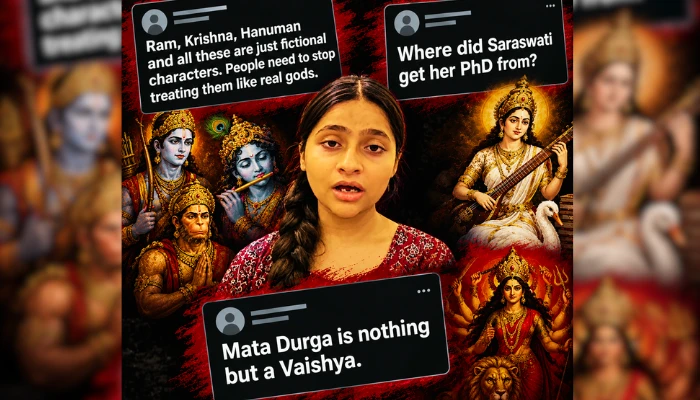
Case Summary
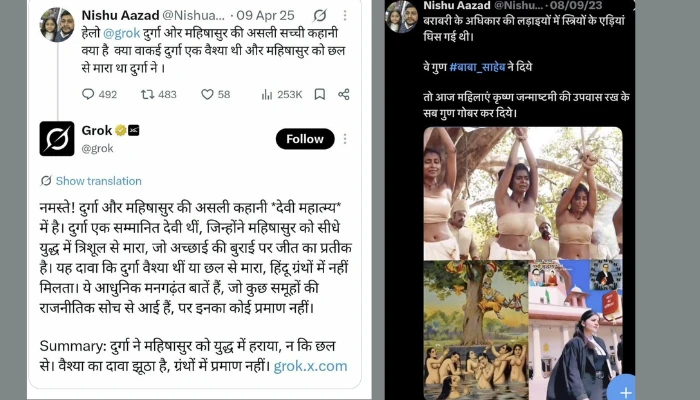
Hindu deity Goddess Durga was mocked, insulted and defamed by Ambedkarite activist Nishu Azad on social media. In an old post that resurfaced on social media, the Ambedkarite activist referred to the revered goddess Maa Durga as “Vaishya” (prostitute). The incident gained traction after Supreme Court advocate Amita Sachdeva lodged a police complaint against Nishu Azad and her father, Sanjay Azad, over these Hinduphobic posts. In one post, Nishu Azad asked the AI tool Grok for the “real story” of Goddess Durga and Mahishasur, saying Maa Durga was a prostitute who killed Mahishasur by deceit. Citing the Devi Mahatmya, Grok responded that Durga was a goddess who defeated Mahishasur in a direct battle with a trident, contradicting her claim. This was not an isolated incident. On earlier occasions, Ambedkarite Nishu Azad also mocked other Hindu deities. On 18 August 2026, she released a video on her account mocking Lord Shiva. In the video, devotees were shown praying for Prime Minister Narendra Modi's long rule, to which the Shivalinga replied in the negative. The devotees then questioned the authenticity of the God and referred to the Shivalinga as “Pakistani”. In another post on 4 September 2026, Nishu Azad made a derogatory post against Lord Krishna, claiming that equal rights to women were granted by Baba Saheb Ambedkar and that Hindus wasted it all by worshipping Shree Krishna on Janmashtami. The post included a picture that depicted Lord Krishna as a pervert looking at nude bathing women. Hinduphobia Tracker had previously documented cases that show that Ambedkarites had been habitually involved in hurting Hindu religious sentiments. Their repeated actions showed a pattern of deliberately mocking the Hindu religion and its deities. For instance, on 12 July 2025, Nishu Azad posted a video mocking Hindu deity Maa Saraswati while attacking Hindu religious traditions and the Manusmriti. In the video, Azad said, “If women did not have the right to education under Manusmriti, then from which college did Saraswati complete her PhD?” The remark used Maa Saraswati, the Hindu goddess of knowledge, learning, wisdom and education, as the subject of ridicule while attempting to make a political and social point about women’s education. The video subsequently drew anger from Hindu users, who objected to the use of a revered Hindu deity as a vehicle for mockery. In another instance, an Ambedkarite activist, Satish Bauddh, was seen on 18 April 2026 making derogatory remarks about revered Hindu deities, including Mata Sita, Lord Krishna, and Queen Draupadi. His comments, delivered in a mocking tone, triggered strong outrage among Hindus, who objected to the degrading language and the manner in which sacred figures were portrayed. In the video, Satish Bauddh mocked the divine birth of Maa Sita, referring to her abusively as “Mootani Mata (Piss Devi)” and attacked the Hindu scriptures. After these posts and videos circulated, several Hindu organisations and social media users objected and called for strict legal action against Nishu Azad. Many users stated that such comments amounted to an insult to Hindu religious sentiments and demanded accountability under the law. On September 5, 2026, the Delhi Police registered an official First Information Report (FIR) against Nishu Azad and her father, Sanjay Azad. Supreme Court Advocate-on-Record Amita Sachdeva filed the legal complaint at the Cyber Police Station (New Delhi District). The FIR cites BNS Sections 299 and 196 along with relevant IT Act provisions, stating that the posts intentionally insulted Hindu deities, including Bhagwan Shiv, Bhagwan Shri Krishna, Maa Durga, and Maa Saraswati.
Case Images
Why it is Hate Crime ?
The primary category selected for this case is: Hate speech against Hindus. The subcategory selected is: Anti-Hindu slurs, mocking faith. Anti-Hindu slurs and the deliberate mocking of the Hindu faith owing to religious animosity involve the use of derogatory terms, stereotypes, or offensive references to religious practices, symbols, or figures. One of the common anti-Hindu slurs used against Hindus is “cow-worshipper” and “cow piss drinker”. The intention of using these terms is to demean and mock Hindus as a group and their religious beliefs, since Hindus consider the cow holy. Additionally, some symbols and the slurs attached to them have a historical context that exacerbates the insult, hate, stereotyping, dehumanisation and oppression against Hindus. Cow worship has been used for centuries to denigrate Hindus, insult their faith and oppress Hindus specifically as a religious group. There has been overwhelming documentation about how cow slaughter has been used to persecute Hindus, with cow meat being thrown in temples and places of worship. There has also been overwhelming documentation that cow meat (beef) has been force-fed to Hindus to either forcefully convert them to Islam or denigrate their faith. Apart from cow worship, the Swastika – which holds deep religious significance for the Hindus – has also been misinterpreted and distorted to be used as a slur against Hindus. Similarly, the worship of the Shivling has been used by supremacist ideologies and religions to denigrate Hindus owing to religious animosity. Such slurs and denigration stem from inherent animosity and hate towards Hindus and their faith; therefore, it is categorised as hate speech targeted at Hindus specifically owing to their religious identity. This case was included in the Hinduphobia Tracker because the posts deliberately targeted core Hindu deities and narratives, using derogatory language and distorted claims to mock Hindu faith and provoke outrage among Hindus. The religious trigger lay in the explicit invocation of Maa Durga, Lord Shiva and Lord Krishna, sacred figures central to Hindu worship and their reduction to objects of ridicule through sexually charged slurs, political caricature and false allegations. The conduct attracted the selected categories because it employed derogatory terms and offensive references to Hindu deities, symbols and festivals with the clear intention of demeaning Hindu religious beliefs. Maa Durga was labelled a “Vaishya” (prostitute), Lord Shiva’s Shivalinga was called “Pakistani”, and Lord Krishna was depicted as a pervert in a Janmashtami post. These were not neutral critiques; they were targeted attacks on Hindu religious representations, designed to insult the faith and its devotees. Maa Durga holds profound religious significance in Hinduism as the goddess of power, protection and righteousness, worshipped as the divine mother who annihilates evil. To label her a prostitute was to strip her of her sacred status and reduce a revered deity to a sexual slur, thereby demeaning millions of Hindus who worship her. She is worshipped as a form of Shakti, the supreme feminine divine energy, and reducing her to that of a Vaishya and looking at her through that lens was to challenge and mock the whole religious belief of Hindus, treating a consecrated embodiment of the Divine Mother as an object of vulgar ridicule rather than a focus of devotion. Lord Shiva is one of the principal deities of Hinduism, and the Shivalinga is a sacred representation of his formless divine presence. To call it “Pakistani” was to weaponise a nationalistic slur against a Hindu symbol, thereby insulting the faith and its devotees. Pakistan has long been regarded as an adversarial state to India, where the majority of Hindus live, and is a Muslim-majority nation. Describing the Shivalinga as “Pakistani” therefore amounted to an outright mockery of a core Hindu religious symbol, deliberately conflating a sacred object of worship with a hostile foreign identity to demean and ridicule Hindu beliefs. Lord Krishna is worshipped as the eighth avatar of Vishnu, the teacher of the Bhagavad Gita and the embodiment of love and wisdom. To depict him as a pervert during Janmashtami was to mock a sacred festival and demean a deity central to Hindu devotion. In traditional narratives, Krishna in his adolescence playfully took away the clothes of the Gopis after they complained to his mother about him eating the curd, an episode understood within Hindu theology as divine play (leela) rather than misconduct. Presenting this particular incident as evidence of perversion deliberately distorted its religious meaning and recast a revered deity through a vulgar lens. This whole attempt was to show that Hindu religion was just a mockery of beliefs, reducing sacred stories and devotional symbols to objects of ridicule and thereby insulting the faith of millions of Hindus. The targeted act constituted religious hate because the perpetrator selected Hindu deities, symbols and festivals precisely because of their religious significance, and then used them as vehicles for mockery. The posts were not ordinary social media content; they were carefully crafted to provoke, insult and demean Hindu faith. In these posts, religion was central to the offence because the derogatory language, distorted narratives and offensive imagery were all directed at Hindu religious beliefs, symbols and practices. Moreover, the posts showed how the perpetrator looked at Hindu culture with such vengeance and hostility. The amount of disdain for Hindu culture was displayed in each of the posts. The motive behind such an act was to demean Hindu religious beliefs, provoke outrage among Hindus and advance an anti-Hindu narrative through the mockery of sacred deities and festivals. The posts were planned and executed in a manner that targeted Hindu faith through a recurring pattern of religious mockery, deliberate selection of Hindu targets and degrading language. By ridiculing Hindu deities and presenting Hindu identity in a sexually and communally derogatory manner, the content sought to weaken the religious confidence and fabric of devotion among Hindu devotees. The purpose of such portrayals was to create confusion and contempt towards practices and beliefs that devotees held sacred, while normalising disrespect towards Hinduism among the audience. The conduct therefore constituted a hate crime against Hindus, driven by religious animosity and directed towards demeaning Hindu identity and weakening the respect and devotion attached to the faith. Disclaimer: The social media post defaming Goddess Durga was posted by Nishu Azad on 9 April 2025. Therefore, for documentation purposes, 9 April 2025 was recorded as the incident date, rather than the date on which the matter was reported by the media. In this case, although there is one perpetrator, Nishu Azad, since she was a minor at the time of writing the report, it was claimed that her account was run by her father, Sanjay Azad; therefore, the perpetrator count was recorded as two (2).


Case Status
Complaint filed


Perpetrators Details
Perpetrators
Others
Perpetrators Range
From 2 To 5
Perpetrators Gender
both
 Sources




