Sacred Hindu scripture mocked, Deities abused and insulted by Ambedkarite activitist's anti-Hindu tirade in Delhi
 Delhi, Delhi, India
  17 April, 2026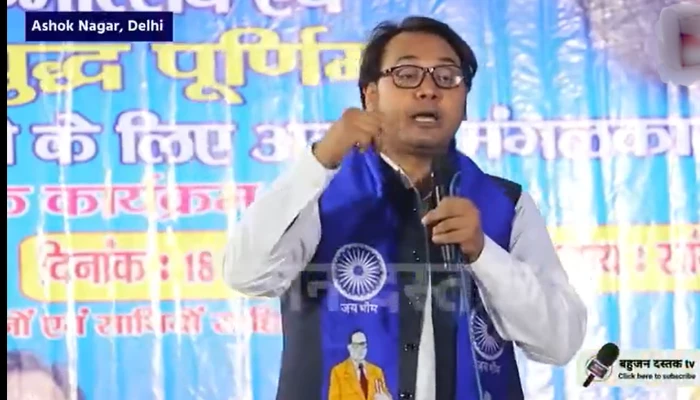
Case Summary
An Ambedkarite activist, Satish Bauddh, resorted to mocking and insulting the Hindu faith. In a widely circulated video on 18 April 2026, he was seen making derogatory remarks about revered Hindu deities, including Mata Sita, Lord Krishna, and Queen Draupadi. His comments, delivered in a mocking tone, triggered strong outrage among Hindus, who objected to the degrading language and the manner in which sacred figures were portrayed. In the video, Satish Bauddh mocked the divine birth of Maa Sita, referring to her abusively as “Mootani Mata (Piss Devi)” and ridiculing the story as if children were “potatoes or radishes” found during excavation. He stated, “There was a king and queen. They were not able to have children… So meet a doctor… But a sage told them that if the king and queen plough the field together, they will have children… Now, when the plough got stuck… a pot was found… There was a girl in it… That girl was named Sita… I did not understand one thing… the kids will come out during the excavation… are they kids or potatoes or radishes… We accepted it as truth because we did not take refuge in intellect… Can it really happen that while digging the ground, a girl comes out…” He further insulted Lord Krishna by calling him a “womaniser” and rebuked people for celebrating Janmashtami, a major Hindu festival celebrating the birth of Lord Krishna. The activist then turned to Queen Draupadi, distorting the Vastra-haran episode, one of the most pivotal episodes in the Mahabharata, which served as the primary catalyst for the catastrophic Kurukshetra war. He falsely claimed that the Pandavas planned her disrobing, and inserted a ‘Dalit-Savarn’ angle to villainise upper-caste Hindus. He said, “A woman was standing there, her name was Draupadi… When the Pandavas planned to disrobe Draupadi… Were there any Dalits in that meeting? They were not Shudras, they were Ati Shudras… those who disrobed the woman were also upper caste… It was Savarn who bet the woman in a gambling… The stories of these people have ruined us… From darkness to darkness, friend, the stories of these people have ruined us.” He further sought to denigrate the Mahabharata epic and the Puranas (specifically the Bhagavata Purana and Vishnu Purana) by mocking a story central to the birth of Lord Krishna, a major figure in the Mahabharata. He commented and mocked that Kansa kept venerable King Vasudev and Mata Devaki together so that their eight sons could be born, ridiculing the whole scripture as it was narrated. He called the birth of Krishna a stepping into darkness. He said, “Vasudev, oh Babuji… the relationship happened with great difficulty… Kansa collected both of them together… Men will be locked up separately, and women will be locked up separately… But Kansa collected both of them together… Brother, farming has started there… The eighth child was about to be born… He left with the boy… They made the exchange… I gave the boy there. I took the girl here… The girl who came turned out to be even smarter than he… Flying in the air, she says, "Kansa son, your arrangements have been made…" So we are moving from darkness to darkness,” he said, while addressing the crowd. Following the circulation of the video, several Hindu organisations and social media users raised objections and called for strict legal action against him. Many users stated that such comments amounted to an insult to Hindu religious sentiments and demanded accountability under the law. Complaints were filed against Satish Bauddh, seeking action for hurting religious sentiments. The incident led to widespread outrage online, with calls for authorities to take cognisance of the matter and initiate appropriate legal proceedings. The controversy continued to gain traction as more people reacted to the video, with demands for accountability and action against the accused growing stronger.
Why it is Hate Crime ?
The primary category for this case is "Hate speech against Hindus". The sub-category here for this case is "Subversion of scriptures." Subverting the religious scriptures of Hindus has particularly devastating consequences. Subversion of the scriptures of Hindus is often done to justify or promote hatred, discrimination, or violence against specific individuals or groups of Hindus. Religious scriptures are often nuanced, and those who harbour religious animosity towards Hindus often misquote or misrepresent the scripture to legitimise their animosity and hate towards the faith and its adherents. Any such misquoting of scriptures or subversion to justify hate, violence and discrimination against Hindus owing to religious animosity is hate speech and is categorised as such. The other sub-category selected for the case is "Anti-Hindu slurs, mocking faith". Anti-Hindu slurs and the deliberate mocking of the Hindu faith owing to religious animosity involve the usage of derogatory terms, stereotypes, or offensive references to religious practices, symbols, or figures. One of the common anti-Hindu slurs used against Hindus is “cow-worshipper” and “cow piss drinker”. The intention of using this term is to demean and mock Hindus as a group and their religious beliefs since Hindus consider the cow holy. Additionally, some symbols and the slurs attached to them have a historical context that exacerbates the insult, hate, stereotyping, dehumanisation and oppression against Hindus. Cow worship has been used for centuries to denigrate Hindus, insult their faith and oppress Hindus specifically as a religious group. There has been overwhelming documentation about how cow slaughter has been used to persecute Hindus, with cow meat being thrown in temples and places of worship. There has also been overwhelming documentation where cow meat (beef) has been force-fed to Hindus to either forcefully convert them to Islam or denigrate their faith. Apart from cow worship, the Swastika – which holds deep religious significance for the Hindus – has also been misinterpreted and distorted to use as a slur against Hindus. Similarly, the worship of the Shivling has been used by supremacist ideologies and religions to denigrate Hindus owing to religious animosity. Such slurs and denigration stem from inherent animosity and hate towards Hindus and their faith; therefore, it is categorised as hate speech targeted at Hindus specifically owing to their religious identity. This case qualified as a religiously motivated hate speech incident because the speech involved a sustained, layered and deliberate attack on core elements of Hindu belief. The first marker is the explicit use of abusive and derogatory language against Hindu deities. The accused did not merely question or analyse but used language designed to insult, including characterising revered figures in demeaning terms. This was significant because it stripped divine figures of their sanctity and invited the audience to view them with contempt rather than reverence. Mocking Hindu deities, distorting their narratives, and using abusive language against them was not a neutral act of critique. It constituted a direct affront to a living faith followed by millions. Hindu deities were not abstract characters but sacred figures embedded in daily worship, cultural identity, and civilisational continuity. When such figures were ridiculed using crude analogies and dismissive language, it reflected not intellectual engagement but a conscious attempt to demean and provoke. Such expressions fell squarely within hate speech as they targeted a religious group through its most revered symbols. The second marker is the systematic targeting of multiple central figures and narratives. The remarks were not limited to a single reference but extended across Maa Sita, Lord Krishna, and Draupadi. This breadth indicated a pattern rather than an isolated comment. By targeting multiple pillars of the faith, the speech created a cumulative effect of denigration, amplifying its impact on the community. The third marker is the distortion of sacred events to create ridicule. The narrative around Maa Sita’s birth was trivialised through crude comparisons, while the life of Lord Krishna was reduced to defamatory characterisation. Similarly, the Draupadi episode was misrepresented with incorrect attribution and reframed to introduce divisive social narratives. Such distortions were significant because they replaced faith-based understanding with caricature, thereby undermining the integrity of the tradition. It is important to understand that the remarks made involved deliberate distortion of foundational Hindu narratives, including the birth of Maa Sita, the life of Lord Krishna, and the episode of Draupadi’s disrobing. These were not casual stories but deeply revered accounts that held theological, cultural, and moral significance. Misrepresenting them in a mocking tone, inserting false claims, and framing them through a hostile lens altered their meaning to suit a narrative of ridicule. Such subversion was often used to delegitimise the faith itself and portray it as regressive or irrational. When sacred narratives were twisted not for interpretation but for derision, it became an instrument of targeted hostility. The fourth marker is the attempt to frame Hindu scriptures as socially harmful. By stating that these stories had “ruined” society and associating them with regressive structures, the speech moved beyond mockery into ideological delegitimisation. This was important because it positioned the faith itself as a problem, thereby justifying hostility towards its adherents. The fifth marker is the performative and public nature of the act. The remarks were made in a manner that engaged an audience, which responded with approval, and the video was later circulated widely on social media. This amplification ensured that the derogatory content reached a larger audience, increasing both its impact and its normalisation. These elements together demonstrated that the act was not a spontaneous or isolated expression but a deliberate, repeated, and public denigration of Hindu religious beliefs. The use of abuse, distortion of sacred narratives, targeting of multiple revered figures, and the framing of the faith as regressive collectively established a clear pattern of hostility. Therefore, this incident met the criteria for classification as hate speech against Hindus, as it involved the intentional and public denigration of their religion, its sacred figures, and its foundational narratives. Since religious mockery underscores the religious animosity driving the crime, it is a clear case of religiously motivated hate, warranting inclusion in the tracker.


Case Status
Unknown


Perpetrators Details
Perpetrators
Others
Perpetrators Range
One Person
Perpetrators Gender
male
 Sources




