Minor Hindu children targeted for Christian conversion through inducements and indoctrination at coaching centre in Hasnabad, West Bengal
 North 24 Parganas district, West Bengal, India
  31 August, 2026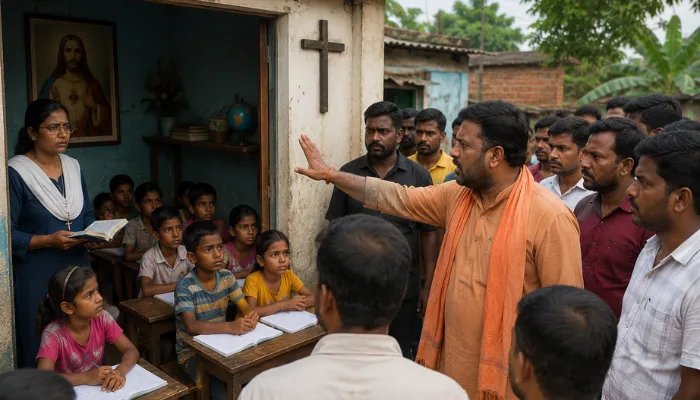
Case Summary
In Rupomari Bazar, Hasnabad, North 24 Parganas, West Bengal, minor Hindu children attending a free coaching centre were targeted for forced conversion by Christian missionaries. The children were offered inducements, exposed to a Christian religious environment and subjected to Christian religious teachings during the coaching classes. The incident came to light after local Hindu residents became aware of the conversion activities taking place at the coaching centre. Hindu activists from Hindu Jagran Manch reached the site and, along with local Hindu residents, opposed the conversion activities. Following the intervention, the coaching centre was shut down. According to Hindu activists and local residents, the area had a Hindu-majority population with a limited Christian presence. Despite this, the coaching centre had a distinctly Christian religious atmosphere. The walls displayed multiple images of Jesus, while there were no images of Hindu deities or other prominent figures commonly associated with the local community. Local Hindu residents further stated that children attending the centre were being indoctrinated with Christian religious teachings alongside their studies. They also stated that young Hindu boys and girls were brought to the coaching centre, where they were offered inducements to convert to Christianity. Residents said that such conversion activities had been taking place in the area for around 20 years. The Christian female teacher conducting the free tuition classes admitted that she had also been teaching the children about Christianity during the classes. She stated that local residents and Hindu organisations had objected to the practice and that government authorities had also made it clear that coercive religious proselytisation could not be carried out. She subsequently stated that she would not engage in such activities in the future. Just days before this incident, Hinduphobia Tracker had documented another case of forced Christian conversion in the Hingalganj Assembly Constituency area of North 24 Parganas district. In that incident, Hindu residents, including minors, were targeted for conversion by Christian missionary members under the pretext of attending prayer meetings and participating in religious activities at ‘house churches’ in the area.
Why it is Hate Crime ?
The primary category selected for this case is: Predatory Proselytisation. The subcategory selected for this case is: Proselytisation by grooming, brainwashing, manipulation or subtle indoctrination. The tertiary category selected for this case is: Conversion of Minor, Pattern of targeting Hindus. Religious brainwashing essentially means the often subtle and forcible indoctrination to induce someone to give up their religious beliefs to accept contrasting regimented ideas. Religious grooming or brainwashing also involves propaganda and manipulation. It involves the systematic effort, driven by religious malice and indoctrination, to persuade “non-believers’ to accept allegiance, command, or doctrine to and of a contrasting faith. Cases of such grooming or brainwashing are far more nuanced than direct threats, coercion, inducement and violence. In such cases, it is often seen that there is repeated, subtle and continual manipulation of the victim to induce disaffection towards their own faith and acceptance of the contrasting faith of the perpetrator. While subtle indoctrination is widely acknowledged as predatory, an element which is often understated in such conversions or the attempts of such conversion is the role of loyalty and trust which might develop between the perpetrator and the victim. Fiduciary relationships are often abused to affect such religious conversion. For example, an educator transmitting religious doctrine of a competing faith to a Hindu student. The Hindu student is likely to accept what the teacher is transmitting owing to existence of the fiduciary relationship. The exploitation of the fiduciary relationship to religiously indoctrinate victims would also be included in this category. Since the underlying animosity towards the victim’s faith forms the basis of predatory proselytization, such cases are considered religiously motivated hate crimes. The other subcategory selected is: Conversion/attempts to convert by inducement. Predatory Proselytisation is not just limited to threat, harassment, force and violence, but it also has contours of stealth. In several cases, the Hindu victim is exploited to convert, with non-Hindus taking advantage of their poverty. In such cases, the Hindu victim who is suffering financially is offered monetary benefits, including lucrative offers for jobs, health treatment, education, etc, to induce the victim into changing his/her religion. In such cases, the religious identity of the victim and the aim to disenfranchise him from his faith form the heart of the crime. Also, taking advantage of and exploiting an individual’s economic vulnerabilities is widely acknowledged as exploitation, forms of which are often penalised by law. Such cases therefore are considered religiously motivated hate crimes since the victim’s religious identity forms the very heart of the crime itself. This case was a clear example of a religiously driven hate crime, as minor Hindu children were targeted for forced Christian conversion through indoctrination and inducements in West Bengal. The targeting of minors for conversion was a significant factor in establishing the coercive nature of the offence. Since the victims were minors, it meant that the element of consent or genuine change of conscience was missing ab initio. Minors, due to their young age and lack of maturity, were more vulnerable to manipulation, indoctrination and coercion. They did not understand the long-term ramifications of discarding their faith and converting to another faith. The Christian perpetrators in this case exploited this age-related vulnerability to enforce Christianity upon them. This showcased a clear instance of religiously motivated hostility where conversion was achieved through coercion rather than wilful conviction, making it a clear case of a hate crime. The victims were subjected to religious indoctrination in an environment that was distinctly Christian. The coaching centre had images of Jesus displayed throughout its premises, with no images of Hindu deities or even revered personalities associated with the local Hindu community, while the children were simultaneously taught Christian religious teachings alongside their studies. This amounted to a clear example of manipulation and indoctrination, as the teachings were intended not merely to impart knowledge about Christianity but to influence the children's understanding of their own faith, sow doubts about Hindu beliefs and weaken their attachment to Hinduism, thereby creating an environment conducive to their eventual conversion to Christianity. By exposing vulnerable Hindu children to such teachings while they were attending the centre for educational purposes and at an age when they lacked the maturity to critically assess or independently evaluate competing religious beliefs, the perpetrators sought to influence their religious outlook and facilitate their conversion. Such tactics demonstrated hostility towards the victims' faith, as the objective was to undermine their existing religious beliefs rather than allow them to make an informed and voluntary religious choice. Seeking to alter a person's religious beliefs through manipulation and indoctrination rather than their own free will and conscience amounted to an infringement upon their religious autonomy and fundamental rights, making the religiously motivated nature of the offence particularly clear. Furthermore, the use of inducements to encourage Christian conversion clearly demonstrated that these actions were not motivated by kindness or charity. Instead, they were attempts to exploit vulnerable Hindus specifically because of their religion. By offering inducements to Hindu children and other vulnerable Hindus to change their faith, the Christian perpetrators sought to influence their religious choices by exploiting their socio-economic circumstances. Such practices had been seen in cases where Christian missionary groups targeted socially and economically vulnerable Hindus to further their agenda of religious conversion. This undermined the victims' agency and dignity and facilitated coercive conversion. Such efforts to persuade Hindus to abandon their faith and convert to Christianity are rooted in hostility towards Hindu victims and their faith, making it a religiously motivated crime. The Christian teacher herself admitted that she had been teaching the children about Christianity during the coaching classes and acknowledged that the government had made it clear that coercive religious proselytisation could not be carried out. She subsequently stated that she would not engage in such activities in the future. Her admission confirmed that Christian religious teachings were being imparted to Hindu children at the coaching centre and that the practice was not merely incidental to their education. Her acknowledgement that such proselytisation was prohibited further established the religious nature of the activity and reinforced that the children had been subjected to Christian teachings and conversion efforts. The fact that these conversion activities had been occurring for around 20 years further showcased that this was not a single instance. It indicated a larger pattern of targeting Hindus on a sustained basis for conversion and constituted an attempt to alter the religious demographics of the area. The prolonged nature of these activities demonstrated that the targeting of Hindus was systematic rather than incidental. These acts were rooted in hostility and disdain towards Hinduism and therefore amounted to a clear case of a hate crime, warranting inclusion in the Hinduphobia Tracker. Disclaimer: The Hinduphobia Tracker records incident dates based on when the crime occurred rather than when it was reported by the media. However, in this case, the media reports did not specify the exact date on which the crime occurred. The incident first came to light on 1 September 2026. Henceforth, this date has been selected as the indicative incident date for documentation purposes only. In this case, the total number of perpetrators was not specified. Only one Christian teacher was mentioned in connection with the incident. Henceforth, the perpetrator count has been recorded as one. This is a conservative estimate recorded for documentation purposes only.


Case Status
Unknown


Perpetrators Details
Perpetrators
Christian Extremists
Perpetrators Range
One Person
Perpetrators Gender
female
 Sources




