Hindu Goddess Kali Mata mocked and temple worship denigrated as superstition and ‘pakhand’ by Ambedkarite-Buddhist singer
 Bara Banki, Uttar Pradesh, India
  31 August, 2025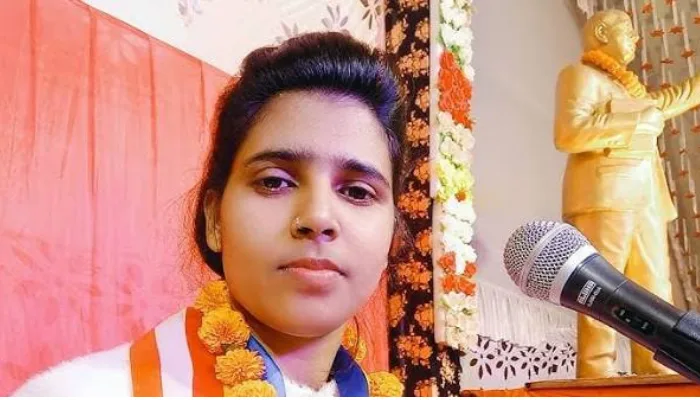
Case Summary
In yet another video, the self-styled Ambedkarite Buddhist preacher/singer Sanghmitra Baudh mocked Kali Mata and Hindu temple worship while portraying Hindu religious practices taught to children as andhvishwas (superstition) and pakhand (sham/hypocrisy). She described the image of Kali Mata by focusing on her sword, khappar, protruding tongue, garland of severed heads, dishevelled hair and red eyes, and said that a small child would become frightened upon seeing such an idol. She further mocked Hindu mothers for taking young children before such deities, asking them to touch the deity’s feet, and compelling them to bow even when the child was unwilling or afraid. Sanghmitra then extended the ridicule to the broader practice of teaching children Hindu religious rituals from an early age. She targeted Hindu mothers for taking children to temples, teaching them to ring temple bells, bow before deities and participate in worship, and presented these practices as religious conditioning imposed during childhood. She also contrasted a child’s biological mother with the Hindu Goddess worshipped in temples, repeatedly referring to the deity as the child’s “other mother.” She said that Hindu mothers themselves introduced children to this “other mother” by teaching them that worship would bring knowledge, intelligence, wealth, fulfilment of wishes and protection, and mocked this devotional relationship by suggesting that children could eventually give greater importance to the temple Goddess than to their own mothers. Sanghmitra told the women gathered that the biological mother was the greatest goddess and that no goddess on earth was greater than her. She urged them not to introduce their children to another “mother” and instead asked them to teach children about education and “great personalities.” She further dismissed puja-path as unnecessary for a child’s progress and said that a child’s future would improve through education and studies rather than through Hindu religious worship. She urged parents not to teach children whom to worship from childhood. Notably, this is only one such video; the so-called preacher and singer has made multiple such videos where she has openly denigrated and mocked Hindus and tradition, and attempted to brainwash Hindus against following their faith.
Why it is Hate Crime ?
The primary category selected for this case is: Hate speech against Hindus. The subcategory selected for this case is: Anti- Hindu slurs mocking faith. Anti-Hindu slurs and the deliberate mocking of the Hindu faith owing to religious animosity involve the usage of derogatory terms, stereotypes, or offensive references to religious practices, symbols, or figures. One of the common anti-Hindu slurs used against Hindus is “cow-worshipper” and “cow piss drinker”. The intention of using this term is to demean and mock Hindus as a group and their religious beliefs, since Hindus consider the cow holy. Additionally, some symbols and the slurs attached to them have a historical context that exacerbates the insult, hate, stereotyping, dehumanisation and oppression against Hindus. Cow worship has been used for centuries to denigrate Hindus, insult their faith and oppress Hindus specifically as a religious group. There has been overwhelming documentation about how cow slaughter has been used to persecute Hindus, with cow meat being thrown in temples and places of worship. There has also been overwhelming documentation that cow meat (beef) has been force-fed to Hindus to either forcefully convert them to Islam or denigrate their faith. Apart from cow worship, the Swastika – which holds deep religious significance for Hindus – has also been misinterpreted and distorted to be used as a slur against Hindus. Similarly, the worship of the Shivling has been used by supremacist ideologies and religions to denigrate Hindus owing to religious animosity. Such slurs and denigration stem from inherent animosity and hate towards Hindus and their faith; therefore, it is categorised as hate speech targeted at Hindus specifically owing to their religious identity. This incident is recorded in the Hinduphobia Tracker because the conduct of self- proclaimed Ambedkarite Buddhist preacher Sanghmitra Baudh reflected sustained animosity and hostility towards Hindu religious beliefs and practices, rather than a limited disagreement with a particular ritual. The speech repeatedly treated core elements of Hindu worship as superstition, pakhand and irrational conditioning, revealing contempt for Hindu religiosity itself. The clearest religious marker was Kali Mata. Kali Mata is a revered Hindu Goddess, and her iconography carries sacred meaning within Hindu tradition. By isolating her visual attributes from their religious context and using them to portray the deity as frightening and absurd, Sanghmitra reduced a sacred Hindu figure to an object of ridicule. Such treatment reflects enmity towards the religious meaning Hindus attach to their deities, rather than a serious engagement with the faith. The same hostility extended to murti (idol) worship. For Hindus, a murti is a sacred representation through which devotion is expressed. Presenting such worship as irrational deliberately strips it of its theological and devotional meaning. This kind of reduction is significant because it turns a central form of Hindu worship into material for mockery and demonstrates disdain towards Hindu belief itself. The treatment of temple rituals and devotional gestures followed the same pattern. Ringing temple bells, bowing before deities and touching their feet are expressions of reverence and devotion in Hindu practice. Portraying these acts as meaningless behaviour forced upon children does not merely criticise a custom; it depicts Hindu worship as intellectually inferior and unworthy of transmission. A further marker was the intergenerational transmission of Hindu faith. Teaching children religious practices is one way Hindu traditions continue within families. Characterising this process as filling a child’s mind with superstition and pakhand reflects hostility not only towards individual rituals, but towards the continuation of Hindu religious identity itself. The comparison between a biological mother and a Hindu Goddess addressed as Mata also carried a clear element of ridicule. The concept of divine motherhood has devotional significance in Hinduism. Recasting this sacred relationship as though a Hindu Goddess competes with or replaces the biological mother distorts a religious idea to make it appear absurd and socially harmful. This reflects religious animosity towards a distinctly Hindu form of devotion. The dismissal of puja-path reinforced the same pattern. Puja-path is a fundamental expression of Hindu worship. Presenting it as something from which children should be kept away, while portraying education and rationality as its opposite, frames Hindu religious practice as inherently regressive. The hostility therefore lies not in advocating education, but in using that advocacy to demean Hindu worship and portray adherence to the faith as a sign of ignorance. Taken together, the speech targeted Kali Mata, murti worship, temple rituals, devotional gestures, divine motherhood, puja-path and the transmission of Hindu religious practices within families. The consistent method was to remove their sacred context and recast them as superstition, irrationality or harmful conditioning. The cumulative nature of these remarks reflects deep-seated animosity, contempt and hatred towards Hinduism and its forms of worship. The target was not an isolated social practice but the religious worldview, symbols and devotional behaviour through which Hindus practise and transmit their faith. For this reason, the case warrants includsion in the tracker. It is also important to mention here that the accused was a member of the Bhim Army. While the Bhim Army presents itself as a champion of Dalit rights, its actions and affiliations often contradict this claim. Dalits are very much Hindus, yet the Bhim Army frequently targets Hindu symbols, festivals, and practices, including those held sacred by Dalits themselves. This pattern suggests that the organisation’s agenda is less about genuine Dalit upliftment and more aligned with broader anti-Hindu narratives that seek to divide and weaken Hindu society from within. This becomes particularly apparent when the Bhim Army aligns with leftist and Islamist platforms, where identity politics is weaponised against Hindus. In such spaces, the micro identities of caste, region, and language are secondary; what matters most is religious identity. It is the Hindu identity, regardless of caste, that often becomes the target of animosity. As seen in cases where Dalit families were attacked for displaying Hindu symbols or worshipping deities, the hostility stems not from caste differences, but from a disdain for Hindu religiosity. For example, on May 19, 2020, reports emerged in which a Dalit family in Bihar’s Kishanganj district accused the local Bhim Army unit of attacking them for their beliefs, desecrating a temple as they objected to their reverence for Hindu deities and saffron flags. Moreover, Bhim Army chief Chandrashekhar Azad has repeatedly made statements and taken positions that reflect his anti-Hindu stance. For instance, he has publicly endorsed conversion as a political weapon, invoking B.R. Ambedkar’s decision to leave Hinduism, and has actively supported movements that call for a rejection of Hindu festivals and practices. In fact, Chandrashekhar Azad's political trajectory has strongly focused on building a Dalit-Muslim alliance, a strategy that became particularly evident during his active participation in the anti-CAA (Citizenship Amendment Act) protests, which culminated in the Delhi anti-Hindu Riots of 2020. His brand of politics, under the banner of Dalit-Muslim unity, has contributed to narratives that vilify Hindu traditions and exacerbate targeted attacks against Hindus. Thus, by attacking Hindu symbols and aligning with forces hostile to Hinduism at large, the Bhim Army effectively turns against the cultural and spiritual traditions of the Dalit community itself. In doing so, it reinforces the very forces of division and religious antagonism that marginalise Dalits, not as a caste, but as Hindus. This contradiction reveals that, despite its stated mission, the Bhim Army’s trajectory increasingly serves an anti-Hindu, rather than a pro-Dalit, agenda. Similar cases involving Sanghmitra Baudh’s continuing pattern of denigrating and ridiculing Hinduism, Hindu deities, scriptures, religious beliefs and practices have also been documented by the Hinduphobia Tracker. Disclaimer: The Hinduphobia Tracker records the incident date based on when the incident actually occurred. However, the exact date of Sanghmitra Baudh's speech could not be determined from the available material. Since the video containing the speech was uploaded on YouTube approximately two years ago, 1st September 2025 has been used as the indicative incident date for documentation purposes only. This was derived by aligning the known year with the date the incident was documented in the tracker.


Case Status
Unknown


Perpetrators Details
Perpetrators
Others
Perpetrators Range
One Person
Perpetrators Gender
female
 Sources




