Hindu deities and religious practices mocked by self-styled Ambedkarite preacher during public gathering organised in Bara Banki, Uttar Pradesh
 Bara Banki, Uttar Pradesh, India
  31 August, 2025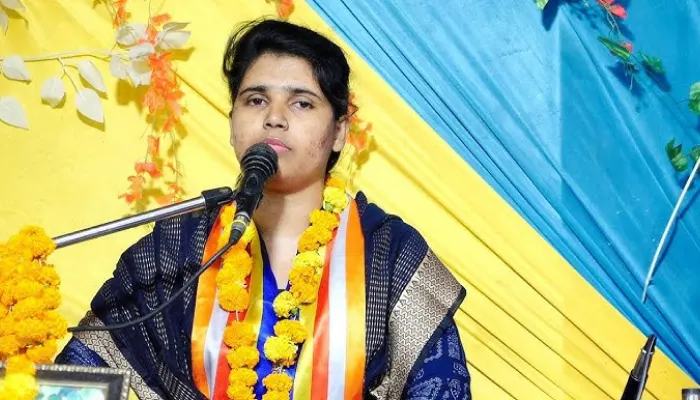
Case Summary
In Bara Banki, Uttar Pradesh, a self-styled Ambedkarite-Buddhist preacher/singer, Sanghmitra Baudh, used a public programme to denigrate and repeatedly mock Hindu idol worship, Hindu deities and long-followed Hindu religious practices, while preaching Buddhist and Ambedkarite ideas to the gathering. The central focus of the video was her attack on Hindu idol worship, which she repeatedly described as andhvishwas (superstition), andh bhakti (blind devotion), pakhand (hypocrisy/sham) and dhong (pretence). Throughout the programme, she portrayed the worship of Hindu idols and sacred religious representations as irrational and urged the audience to abandon such practices and instead follow the teachings of Gautam Buddha and Dr B.R. Ambedkar. At the beginning of the programme, Sanghmitra said that India had once been a prosperous country under Emperor Ashoka because he followed the teachings of Buddha, but had now declined because people have become trapped in what she called superstition and hypocrisy. She said that clever and cunning people had pushed society into such practices and that people had moved away from the teachings of the great personalities. She said India was once " sone ki chidiya" and is now "rone ki chidiya", which means India was once a golden bird and is now a crying bird. She then directly targeted Hindu idol worship and the practice of offering bhog to Hindu deities. She mocked devotees for offering laddus, pedas and sweets to idols while people remained hungry, repeatedly referring to the sacred idols as “stones”. She said that living people suffered for food while sweets were offered to stone idols and used this comparison to portray Hindu worship as wasteful and irrational. Sanghmitra specifically mocked Lord Ganesha and the Hindu religious association of the mouse with him. She told the gathering that when a stone mouse was placed inside a temple, Hindus worshipped it as Lord Ganesha's vehicle and offered laddus and prasad to it. She then compared this to real mice entering a house and asked whether people brought them laddus or rat poison. She said that no one considered themselves blessed when mice entered their homes and instead killed them, using this comparison to ridicule Hindu belief and devotion connected with Lord Ganesha. She described such worship as “blind faith” and “blind devotion”. She next mocked the worship of Nag Devta. Sanghmitra said that Hindus offered milk to a stone representation of a snake inside a temple and worshipped it as Nag Devta, but when a real snake appeared inside their homes, they searched for sticks and tried to kill it. She used this comparison to ridicule the Hindu religious practice of worshipping Nag Devta. She similarly targeted the Hindu reverence for Gau Mata. Sanghmitra said that if a stone representation of a cow was placed inside a temple, Hindus would worship it as Gau Mata and offer prasad before it, whereas the condition of living cows was different. Sanghmitra also mocked the Hindu devotees. She told the audience that if a stone mouse was placed inside a house, even a cat would recognise from a distance that it was not a real mouse and would not attack it. She then contrasted this with Hindu women bowing before stone idols and said that they continued to “bang their heads” before a stone. Through this comparison, she questioned the intelligence of Hindu devotees and again characterised their worship as superstition. The song performed during the programme continued the same attack on Hindu worship. It mocked the practice of placing golden canopies over Hindu idols, contrasting it with poor people lacking clothes. The song then contained a derogatory reference to Ganpati, stating that sindoor was applied to cow dung and treated as Ganpati. Sanghmitra then broadened her attack to several forms of Hindu religious practice. She said that in India people worshipped stone, clay, water, trees, plants, animals, birds and cow dung, presenting these different expressions of Hindu reverence as examples of superstition. She specifically mocked the use of cow dung in Hindu rituals and said that India was the only country where even cow dung was worshipped. She also targeted Hindu beliefs connected with Swarg and Narak. Sanghmitra said that people had been frightened into performing puja-path, bhajan and giving daan-dakshina through promises of heaven and fear of hell. She mocked the idea of punishment in Narak, saying people were told they would be fried in boiling oil “like pakoras”. She rejected the belief in an afterlife and told the gathering that heaven and hell existed only in this life and that there was nothing after death. A substantial part of the programme was also devoted to mocking cow-dung-based Hindu religious rituals and Govardhan worship. Sanghmitra described Hindu women forming cow dung into shapes, applying sindoor to it and sitting before it with folded hands. She questioned their intelligence for doing so and directly asked the gathering whether such worship should continue, encouraging them to stop and persuade others to do the same. She then recounted an incident from a traditional Hindu wedding in which cow dung was used during a ritual while mantras were being recited. She said she confronted the religious officiant and accused him of fooling innocent people by making them sit with folded hands before cow dung. According to her narration, when the officiant explained that after sindoor was applied it represented Govardhan Bhagwan, Sanghmitra mocked the belief by asking whether adding khoya and sugar to the same cow dung would turn it into halwa. She used the comparison to ridicule Govardhan worship and again urged the audience to abandon what she called superstition and hypocrisy. Sanghmitra further criticised the continuation of traditional Hindu religious customs inherited from previous generations. She said that ancestors had been uneducated and had lived without modern facilities, and argued that contemporary people should not continue religious practices merely because their forefathers had followed them. She repeatedly singled out puja and ritual practices as traditions that people had failed to abandon and urged women to leave them behind. She told the gathering to stop spending money on what she called superstition and hypocrisy and instead use that money for their children's education. At the same time, she repeatedly promoted the teachings of Gautam Buddha and Dr B.R. Ambedkar, presenting their path as an alternative to the Hindu practices she was denigrating. Later in the programme, another song was played that again attacked idol worship by referring to it as 'stone worship' and describing it as dhong. It also described religious practitioners as people who deceived ordinary devotees and took their money. Sanghmitra then mocked the Hindu practice of daan-dakshina and the belief that religious giving could contribute to spiritual welfare after death. She used wordplay between uddhar and udhaar to ridicule the belief and told the gathering that such promised spiritual benefit would never be received. Notably, this is only one such video; the so-called preacher and singer has made multiple such videos where she has denigrated and mocked Hindus, their faith and tradition.
Why it is Hate Crime ?
The primary category selected for this case is: Hate speech against Hindus. The subcategory selected for this case is: Anti-Hindu slurs, mocking faith. Anti-Hindu slurs and the deliberate mocking of the Hindu faith owing to religious animosity involve the use of derogatory terms, stereotypes, or offensive references to religious practices, symbols, or figures. One of the common anti-Hindu slurs used against Hindus is “cow-worshipper” and “cow piss drinker”. The intention of using this term is to demean and mock Hindus as a group and their religious beliefs, since Hindus consider the cow holy. Additionally, some symbols and the slurs attached to them have a historical context that exacerbates the insult, hate, stereotyping, dehumanisation and oppression against Hindus. Cow worship has been used for centuries to denigrate Hindus, insult their faith and oppress Hindus specifically as a religious group. There has been overwhelming documentation about how cow slaughter has been used to persecute Hindus, with cow meat being thrown in temples and places of worship. There has also been overwhelming documentation that cow meat (beef) has been force-fed to Hindus to either forcefully convert them to Islam or denigrate their faith. Apart from cow worship, the Swastika – which holds deep religious significance for Hindus – has also been misinterpreted and distorted to be used as a slur against Hindus. Similarly, the worship of the Shivling has been used by supremacist ideologies and religions to denigrate Hindus owing to religious animosity. Such slurs and denigration stem from inherent animosity and hate towards Hindus and their faith; therefore, it is categorised as hate speech targeted at Hindus specifically owing to their religious identity. The other subcategory selected here is: Subversion of scriptures. Subverting the religious scriptures of Hindus has particularly devastating consequences. Subversion of the scriptures of Hindus is often done to justify or promote hatred, discrimination, or violence against specific individuals or groups of Hindus. Religious scriptures are often nuanced and those who harbour religious animosity towards Hindus often misquote or misrepresent the scripture to legitimise their animosity and hate towards the faith and its adherents. Any such misquoting of scriptures or subversion to justify hate, violence and discrimination against Hindus owing to religious animosity is hate speech and is categorised as such. This incident is recorded in the Hinduphobia Tracker as the conduct of the self-styled preacher went far beyond promoting the teachings of Gautam Buddha and Dr B.R. Ambedkar. The speaker repeatedly mocked Hindu idol worship, Hindu deities, puja, bhog, prasad, Gau Mata, Nag Devta, Govardhan worship, religious rituals, and beliefs in Swarg and Narak. The repeated focus on Hindu religious practices makes the conduct's religious character unmistakable. Repeatedly denigrated Hindu beliefs, deities and religious practices and presented them as objects of ridicule. The central target was Hindu idol worship, which was repeatedly described through insulting terms such as andhvishwas (superstition), andh bhakti (blind devotion), pakhand (hypocrisy) and dhong (sham or fraud). These expressions were used to demean the Hindu faith and those who practise it, and their repeated use portrayed Hindu worship as irrational, fraudulent and intellectually inferior. The reference to idols as mere "stones", for example, was used specifically to ridicule the faith of the million Hindus who worship them. This was not a neutral theological disagreement. The language was directed at practices that are sacred to practising Hindus. Calling a Hindu murti merely a "stone" ignores the religious meaning attached to it. The physical material of an idol is not the theological point. Through consecration and ritual, the murti becomes the sacred embodiment through which the devotee worships the deity. Hindu traditions have extensive textual and ritual literature dealing with the making, installation and worship of such images. The Vishnudharmottara Purana, for instance, contains detailed prescriptions concerning deity images and their installation. Therefore, the speaker's comparison between a Hindu deity's murti and an ordinary stone deliberately removes the religious context that gives the object its significance. A devotee does not worship an object merely because it is made of stone. The stone serves as a physical medium for the deity's presence and worship. Reducing the murti to its raw material would be like dismissing a crucifix as merely a piece of wood or a Quran as merely a printed book, while ignoring the sacred meaning attached to it by believers. The accused also targeted Lord Ganesha, Nag Devta, Gau Mata and Govardhan Bhagwan, all of whom hold distinct religious significance within Hindu traditions. Lord Ganesha is among the most widely worshipped Hindu deities and is associated with wisdom, auspicious beginnings and the removal of obstacles. Nag Devta worship forms part of long-established Hindu religious traditions. The cow is regarded as sacred by Hindus and is deeply connected with Hindu religious life. Govardhan Bhagwan is associated with Lord Krishna and is an important Hindu devotional tradition. By deliberately taking sacred Hindu symbols and contrasting them with ordinary animals and objects, the speaker ridiculed the religious meaning attached to them. The mockery of cow dung also ignores its documented ritual role in Hindu tradition. Cow dung has long been used in Hindu ritual purification and ceremonial practices. Textual material associated with the Atharvaveda describes the purification of ritual spaces with cow dung and records the use of panchagavya, the five products of the cow. Scholarly research has likewise documented the religious use of cow dung in Hindu rituals and even its use in creating sacred images. The repeated use of derogatory language, including terms like "cow urine" and "cow dung", not only insults Hindu practices but also demonstrates a lack of respect for the culture and faith of millions. In Hinduism, cow urine (gaumutra) and cow dung hold religious, spiritual, and medicinal significance, deeply rooted in the belief that the cow is a sacred animal. However, recently, these jibes have become a frequent tool for anti-Hindu bigots, serving as a deliberate insult against the Hindu community’s reverence for the cow. This slur, often wielded by individuals or groups harbouring deep-seated animosity towards Hindu beliefs and practices, is a calculated attack on the sanctity of the cow in Hinduism, a religion where cows are considered holy. Mocking cow urine or cow dung is an attempt to delegitimise and belittle the Hindu faith itself. Such remarks have been observed in statements made by those who express open hostility towards Hindus, including Pulwama terrorist Ahmed Dhar, who used the slur to denigrate Hindus while justifying violence. His remark about killing CRPF soldiers because they "drink cow urine" highlights how this slur is weaponised not only to ridicule religious practices but also to justify acts of hatred and violence. The increasing use of such jibes suggests a broader agenda to normalise the mockery of Hindu religious symbols, setting the stage for more direct attacks on Hindu deities and beliefs. By trivialising or ridiculing something as sacred as cow worship, it becomes easier for those with malicious intent to escalate their rhetoric into outright abuse of Hindu Gods, a pattern that has been witnessed in recent years. This slur is not simply about targeting a practice but serves as a stepping stone towards undermining the entire Hindu faith. The same pattern appears in the comments on Lord Ganesha and Nag Devta. The speaker reduced the mouse associated with Ganesha and the serpent associated with Nag Devta to ordinary animals and then used their ordinary-world behaviour to ridicule Hindu worship. This deliberately ignores the fact that Hindu iconography uses animals symbolically and that their association with deities carries meanings developed through religious tradition. The comparison was therefore not an attempt to understand the belief but to make a sacred practice appear ridiculous by stripping it of its theological context. Similarly, the speaker mocked established Hindu rituals and devotional practices, including bhog, puja-path, bhajan, daan-dakshina, sindoor, and traditions passed down through generations. These practices form an integral part of Hindu religious life and devotion. By collectively dismissing them as superstition, fraud, or foolishness, she stripped them of their religious context and portrayed Hindu devotion itself as irrational and contemptible. The speech mocked Hindu beliefs concerning Swarg and Narak, which are linked to karma, moral conduct, and the consequences of one's actions. While concepts of divine reward and punishment in the afterlife are also found in Christianity and Islam, the speaker singled out Hindu beliefs for ridicule and portrayed them as irrational. The mockery therefore targeted a core element of Hindu theology rather than constituting a neutral comparison of different religious beliefs. Another important aspect was the denigration of Hindu devotees, particularly women, who were mocked for bowing before idols and performing religious rituals. The comparison involving women "banging their heads" before stones was directed at the people practising the faith, portraying them as incapable of recognising what was supposedly irrational. This turned criticism of a belief into ridicule of its followers and transformed the speech from criticism of religious ideas into direct contempt for people because of the manner in which they practised their Hindu faith. The speaker did not merely criticise Hinduism. She repeatedly urged the audience to stop performing puja and other Hindu rituals, abandon practices followed by previous generations, and instead follow the teachings of Buddha and Ambedkar. This gives the incident an additional dimension because the denigration of Hindu practices was coupled with active promotion of an alternative religious and ideological path. This contrast placed Hindu faith in a position of ridicule while presenting another ideological and religious path as superior. Moreover, these remarks were delivered before a gathering and repeatedly encouraged the audience to question, abandon and persuade others to give up Hindu practices. The conduct therefore functioned not simply as a private expression of personal belief but as public religious messaging aimed at influencing community members. One isolated comment about a religious practice could be characterised as criticism or theological disagreement. That explanation becomes difficult to sustain when an entire programme repeatedly targets Hindu gods, idols, rituals, devotees and beliefs about the afterlife, while simultaneously promoting an alternative worldview. The repeated and systematic nature of the remarks is what gives the incident its character as religiously motivated hostility. The speech therefore contained a sustained pattern of mocking Hindu deities, sacred religious representations, rituals, theological beliefs and devotees themselves. The repeated use of derogatory descriptions for Hindu worship, combined with the ridicule of specific Hindu religious markers, made the religious identity of Hindus central to the attack. The speaker moved from idol worship to festivals, religious donations, rituals, sacred animals, deity worship, ideas of heaven and hell, and customs passed down through generations. The common target throughout was the Hindu religious worldview itself. By portraying multiple elements of Hindu life as superstition, hypocrisy or fraud, the programme presented Hindu religious practice as something that should be abandoned. There is a distinction between saying that one does not personally believe in idol worship and repeatedly publicly humiliating Hindu deities, mocking devotees, ridiculing sacred rituals and urging Hindus to abandon those practices. The latter crosses into conduct directed at a community's religious identity and its adherents. The repeated and deliberate nature of these attacks, directed at multiple aspects of Hindu faith and practice, reflects a deep-seated hostility towards Hinduism rather than a mere difference in religious belief, and for this reason, this incident warrants inclusion in the tracker. It is also important to mention here that the accused was a member of the Bhim Army. While the Bhim Army presents itself as a champion of Dalit rights, its actions and affiliations often contradict this claim. Dalits are very much Hindus, yet the Bhim Army frequently targets Hindu symbols, festivals, and practices, including those held sacred by Dalits themselves. This pattern suggests that the organisation’s agenda is less about genuine Dalit upliftment and more aligned with broader anti-Hindu narratives that seek to divide and weaken Hindu society from within. This becomes particularly apparent when the Bhim Army aligns with leftist and Islamist platforms, where identity politics is weaponised against Hindus. In such spaces, the micro identities of caste, region, and language are secondary; what matters most is religious identity. It is the Hindu identity, regardless of caste, that often becomes the target of animosity. As seen in cases where Dalit families were attacked for displaying Hindu symbols or worshipping deities, the hostility stems not from caste differences, but from a disdain for Hindu religiosity. For example, on May 19, 2020, reports emerged in which a Dalit family in Bihar’s Kishanganj district accused the local Bhim Army unit of attacking them for their beliefs, desecrating a temple as they objected to their reverence for Hindu deities and saffron flags. Moreover, Bhim Army chief Chandrashekhar Azad has repeatedly made statements and taken positions that reflect his anti-Hindu stance. For instance, he has publicly endorsed conversion as a political weapon, invoking B.R. Ambedkar’s decision to leave Hinduism, and has actively supported movements that call for a rejection of Hindu festivals and practices. In fact, Chandrashekhar Azad's political trajectory has strongly focused on building a Dalit-Muslim alliance, a strategy that became particularly evident during his active participation in the anti-CAA (Citizenship Amendment Act) protests, which culminated in the Delhi anti-Hindu Riots of 2020. His brand of politics, under the banner of Dalit-Muslim unity, has contributed to narratives that vilify Hindu traditions and exacerbate targeted attacks against Hindus. Thus, by attacking Hindu symbols and aligning with forces hostile to Hinduism at large, the Bhim Army effectively turns against the cultural and spiritual traditions of the Dalit community itself. In doing so, it reinforces the very forces of division and religious antagonism that marginalise Dalits, not as a caste, but as Hindus. This contradiction reveals that, despite its stated mission, the Bhim Army’s trajectory increasingly serves an anti-Hindu, rather than a pro-Dalit, agenda. Disclaimer: The Hinduphobia Tracker records the incident date based on when the incident actually occurred. However, the exact date of Sanghmitra Baudh's speech could not be determined from the available material. Since the video containing the speech was uploaded on YouTube approximately one year ago, 1 September 2025 has been used as the indicative incident date for documentation purposes only.


Case Status
Unknown


Perpetrators Details
Perpetrators
Others
Perpetrators Range
One Person
Perpetrators Gender
female
 Sources




