Khalistani protest turns anti-Hindu: PM Modi targeted with “Hindu terror” slur, Indian Tricolour desecrated amid “Khalistan Zindabad” chants
 New York City, New York, United States
  28 August, 2026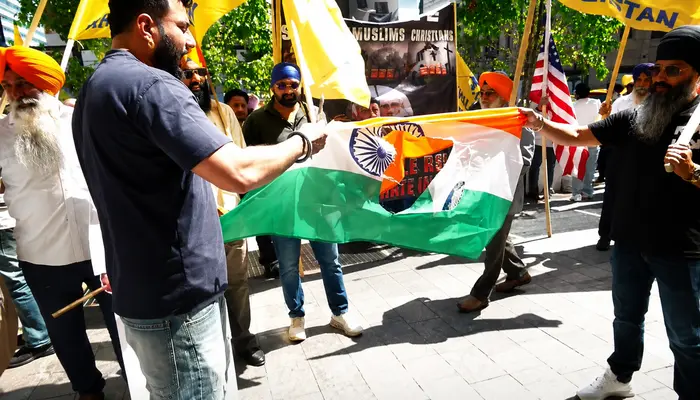
Case Summary
In New York, United States, Prime Minister Narendra Modi was described as the “face of Hindu terror” by Khalistani protesters. This was said during a pro-Khalistan demonstration outside Madison Square Garden on 29 August 2026. The protesters also desecrated the Indian national flag and raised “Khalistan Zindabad” slogans. The demonstration featured anti-India and anti-Hindu imagery and was directed against RSS chief Mohan Bhagwat, the Rashtriya Swayamsevak Sangh (RSS) and the Bharatiya Janata Party (BJP). The protest took place during RSS chief Mohan Bhagwat’s visit to the United States. Bhagwat had arrived in the country on 25 August 2026 as part of a three-country visit connected with the RSS’s centenary-year global outreach. On 29 August 2026, he addressed an event titled “Universal Oneness Celebration” at the Infosys Theatre inside Madison Square Garden. He had been invited by American Hindus for Engagement and Dialogue (AHEAD) to address the event. His presence at the venue drew pro-Khalistan and anti-Hindu and anti-India elements, who staged a demonstration outside against him. Sikhs for Justice (SFJ), which is designated as a Khalistani terrorist organisation by the Government of India, was at the forefront of the demonstration. The Khalistani protesters carried banners and posters opposing Bhagwat, the RSS and the BJP. They accused the RSS and BJP of attempting to turn India into a Hindu nation and falsely accused the Indian government and its machinery of being used as a weapon against Sikhs, Muslims and Christians. They also displayed a cut-out of Bhagwat with a shoe garland and raised “Khalistan Zindabad” and other anti-India slogans. The Indian national flag was desecrated during the demonstration. Viral videos showed a Khalistani protester tying an Indian Tricolour around his foot and posing for cameras while insulting the flag. In another incident, protesters took another Indian Tricolour and tore it apart while dancing and cheering. Police personnel were present at the scene but did not stop the protesters while the flag was being desecrated. Indian-origin people present at the venue opposed the Khalistani protesters and called them agents of Pakistan and China. They confronted the demonstrators during the protest and questioned the New York City administration led by Zohran Mamdani over its handling of the demonstration. The Hindu American Foundation (HAF) subsequently addressed the demonstration in a post on X. It described the scenes outside Madison Square Garden as “really bad” and referred to what it described as threats from Khalistanis against New Yorkers. The organisation said that it had expected such developments and expressed satisfaction that its security warnings were heeded and that attendees at the event were not affected. The demonstration took place amid wider controversy surrounding Bhagwat’s visit to the United States. Ahead of his visit, the United States Commission on International Religious Freedom (USCIRF), chaired by Pakistan-born American Dr Asif Mahmood, had called for United States sanctions against the RSS. India opposed the USCIRF’s position. Dr Asif Mahmood was also cited in connection with criticism of the RSS and reports of hostility towards Hindus and Sikhs, while the USCIRF’s position became part of the wider controversy surrounding Bhagwat’s visit. Notably, SFJ, which was at the forefront of the demonstration, has previously been associated with threats and hostile statements targeting Hindus, Hindu religious institutions and Prime Minister Narendra Modi. In September 2023, SFJ chief Gurpatwant Singh Pannun targeted Canadian Hindus over their support for India, referring to them as “Indo-Canadian Hindus” and telling them to leave Canada and return to India. In September 2024, he similarly targeted Indian-origin Hindus in the United States, referring to them as “Indo-American Hindus” and followers of Modi’s “Hindutva ideology”, and telling Modi to take them back to India. In November 2024, Pannun threatened Hindu temples and households over Diwali celebrations and called on Sikh youths to prevent Hindus from bursting firecrackers, suggesting that violence could be used if Hindus did not comply. In December 2024, he also threatened attacks during the Maha Kumbh, specifically targeting Prime Minister Narendra Modi and Uttar Pradesh Chief Minister Yogi Adityanath.
Why it is Hate Crime ?
The first primary category selected is: Hate speech against Hindus. The subcategory selected is: Anti-Hindu slurs, mocking faith. Anti-Hindu slurs and the deliberate mocking of the Hindu faith owing to religious animosity involve the usage of derogatory terms, stereotypes, or offensive references to religious practices, symbols, or figures. One of the common anti-Hindu slurs used against Hindus is “cow-worshipper” and “cow piss drinker”. The intention of using this term is to demean and mock Hindus as a group and their religious beliefs, since Hindus consider the cow holy. Additionally, some symbols and the slurs attached to them have a historical context that exacerbates the insult, hate, stereotyping, dehumanisation and oppression against Hindus. Cow worship has been used for centuries to denigrate Hindus, insult their faith and oppress Hindus specifically as a religious group. There has been overwhelming documentation about how cow slaughter has been used to persecute Hindus, with cow meat being thrown in temples and places of worship. There has also been overwhelming documentation that cow meat (beef) has been force-fed to Hindus to either forcefully convert them to Islam or denigrate their faith. Apart from cow worship, the Swastika – which holds deep religious significance for Hindus – has also been misinterpreted and distorted to be used as a slur against Hindus. Similarly, the worship of the Shivling has been used by supremacist ideologies and religions to denigrate Hindus owing to religious animosity. Such slurs and denigration stem from inherent animosity and hate towards Hindus and their faith; therefore, it is categorised as hate speech targeted at Hindus specifically owing to their religious identity. The second primary category selected in this case is: Attack on Hindu religious representations. The subcategory selected is: Desecration of Hindu religious symbols. Icons and symbols, or religious representations of a spiritual ideal, are widely revered in Hinduism. Iconography is of vital significance in the Hindu milieu. It helps connect people’s spiritual beliefs with the real world. Iconography within the Hindu faith takes several shapes and forms. Murtis are of great significance to Hindus, to which daily rituals, prayers and offerings are done. Besides the murtis, there are several other symbols which have deep significance in the Hindu faith – the Om and Swastika, for example. Since these Hindu religious symbols hold paramount importance in Hinduism, any desecration of symbols, icons, murtis, religious representations and manifestations is driven by animosity towards the faith itself, which manifests itself through these murtis, icons and symbols. Therefore, any desecration of these Hindu religious symbols and representations is considered religiously motivated hate crimes under this category. This case is a clear example of a religiously driven hate crime because the Khalistani perpetrators hurled the anti-Hindu slur “Hindu terror” at Prime Minister Narendra Modi, while also desecrating the Indian national flag and raising “Khalistan Zindabad” slogans. The use of the expression “Hindu terror” was significant because it did not merely attack Modi by name or criticise a particular government policy; it attached the word “Hindu” to terrorism and used that association as an insult against a Hindu political leader. The accompanying desecration of the national flag and explicitly separatist slogans further placed the incident in a context of hostility towards India and its Hindu-majority civilisational identity. The description of Modi as the “face of Hindu terror” is particularly significant in establishing the religious dimension of the rhetoric. Modi was targeted in the context of his association with the BJP, which the protesters portrayed as seeking to establish a Hindu nation, and with Hindutva, a Hindu civilisational and political movement. The protest was also directed against RSS chief Mohan Bhagwat and the RSS, an organisation associated with Hindu cultural and civilisational causes. Thus, the targeting of Modi, Bhagwat and the RSS, coupled with the use of “Hindu terror”, went beyond criticism of individual political positions and invoked their Hindu identity and affiliations as part of the attack. By placing “Hindu” before “terror”, the rhetoric presented Hindu identity and organisations associated with it through the imagery of violence and extremism, reflecting religious animosity towards them. The “Hindu terror” or “saffron terror” terminology also has a longer political and ideological history in India. Anti-Hindu forces like Leftists, Islamists and Khalistani terrorists have repeatedly used this narrative to associate Hindus and Hindu organisations with terrorism. Congress leader Digvijaya Singh was among the prominent political figures who propagated the terminology and linked the RSS to the Malegaon, Samjhauta Express and Mecca Masjid blast cases, even though the alleged Hindu-terror conspiracies could not be proved in court and the accused were acquitted in these cases. Singh was also associated with the 2010 launch of *26/11 RSS Ki Saazish?* (“RSS’s conspiracy in 26/11”), which sought to implicate the RSS in the 2008 Mumbai terror attacks despite the attacks having been carried out by Pakistan-based Lashkar-e-Taiba terrorists. Singh was among the political figures who popularised the terms “Hindu terror” and “saffron terror”, helping establish a rhetoric in which Hindu identity, the RSS and Hindutva were repeatedly associated with terrorism. The use of the same terminology by Khalistani protesters in the present case therefore placed their rhetoric within a broader narrative that has been used to portray Hindu organisations and Hindu civilisational movements as extremist or violent. The desecration of the Indian national flag must also be viewed in this wider context. While the act could, in isolation, be described as anti-India or pro-Khalistan, it is pertinent to note that Khalistani extremists have harboured specific animosity towards Hindus and their faith and view India as a Hindu collectivity. The very basis of their demand for a separate country carved out of India is the assertion that Sikh religious and political identity is distinct from the Hindu-majority Indian collective and therefore requires a separate homeland. Consequently, their rejection of India and its national symbols cannot be completely divorced from this religiously defined hostility. In the present case, the Tricolour was desecrated alongside the “Hindu terror” slur, attacks on the RSS and Bhagwat, and “Khalistan Zindabad” slogans, making the religious context of the act particularly significant. The anti-India hostility expressed through the desecration of the national flag and accompanying slogans therefore also manifested the perpetrators’ anti-Hindu sentiment, as their rejection of India was directed at a national collective they themselves viewed through the prism of its Hindu-majority identity. In this context, the desecration of the Tricolour constituted not merely an anti-India or extremist act, but an expression of religious animosity towards Hindus and their collective identity. The “Khalistan Zindabad” slogans further reinforced this religious dimension. By calling for the establishment of Khalistan, the protesters were asserting a separate Sikh political and religious identity against the Indian national identity that they reject and associate with a Hindu-majority collective. The slogan therefore carried an element of religious exclusivism: it asserted the supremacy and separate political existence of one religious identity while rejecting the national collective identified with the Hindu majority. In the context of the simultaneous use of “Hindu terror”, targeting of Hindu organisations and representatives, and desecration of the Indian flag, “Khalistan Zindabad” cannot be viewed merely as an expression of separatist politics. It formed part of a broader ideological expression of hostility towards India as a Hindu-majority collective and, consequently, towards Hindus and their national and civilisational identity. Furthermore, the involvement of Sikhs for Justice (SFJ), a designated terrorist organisation, provides additional context to the incident. SFJ and its leadership have previously made hostile statements and issued threats targeting Hindus, Hindu religious institutions and individuals associated with India and Hindu civilisational causes. The organisation’s involvement in the present incident is therefore consistent with this established pattern of anti-Hindu hostility and indicates deep-seated religious animosity towards Hindus and their collective identity. Overall, the use of explicitly anti-Hindu rhetoric, the targeting of Hindu organisations and representatives, the desecration of the Indian national flag and the raising of separatist slogans, viewed together with SFJ’s history of anti-Hindu hostility, establish the religious dimension of the incident. Since the case meets the parameters of a religiously driven offence, it is being added to the hate crime database of the Hinduphobia Tracker.


Case Status
Unknown


Perpetrators Details
Perpetrators
Sikh Extremists
Perpetrators Range
Unknown
Perpetrators Gender
unknown
 Sources




