Anti-Hindu prejudice on display: USCIRF vilifies revered Hindu organisation, calls for its ban and falsely portrays it as threat to religious minorities in India
 United States
  18 August, 2026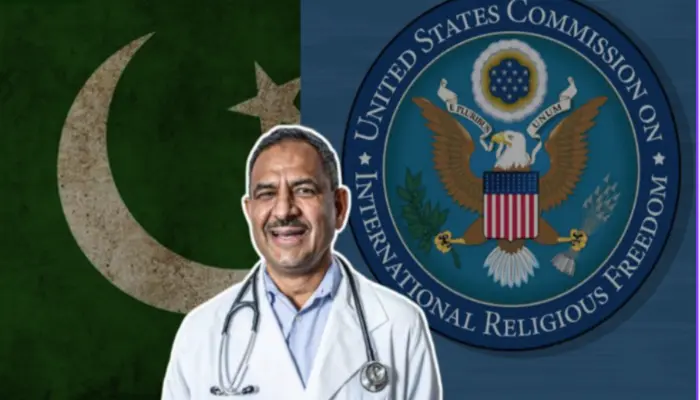
Case Summary
Anti-Hindu prejudice was on display on 19 August 2026 when the United States Commission on International Religious Freedom (USCIRF) Chair Asif Mahmood, a Pakistan-born American, targeted the Hindu organisation Rashtriya Swayamsevak Sangh (RSS) and falsely portrayed it as a threat to religious minorities in India. Ahead of a scheduled visit to the United States by RSS chief Mohan Bhagwat, Mahmood stated that Prime Minister Narendra Modi was a member of the RSS and falsely described the organisation as an umbrella group whose sub-groups had been accused of perpetrating attacks against religious minorities, including Christians and Muslims. USCIRF Commissioner Gene Mills called on the United States Government to deny RSS leaders high-level meetings and diplomatic courtesies and instead urged it to impose sanctions on RSS members for violations of freedom of religion or belief. The August 2026 remarks followed the USCIRF's March 2026 annual report, which had previously been documented by the Hinduphobia Tracker. The report recommended that India continue to be designated as a Country of Particular Concern and called for targeted sanctions against the RSS and India's internal intelligence agency, the Research and Analysis Wing (R&AW). The report also recommended linking United States-India trade to freedom of religion or belief conditions and considering restrictions on defence cooperation with India. The Government of India rejected the report, describing it as biased and lacking credibility. Mahmood had previously made a series of statements against India and Hindus. In 2017, he wrote on the social media platform X that Pakistan had been founded and carved out of India on the basis of Islam and should remain ruled by Muslim leaders. In the same post, he wrote, “Give no breath to Sikhs and Hindus,” explicitly targeting the Hindu and Sikh communities while stating that Pakistan was a land of Islam. In 2023, Mahmood referred to Kashmir as being subject to Indian encroachment and called for attention to violations involving minorities in India. In January 2024, following the consecration of the Hindu Ram Temple in Ayodhya, he stated that the event marked the 'end of a secular India'. In March 2024, he claimed that the implementation of the Citizenship Amendment Act (CAA) sent a message to Muslims that they were no longer equal citizens. In April 2024, Mahmood accused Prime Minister Narendra Modi of pursuing a Hindu nationalist agenda and called for people to stand up to protect Muslims and other minorities in India. In May 2024, he falsely claimed that Indian agents were involved in the victimisation and assassination of Sikh individuals in the United States, Canada and Pakistan, and called for measures to counter them. On 2 April 2026, Mahmood said that supposed church burnings, meat bans, forced marriages involving non-Hindu girls and mob lynchings were worrisome. He also claimed that India's anti-conversion laws disproportionately harmed Christians and Muslims. These statements preceded his August 2026 intervention against the RSS, in which he again portrayed an organisation associated with India's Hindu majority as a threat to religious minorities.
Why it is Hate Crime ?
This case has been added to the tracker under the primary category of - Hate speech against Hindus. Within it, the sub-category selected is - Anti Hindu subversion and prejudice. Hate speech is defined as any speech, gesture, conduct, writing, or display that is prejudicial against a specific individual and/or group of people, which is leading to or may lead to violence, prejudicial action or hate against that individual and/or group. Media plays a specific and overarching reach in perpetuating prejudicial attitudes towards a community owing to unfair, untrue coverage and/or misrepresentation/misinterpretation, selective coverage and/or omission of facts of/pertaining to issues affecting a specific religious group. This type of bias can dehumanise the victim group, making it easier for others to justify harmful actions against them, which aligns with the objectives of hate speech laws aimed at preventing such harm. It is often observed that the media takes a prejudicial stand against the Hindu community driven by their need to shield the aggressor community which happens to be a numeric minority, however, is the one perpetrating violence against Hindus. For example, the media is often quick to contextualise religiously motivated crimes against Hindus, omit or misrepresent facts that point towards religiously motivated hate crimes, justify and/or downplay religiously motivated hate crimes or simply present fake news to stereotype Hindus. Such media bias leads to the denial of persecution and is often used to dehumanise Hindus, leading to justification for violence against them. For example, the media covered several fake allegations of Hindus targeting Muslims and forcing them to chant Jai Shree Ram. Most of these cases were proved false and fabricated after police investigation. These fake news reports were subsequently never retracted or clarified. Such fake news led to the justification of violence and dehumanisation of Hindus based on the argument that since Hindus targeted Muslims and forced them to chant Jai Shree Ram, the dehumanisation of Hindus and violence against them was par for the course and merely a retaliation. Such media bias leads to prejudicial portrayal of Hindus and offers a justification for violence against them and therefore, is considered hate speech under this category. This case was a clear example of religiously motivated hate speech targeting Hindus and a prominent Hindu organisation. The United States Commission on International Religious Freedom (USCIRF) Chair Asif Mahmood targeted the Rashtriya Swayamsevak Sangh (RSS) and falsely portrayed it as a threat to religious minorities in India. By presenting a prominent Hindu organisation as inherently associated with violations against minorities and advocating punitive measures against its members, the statements went beyond criticism of specific policies or actions and contributed to the vilification of a Hindu organisation on the basis of its religious and ideological identity. The RSS holds considerable cultural and social significance within the Hindu community and is one of the most prominent organisations associated with Hindu collective identity and social mobilisation. It follows the principle of Hindutva, a civilisational and political ideology that is pro-Hindu in character and advocates the preservation and advancement of Hindu civilisational, cultural and national interests. Against this background, falsely portraying the RSS as a threat to religious minorities and broadly associating it with attacks against Christians and Muslims cast the organisation, and by extension the wider Hindu community it represents, in a deeply negative light. By presenting the RSS as inherently hostile towards other faiths, the narrative portrayed Hindus and their organisations as intrinsically intolerant, supremacist and fanatical, reinforcing stereotypes that Hindu institutions are communal, exclusionary and threatening to religious minorities. Such a portrayal contributed to the broader stigmatisation of Hindu identity and collective activity and exemplified anti-Hindu rhetoric by associating a prominent Hindu institution with intolerance and hostility towards other faiths. This false depiction was particularly prejudicial because no evidence was provided to substantiate the sweeping accusations against the RSS or to establish that the organisation itself was against minorities in India. Despite making such serious allegations and calling for punitive measures against RSS members, Mahmood and the USCIRF provided no evidence demonstrating that the RSS itself posed a threat to religious minorities. The attempt to portray and effectively target a Hindu organisation through unsubstantiated accusations, rather than evidence-based findings, reflected the use of hostile rhetoric to discredit Hindu institutions and reinforced negative stereotypes against the Hindu community, amounting to religiously motivated hate speech. The RSS's engagement with members of other religious communities also contradicted the portrayal of the organisation as inherently devoted to hostility towards religious minorities. Although it is a pro-Hindu and pro-India organisation, it has engaged members of minority religious communities through dedicated platforms, including the Muslim Rashtriya Manch (MRM), which works among Muslims, and the Rashtriya Christian Manch (RCM), which engages with Christians. These initiatives reflected its stated emphasis on engaging different communities within a broader national and cultural framework. Its engagement with members of other religious communities demonstrated that its identity as a Hindu organisation did not, in itself, amount to hostility towards people belonging to other faiths. Against this background, portraying the RSS broadly as a threat to religious minorities reinforced a prejudicial depiction of a Hindu institution and contributed to a hostile narrative against the organisation and the wider Hindu community. The call for punitive action against RSS members made the nature of the targeting particularly serious. Rather than limiting the criticism to specific individuals or substantiated instances of misconduct, the USCIRF officials called for RSS leaders to be denied diplomatic courtesies and urged sanctions against its members for alleged violations of freedom of religion or belief. Such measures, when directed against members of a prominent Hindu organisation on the basis of broad unproven accusations concerning the organisation and its affiliates, risked treating association with a Hindu institution as grounds for punitive action. The intervention therefore amplified the portrayal of the RSS as an illegitimate or dangerous Hindu organisation and sought to legitimise restrictions against its representatives and members. This framing reflected a hostile bias against a prominent Hindu institution by associating Hindu organisational activity and Hindu ideological identity with religious persecution without establishing that the RSS itself had committed the alleged violations. Mahmood's previous statements concerning India and Hindus further demonstrated a pattern of religiously biased rhetoric. He had criticised the Citizenship Amendment Act (CAA), a law that provided a pathway to Indian citizenship for persecuted religious minorities from Pakistan, Afghanistan and Bangladesh, including Hindus, Sikhs, Buddhists, Jains, Parsis and Christians. His portrayal of the CAA as sending a message to Muslims that they were no longer equal citizens, while overlooking its purpose of providing protection and citizenship to religiously persecuted minorities, reflected a hostile characterisation of a measure that directly benefited persecuted Hindu communities. Similarly, following the consecration of the Ram Janmabhoomi temple in Ayodhya in January 2024, Mahmood described the development as marking the “end of a secular India”. The construction of the Hindu temple at the site revered by Hindus as the birthplace of Lord Ram, following the legal resolution of a longstanding dispute over the site, was thus portrayed by him as a threat to secularism rather than as the restoration of a major Hindu religious institution. These statements, when considered alongside his repeated criticism of Hindu religious and cultural developments in India, demonstrated a pattern of hostility towards Hindu interests and Hindu religious identity. Mahmood's previous statements about Pakistan further exposed the religious character of his rhetoric. In 2017, he stated that Pakistan had been founded on the basis of Islam and should remain ruled by Muslim leaders, while writing, “Give no breath to Sikhs and Hindus.” The explicit targeting of Hindus coupled with his assertion that political leadership in Pakistan should be reserved for Muslims demonstrated a starkly exclusionary conception of religious identity. Viewed alongside his repeated targeting of India, Hindu institutions and Hindu religious developments, these statements demonstrated a deep-seated pattern of religious intolerance towards the Hindu community and reinforced the broader anti-Hindu character of his rhetoric. Taken together with his August 2026 targeting of the RSS, his previous statements provided further context for understanding his portrayal of Hindu organisations and Hindu interests through a consistently hostile lens, amounting to religiously driven hate speech. Therefore, since this case met the parameters of hate speech, it is being added to the Hate Crime Database of the Hinduphobia Tracker.


Case Status
Unknown


Perpetrators Details
Perpetrators
State and Establishment
Perpetrators Range
One Person
Perpetrators Gender
male
 Sources




